
• Skip to primary navigation
  • Skip to main content
  • Skip to primary sidebar
Virtualization.com

Virtualization.com

News and insights from the vibrant world of virtualization and cloud computing

  • News
  • Featured
  • Partnerships
  • People
  • Acquisitions
  • Guest Posts
  • Interviews
  • Videos
  • Funding

Search Results for: virtualization security

VirtualLogix To Support Newest Multicore Association Specification

September 28, 2008 by Robin Wauters Leave a Comment

VirtualLogix has announced VLX real-time virtualization software support for the Multicore Association’s recently approved specification for Multicore Communications API (MCAPI).

MCAPI has been defined to flexibly support hundreds of processor cores and systems with tight memory constraints, fast task execution times, reliable on-chip interconnect and high system throughput requirements. By supporting the MCAPI specification within VLX, customers are able to apply this same flexibility and scalability to virtualized environments allowing them to easily migrate applications from a physical multicore system to one implemented with VirtualLogix VLX virtualization software via this industry accepted API.

VirtualLogix VLX real-time virtualization software helps users reduce bill of material costs by consolidating hardware, improving security and reducing overall power consumption. VirtualLogix offers extensive support for multicore technology, including its VLX for Network Infrastructure, which supports Intel® Core™ MicroArchitecture and Texas Instruments Multi-core Digital Signal Processors. VLX Developer, VirtualLogix’s Eclipse-based development tool set, assists developers to optimize the software architecture of their virtualized, multicore platforms.
VirtualLogix

Filed Under: News Tagged With: MCAPI, Multicore Association, Multicore Association specification, Multicore Communications API, real-time virtualization, specification, virtualisation, virtualization, VirtualLogix, VirtualLogix MCAPI, VirtualLogix VLX, VLX

Tenable Releases Virtual Appliance for Nessus

September 28, 2008 by Robin Wauters Leave a Comment

Tenable Network Security recently announced the general availability of a virtual appliance for the Nessus Vulnerability Scanner.

Tenable’s Nessus Virtual Appliance for VMware is a pre-built, pre-configured and ready-to-run software application packaged with the operating system inside a virtual machine. This is available to Tenable ProfessionalFeed subscribers as a free download and the virtual appliance is easily deployed in under 10 minutes — reducing infrastructure cost/complexity, simplifying deployment and maximizing ROI in VMware environments. The combination of Tenable’s Nessus with VMware virtualization technologies allows organizations to deploy Nessus scanners using physical as well as virtual servers.

With server consolidation, disaster recovery and cost considerations thrusting server virtualization into mainstream datacenter operations, IT operations personnel are beginning to worry about security. The virtual appliance for Nessus brings significant benefits to the marketplace. First, instead of building a server to host Nessus and deal with the installation process, Tenable customers can download and operate Nessus on a dedicated VM and reduce the complexity of installation and configuration. Second, as new images of the Nessus VM are made available, moving to them saves time by using an image that has been tested. Finally, Nessus can be positioned on a pre-configured virtual server in locations of your network that would not regularly host a scanner but can be on an as needed basis allowing for less disruption to the network.

Filed Under: News Tagged With: Nessus, Nessus Virtual Appliance for VMware, Nessus Vulnerability Scanner, Tenable, Tenable Nessus Virtual Appliance for VMware, Tenable Nessus Vulnerability Scanner, Tenable Network Security, virtual appliance, Virtual Appliance for Nessus, virtualisation, virtualization

Alternative Technology to Distribute and Offer Support for Oracle VM

September 24, 2008 by Robin Wauters Leave a Comment

Alternative Technology, an Arrow Electronics company and specialty distributor of thin-client/server-based computing, edge infrastructure, virtualization, storage and security solutions, today announced that they will distribute Oracle VM software and sell Oracle VM server virtualization support for both Oracle and non-Oracle applications.

Oracle VM software is available to download for free and consists of open source server software and an integrated Web browser-based management console. Oracle VM provides an easy-to-use graphical interface for creating and managing virtual server pools, running on x86 and x86-64-based systems across an enterprise. Users can create and manage virtual machines that exist on the same physical server but behave like independent physical servers. Each virtual machine created with Oracle VM has its own virtual CPUs, network interfaces, storage and operating system. With Oracle VM, users have an easy-to-use browser-based tool for creating, cloning, sharing, configuring, booting and migrating virtual machines.

Backed by Alternative Technology and Oracle’s world-class support organization, solution providers now have a single point of support for their customers’ entire virtualization environments including the Linux operating system, Oracle Database, Oracle Fusion Middleware and Oracle Application software. Customers who want to deploy Oracle products in a faster, lower cost server virtual environment can now use Oracle VM and subscribe to Oracle VM support.

Filed Under: News, Partnerships Tagged With: Alt Tech, Alternative Technology, AltTech, oracle, Oracle VM, Oracle VM Server, Oracle VM server virtualization, virtualisation, virtualization

Avnet Technology Solutions Introduces Virtual Desktop Infrastructure Solution, Based on VMware Technology

September 24, 2008 by Robin Wauters Leave a Comment

Avnet Technology Solutions, an operating group of Avnet, today announced a comprehensive solution to assist partners in targeting the emerging virtual desktop market in the US and Canada. Avnet Technology Solutions’ new solution combines VMware Virtual Desktop Infrastructure (VDI) software with the services and enablement resources needed to develop market expertise and effectively implement virtual desktop environments. Partners can use virtual desktop solutions to help their customers improve manageability, increase control and enhance the security of their enterprise desktops. The centralization of desktop management through virtualization also helps companies more effectively leverage their IT resources.

Avnet’s new solution is based on VMware VDI, which includes VMware Virtual Desktop Manager and provides simplified management and secure provisioning of virtual desktops and manages user access to the virtual desktops from a wide range of devices such as Windows, Linux and Mac computers, and thin clients. By deploying the VMware platform, partners can extend business continuity and disaster recovery capabilities to their customers’ desktops and streamline desktop management to reduce operating costs, increase control and deliver complete desktop environments with greater application compatibility.

Filed Under: News, Partnerships Tagged With: Avnet, Avnet Inc, Avnet Technology Solutions, desktop virtualization, VDI, virtual desktop, Virtual Desktop Infrastructure, virtualisation, virtualization, vmware, VMware VDI, VMware Virtual Desktop Infrastructure

Microsoft Bashes VMware With A New Website; “Get The Facts” Revisited?

September 23, 2008 by Toon Vanagt 3 Comments

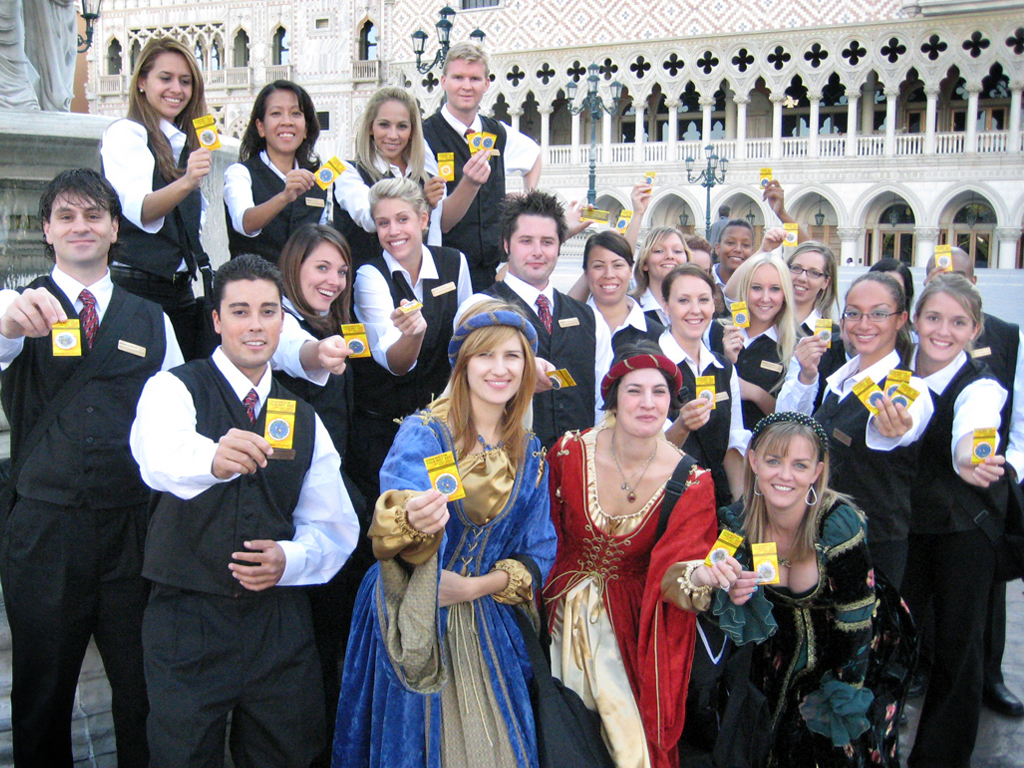
Thanks for reading us. We are bundling all our VMworld 2008 coverage in one handy page, go check it out now for more reports and videos!Hyper-V flyer team at the VMworld entrance The Venetian

Microsoft had people dressed up like medieval Venetian models at the hotel entrance of last week’s VMworld conference in Las Vegas. They distributed dollar chips and flyers to anybody wearing a VMworld bag, with on it the website address VmwareCostsWayTooMuch.com, which led VMware customers and partners to a landing page, on which the headlines all redirect to the Microsoft Hyper-V portal.

The guerilla marketing tactics actually worked, with coverage from publications like NetworkWorld, ZDNet Blogs, Channel Marker, Virtualization Information,  Burton Group’s Data Center Strategies blog, and others.

We ignore whether this smear marketing stunt was inspired by the US presidential campaign, but it was certainly not the first time Microsoft engages into heads-on advertising. Last time around it was targeted against Linux. However, we were never aware of Microsoft distributing any leaflets with GetTheFacts.com at the entrance of LinuxWorldExpo or LinuxTag. It is also quite funny to observe that Linux distributions (starting with SUSE) are now supported as Guest Operating Systems on Hyper-V and that Redmond advertises this feature extensively.

Microsoft even provides integration components and technical support for customers running select Linux distributions (limited to SUSE for the moment) as guest operating systems. IF history repeats itself, VMware can be reassured that in a few years this type of Microsoft campaign results in supporting a competing technology.

It took the VMware conference staff a little while to get notified about the leaflets and some more time before they got the hotel staff at The Venetion to stop the flyers from being handed out at the entrance of their annual user conference, attracting over 14.000 attendees to Las Vegas. It is estimated at least 4.000 flyers were distributed in the elapsed time.

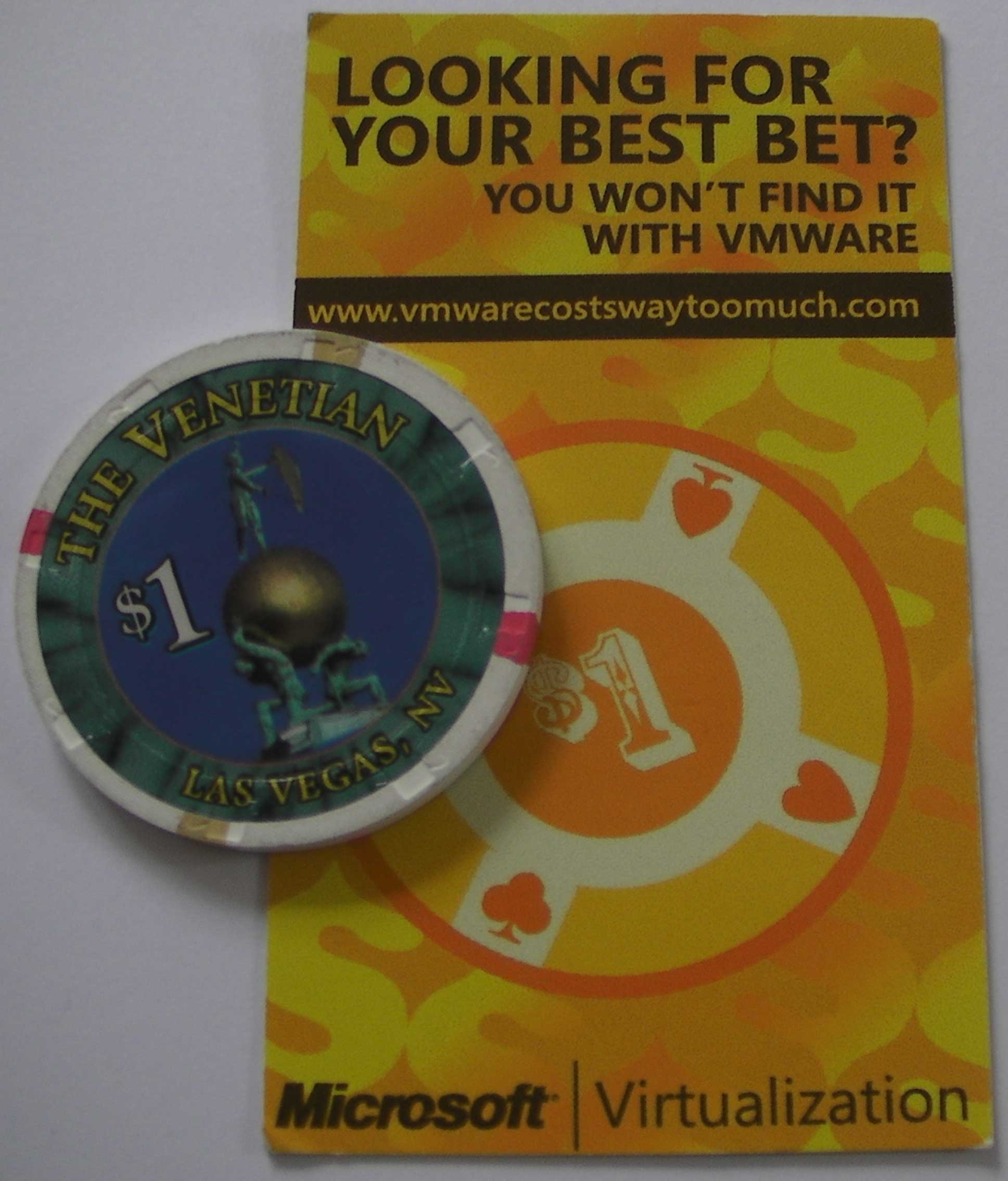
Flyer front side and One Dollar Chip

The distributed 1 dollar chips were actually valid inside The Venetian Casino. This guerilla marketing initiative has cost at least 4.000 dollars in casino money, but the website and distribution must have cost a lot more.

It is hard to believe The Venetian did not make the connection between selling a few thousand ‘Dollar chips’ to Microsoft and concurrently renting their entire event facilities and rooms to VMware. Especially with those video cameras and security personell all over, it can be assumed Microsoft had obtained some sort of permission before handing out those free chips at the hotel entrance.

What do you think about this remarkable anti-VMware propaganda? Does it make MS look desperate as the new kid on the hypervisor block? Does it suit a multinational that runs entirely on ‘expensive‘ licenses to attack a ‘partner’ at its annual user conference over that very cost element? Do the facts that they present on their marketing website actually make sense? What boomerang effect can they expect? How would Microsoft react if Sun would hand out flyers at the gates of TechEd or DevDays with a catchy URL: GetOfficeForFreeAndStopPayingMicrosoft.Com. We look forward to seeing who will register that available domain. 🙂

As we all know, hypervisors are a commodity nowadays and just like Xen and Hyper-V, it must be said that ESX comes free of license cost too. At Virtualization.com, we like to think the value and related cost are no longer in that free naked hypervisor, but in the integrated management and extended tool sets that surround it.

If you were among those first 4.000 VMworld attendees, feel free to tell us how much you made with your Microsoft dollars on the gambling tables and if that was enough to cover/upgrade a VMware license?

Filed Under: News Tagged With: FUD, Get The Facts, guerilla marketing, licensing, marketing, microsoft, MS, virtualisation, virtualization, vmware, VMwareCostsWayTooMuch, VMWorld, VMWorld 2008, VMworld conference

Parallels Readying Attack on VMware Fusion With Desktop 4

September 22, 2008 by Robin Wauters Leave a Comment

AppleInsider has taken a close look at a few features of the upcoming Parallels Desktop 4, which will be Parallels’ answer to the latest release of VMware Fusion 2.0.

“Those aware of the changes say the new release will be Parallels’ first to make good on promise made in early January that it would enable virtualization of Mac OS X Server on Macs already running the operating system, making use of a change in licensing terms with Leopard’s release late last year that permits more than one copy to run at the same time.

Such features have been frequently requested by IT administrators, who on Linux and Windows have already been able to segregate individual apps away from the main operating system in the event of a crash or a security breach.”

Ars Technica adds:

“Desktop 4’s performance will also be beefed up by adding DirectX 9 and OpenGL 2 support, an improved virtualization engine, and support for multiple cores and more RAM.

A makeover for the new version of Parallels Desktop is also in the cards, including a redesigned and simplified interface and more Terminal-based controls. In addition, the team is working on improving the ACPI interface (used for shutdowns and sleeping), and should be adding virtual machine resizing and 64-bit support. Based on those features, the software shouldn’t have a hard time catching up to Fusion, but I hope the team has something else waiting in the wings.”

Parallels

Filed Under: Featured, News Tagged With: Apple, Desktop 4, desktop virtualization, Fusion, Fusion 2.0, Parallels, Parallels Desktop, Parallels Desktop 4, Parallels Desktop for Mac, VDI, virtualisation, virtualization, vmware, VMWare Fusion, VMWare Fusion 2.0

  • « Go to Previous Page
  • Go to page 1
  • Interim pages omitted …
  • Go to page 50
  • Go to page 51
  • Go to page 52
  • Go to page 53
  • Go to page 54
  • Interim pages omitted …
  • Go to page 65
  • Go to Next Page »

Primary Sidebar

Tags

acquisition application virtualization Cisco citrix Citrix Systems citrix xenserver cloud computing Dell desktop virtualization EMC financing Funding Hewlett Packard HP Hyper-V IBM industry moves intel interview kvm linux microsoft Microsoft Hyper-V Novell oracle Parallels red hat research server virtualization sun sun microsystems VDI video virtual desktop Virtual Iron virtualisation virtualization vmware VMware ESX VMWorld VMWorld 2008 VMWorld Europe 2008 Xen xenserver xensource

Recent Comments

  • C program on Red Hat Launches Virtual Storage Appliance For Amazon Web Services
  • Hamzaoui on $500 Million For XenSource, Where Did All The Money Go?
  • vijay kumar on NComputing Debuts X350
  • Samar on VMware / SpringSource Acquires GemStone Systems
  • Meo on Cisco, Citrix Join Forces To Deliver Rich Media-Enabled Virtual Desktops

Copyright © 2025 · Genesis Sample on Genesis Framework · WordPress · Log in

  • Newsletter
  • Advertise
  • Contact
  • About