• Skip to primary navigation
  • Skip to main content
  • Skip to primary sidebar
Virtualization.com

Virtualization.com

News and insights from the vibrant world of virtualization and cloud computing

  • News
  • Featured
  • Partnerships
  • People
  • Acquisitions
  • Guest Posts
  • Interviews
  • Videos
  • Funding

virtualization

VMware Eyes Chinese Market, Signs OEM Agreement With Inspur

June 25, 2008 by Robin Wauters Leave a Comment

VMware and Inspur today announced an OEM agreement to further accelerate the adoption of VMware virtualization in China. Starting today, Inspur is selling, distributing and fully supporting VMware’s datacenter virtualization and management suite, VMware Infrastructure, on Inspur server systems.

Inspur

The two companies will collaborate on market development, product sales, professional training and customer acquisition as well as technical services.

“China’s rapid economic growth and increased focus on conserving energy have spurred the need for customers to adopt the best solutions for meeting business demands while enabling a green datacenter,” said Diane Greene, president and chief executive officer of VMware. “VMware virtualization addresses this need with solutions that not only consolidate servers, but also jump ahead to the next stages of virtualization: aggregating IT resources in virtualized pools and automating the management of these resources. VMware virtualization combined with Inspur’s expertise in local customer requirements offers a way to quickly cut operating and capital costs by as much as half, deliver applications faster and more reliably in virtual machines, improve information security, and run a more flexible and eco-friendly IT environment.”

Customers can now purchase Inspur servers bundled with VMware Infrastructure 3, provided with full support from Inspur.

[Source: Welt Online]

Filed Under: Partnerships Tagged With: China, datacenter virtualization, Diane Greene, Inspur, OEM, OEM agreement, virtualisation, virtualization, virtualization management, vmware, VMware Infrastructure, VMware Infrastructure 3, VMware Inspur

ProxMox, The Open Source Virtual Environment You Didn’t Know

June 24, 2008 by Robin Wauters Leave a Comment

Jason Perlow over at ZDNet Blogs today wrote an interesting article about ProxMox, a Vienna, Austria-based Open Source turnkey virtualization server provider we weren’t aware of until this day. Proxmox Virtual Environment (VE) is basically an easy to use Open Source virtualization platform for running Virtual Appliances and Virtual Machines.

ProxMox

ProxMox VE, which is is licensed under GPLv2, boasts:

  • Pre-built Virtual Appliances
  • Install and manage with a view clicks
  • Selection of products for the use in the enterprise

Proxmox VE is optimized for performance and usability. For maximum flexibility, the following virtualization technologies are installed by the bare metal ISO-installer. It leverages two virtualization platforms, OpenVZ and KVM.

As Jason writes:

In a nutshell, ProxMox VE is a bare-metal install CD that contains a highly-tweaked version of Debian Etch that is optimized for use as a virtualization server, using a modified Linux kernel which includes all the support needed for KVM and OpenVZ. The system runs completely headless and in a light configuration — the entire install CD is only 250MB. To take advantage of ProxMox VE, you’ll want a 64-bit CPU that supports the Intel VT or AMD-V instruction sets, such as recent Core Duo, Xeon, AMD64 Athlon X2 or Opteron chips. You’ll also want at least 2GB of RAM to run a few virtual machines/virtual environments comfortably.

Read the rest of the article here.

Filed Under: News Tagged With: GPLv2, open source, ProxMox, ProxMox VE, ProxMox Virtual Environment, virtual appliances, virtual machines, virtualisation, virtualization

David Coyle, Gartner Researcher: The 7 Side Effects Of Lousy Virtualization

June 24, 2008 by Robin Wauters Leave a Comment

David Coyle, research VP at Gartner, detailed the seven side effects at the research firm’s Infrastructure, Operations and Management Summit, which drew nearly 900 attendees. While virtualization promises to solve issues such as underutilization, high hardware costs and poor system availability, the benefits come only when the technology is applied with proper care and consistently monitored for change, Coyle explained.

Here are the reasons Gartner says virtualization is no IT cure-all:

1. Magnified failures. In the physical world, a server hardware failure typically would mean one server failed and backup servers would step in to prevent downtime. In the virtual world, depending on the number of virtual machines residing on a physical box, a hardware failure could impact multiple virtual servers and the applications they host

2. Degraded performance. Companies looking to ensure top performance of critical applications often dedicate server, network and storage resources for those applications, segmenting them from other traffic to ensure they get the resources they need. With virtualization, sharing resources that can be automatically allocated on demand is the goal in a dynamic environment. At any given time, performance of an application could degrade, perhaps not to a failure, but slower than desired.

3. Obsolete skills. IT might not realize the skill sets it has in-house won’t apply to a large virtualized production environment until they have it live. The skills needed to manage virtual environments should span all levels of support, including service desk operators who may be fielding calls regarding their virtual PCs. Companies will feel a bit of a talent shortage when moving toward more virtualized systems, and Coyle recommends starting the training now.

4. Complex root cause analysis. Virtual machines move — that is the part of their appeal. But as Coyle pointed out, it is also a potential issue when managing problems. Server problems in the past could be limited to one box, but now the problem can move with the virtual machine and lull IT staff into a false sense of security.

5. No standardization. Tools and processes used to address the physical environment can’t be directly applied to the virtual world, so many IT shops will have to think about standardizing how they address issues in the virtual environment.

6. Virtual machine sprawl. The most documented side effect to date, virtual server sprawl results from the combination of ease of deployment and lack of life-cycle management of virtual machines. The issue could cause consolidation efforts to go awry when more virtual machines crop up than there are server administrators to manage them.

7. May be habit forming. Once IT organizations start to use virtualization, they can’t stop themselves, Coyle said. He offered tips to help curb the damage done from giving into a virtual addition.

[In large part thanks to NetworkWorld]

Filed Under: Featured Tagged With: David Coyle, gartner, Gartner Infrastructure Operations and Management Summit, Infrastructure Operations and Management Summit, research, side effects, virtualisation, virtualization

Cisco Talks Up Data Center 3.0 Initiative, Wants To “Demistify Virtualization”

June 24, 2008 by Robin Wauters 2 Comments

Cisco Systems today announced updates to several of its key products to accelerate applications in Data Center 3.0, Cisco’s vision for a virtualized data center tied together by a unified network fabric.

Cisco

Today’s announcements at Cisco Live also featured new tools and training to help networking professionals master the complexity of virtualized data centers. In essence, the company is rolling out a host of software and services designed to expand what data center administrators can do with virtualization.

“Real-time collaborative applications, energy concerns and the need to achieve greater efficiency from assets are driving IT managers to transform their data centers through new technologies,” said John McCool, senior vice president and general manager, Cisco Data Center, Switching and Services Group, and co-chair of the Cisco EcoBoard . “By providing virtualization technologies across the data center, Cisco aims to help businesses achieve the agility and resiliency they need to compete on a global scale.”

Where’s the beef, you ask?

The announcements coming out of Cisco include the release of the company’s WAAS (Wide Area Application Services) software version 4.1, which offers virtualized application hosting services, application acceleration and video deliver for branch offices, and Cisco’s VFrame Data Center release 1.2 for infrastructure provisioning with Cisco’s ACE (Application Control Engine) and VMware’s ESX Server software.

In addition, Cisco is releasing version 3.1 of ACE for the ACE 4710 application switch, which offers up to 4 gigabits-per-second of throughput. The company also is announcing the Cisco Data Center 3.0 professional programs and services for support customers and partners with data center deployments. Included in the services offerings is Cisco’s new Data Center Efficiency Program, part of the company’s Data Center Assurance Program 4.0, a Web-based tool that enables users to analyze power use in the data center and identify power and cooling technologies most useful in their facilities.

WAAS 4.1, VFrame 1.2 and the ACE Appliance will be available in the third quarter.

[Source: The Register]

Filed Under: Featured, News Tagged With: ACE 3.1, Cisco, Cisco ACE, Cisco ACE 3.1, Cisco Data Center 3.0, Cisco Live, Cisco Systems, Cisco VFrame Data Center 1.2, Cisco virtualization, Cisco WAAS, Cisco WAAS 4.1, Cisco Wide Area Application Services, Data Center 3.0, Data Center Assurance Program 4.0, Data Center Efficiency Program, John McCool, network virtualization, VFrame Data Center 1.2, virtualisation, virtualization, virtualized data center, WAAS, WAAS 4.1, Wide Area Application Services

rPath Raises $10 Million More

June 24, 2008 by Robin Wauters Leave a Comment

rPath, which got on our radar thanks to some high-profile customers, today announced that the company has closed a $10M round of venture financing. The Series C round was led by rPath’s existing backers, General Catalyst, North Bridge Venture Partners and Wakefield Group. The company says it plans to use this new capital to increase its leadership in enabling cloud computing.

rPath

“As the demand for cloud computing continues to explode, rPath is in a unique position to drive adoption as the fastest and most scalable approach for delivering applications to cloud computing environments such as Amazon’s Elastic Compute Cloud (EC2), Citrix’s XenServer, and VMware’s Virtual Infrastructure,” said Billy Marshall, rPath founder and CEO.

Since the beginning of 2008, rPath has seen a surge of interest in its technology resulting in an increase of over 100% in new customers, including 3SP, Avinity Systems, CERN, Cynapse, Department of Energy, DigitalStakeout, Firescope, VIP Tone and Webalo.

[Source: Private Equity HUB]

Filed Under: Funding Tagged With: financing, Funding, General Catalyst, North Bridge Venture Partners, rPath, Series C, venture capital, venture financing, virtualisation, virtualization, Wakefield Group

Hyper9 Comes Out Of Stealth, Focuses On Letting You Find And Manage Virtual Machines

June 24, 2008 by Robin Wauters 1 Comment

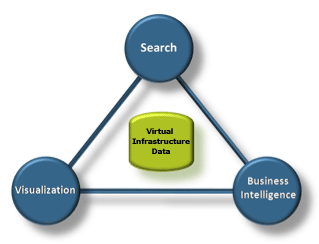
Hyper9, formerly known as InovaWave, provider of search-based software for virtual environment management, today announced its first product, carrying the same name as its parent company. Hyper9 will be free to download in September.

Hyper9

Hyper9, a privately held company headquartered in Austin, Texas, leverages a “Google-like” search engine to access both real-time and historical data on everything from the guest operating system to the physical infrastructure, then presents that data via a “next-generation” user interface. As a result, Hyper9 claims this approach supports faster troubleshooting, comprehensive monitoring and detailed reporting on the performance, configuration and utilization of virtual environments.

“Just as virtualization is transforming traditional computing, Hyper9 is ready with a truly scalable, flexible and intuitive approach to managing these dynamic environments,” said Chris Ostertag, president and CEO of Hyper9, Inc. “Hyper9’s unique architecture ensures that it can adapt to and accommodate the continually changing nature of virtual environments even as they gravitate to more hybrid states.”

The initial Hyper9 virtual appliance is designed to work only with the VMware ESX environment. Later versions will work with additional hypervisors, the company announced.

Hyper9

Filed Under: News Tagged With: Chris Ostertag, Hyper 9, Hyper9, Hypervisor, management, search, virtual machines, virtualisation, virtualization, vm management, vmware, VMware ESX

  • « Go to Previous Page
  • Go to page 1
  • Interim pages omitted …
  • Go to page 132
  • Go to page 133
  • Go to page 134
  • Go to page 135
  • Go to page 136
  • Interim pages omitted …
  • Go to page 206
  • Go to Next Page »

Primary Sidebar

Tags

acquisition application virtualization Cisco citrix Citrix Systems citrix xenserver cloud computing Dell desktop virtualization EMC financing Funding Hewlett Packard HP Hyper-V IBM industry moves intel interview kvm linux microsoft Microsoft Hyper-V Novell oracle Parallels red hat research server virtualization sun sun microsystems VDI video virtual desktop Virtual Iron virtualisation virtualization vmware VMware ESX VMWorld VMWorld 2008 VMWorld Europe 2008 Xen xenserver xensource

Recent Comments

  • C program on Red Hat Launches Virtual Storage Appliance For Amazon Web Services
  • Hamzaoui on $500 Million For XenSource, Where Did All The Money Go?
  • vijay kumar on NComputing Debuts X350
  • Samar on VMware / SpringSource Acquires GemStone Systems
  • Meo on Cisco, Citrix Join Forces To Deliver Rich Media-Enabled Virtual Desktops

Copyright © 2025 · Genesis Sample on Genesis Framework · WordPress · Log in

  • Newsletter
  • Advertise
  • Contact
  • About