• Skip to primary navigation
  • Skip to main content
  • Skip to primary sidebar
Virtualization.com

Virtualization.com

News and insights from the vibrant world of virtualization and cloud computing

  • News
  • Featured
  • Partnerships
  • People
  • Acquisitions
  • Guest Posts
  • Interviews
  • Videos
  • Funding

Virtual Iron

YuuZoo Deploys Virtual Iron Solution To Streamline IT Infrastructure

April 17, 2008 by Robin Wauters Leave a Comment

Virtual Iron today announced that YuuZoo, one of the world’s premier, mobile content aggregators, is deploying Virtual Iron’s solution across its content management system and mobile content distribution platforms in Singapore and the US. The company expects significant benefit from the software, including reduction of its server environment by almost half, streamlined management of its computing environment, easy provisioning and set-up of systems for new users, and cost-efficient business continuity capabilities. YuuZoo is working with ICSP Solutions out of Singapore to deploy the Virtual Iron solution.

YuuZoo

“We tested out pretty much all of the virtualization offerings before ICSP introduced the Virtual Iron solution,” said Anthony Cacciola, CTO for YuuZoo in Singapore. “The Virtual Iron feature set is comprehensive yet easy to use and manage. This is a solution that can deliver on our needs now and continue to meet them as we grow and expand our virtualization initiative.”

YuuZoo has built a global distribution network that enables personalized distribution of wireless value-added services and advertising to billions of mobile end users, offering wireless content owners and developers, advertisers and media companies exciting new revenue possibilities. The YuuZoo network includes access to more than 200 leading wireless carriers, portals and wireless phone manufacturers in over 50 countries across the globe, enabling a reach to more than half of the world’s 3 billion mobile subscribers. The upstream media network includes hundreds of leading wireless content developers and owners giving YuuZoo one of the world’s largest content libraries designed specifically for mobile phone use.

The company currently supports about 50 internal users in four offices and mobile applications located in four different co-location sites using 40 servers in its Windows/Linux environment. Working with ICSP Solutions, Virtual Iron and Dell, YuuZoo expects to reduce its number of servers to eight. In addition to the savings on servers, the company also expects significant reductions in its power, cooling and space requirements. Using two Dell blade server (4 Blades each) SANs and Virtual Iron, YuuZoo has also been able reduce its co-location space from four sites to two, significantly reducing its hosting costs.

Virtual Iron combines an open source hypervisor with advanced virtualization services and policy-based automation capabilities. It also includes an automated X2V conversion software solution that enables customers to easily migrate workloads (data, applications, and operating systems) across physical, virtual, blade and image-based infrastructures in any direction. Virtual Iron also takes full advantage of the latest hardware–assisted virtualization capabilities from Intel and AMD to deliver near native performance. The software offers large memory support (up to 128 GB), large SMP capabilities (up to 8 virtual CPUs) and the ability to virtualize server platforms with up to 32 physical CPUs.

[Source: VMBlog]

Filed Under: News, Partnerships Tagged With: Anthony Cacciola, iSCP Solutions, Virtual Iron, virtualisation, virtualization, YuuZoo

The Current State of Open Source Virtualization

March 26, 2008 by Kris Buytaert 6 Comments

We’ve started by looking back at a decade of Open Source virtualization, and in this second part of the series we’ll tackle today’s landscape (last updated in March 2008).

The least you can say about the current state of Open Source virtualization is that the field is extremely diverse: different approaches in the virtualization area are all represented, with paravirtualization, OS virtualization and hardware-assisted virtualization in various colors and flavours.

Let’s start with paravirtualization:

Xenmaster Ian Pratt released the 1.0 version of Xen somewhere in September 2003, it wasn’t till the Xen 2.0 release (around December 2005) that Xen adoption really started to accelerate. Ian announced the 2.0 release in November 2004 with support for both Linux 2.4, 2.6, FreeBSD and Live Migration support.

Xen pioneered Paravirtualization, giving it both a giant performance boost but also an argument for the naysayers who claimed it was impossible to run Windows on the platform. The fact that the Cambridge lab had access to the Windows source code and even had it running on Xen wasn’t really an argument since they were unable to redistribute it.

Different Linux distributions adopted quickly making Xen the de facto Linux virtualization solution. Also: the Open Solaris project was working on Xen support, first only as a guest but later also as a host operating system.

Then came the VT capabilities, and once again Xen was leading the pack, bringing out a Xen version that supported hardware-assisted virtualization. So the Open Source Xen version was beating the competition on different levels – speed, flexibility, etc. – but had one key element missing: the management layer, a GUI, the part that people actually spend money on …

Meanwhile, the company XenSource Inc. had been founded by the original developers of Xen and they started to work on a set of management tools and bang, next thing we know is Citrix announcing the acquisition of XenSource for $ 500 million USD in the summer of 2007.

While the discussion between Xen and VMware was still going on to see what infrastructure was needed in the kernel to support virtualization, KVM (Kernel Based Virtual Machine) had come out of nowhere: a lightweight kernel module that enabled the VT Capabilities of the new generation of CPUs and that ended up in the mainstream kernel in no time. KVM was ultimately included in the 2.6.20 release of the Linux kernel after merely a couple of months of development.

KVM enabled Qemu to benefit from the VT features and a new team was born. KVM is the lean and mean, small virtual machine, and the fact that it was so small only made it easier to adopt in the main tree. KVM is maintained by Avi Kivity who is working at Qumranet, with Moshe Bar amongst its founders about to launch a product called Solid ICE, aiming for the desktop virtualization market. KVM however is not doing all the work, a modified Qemu version acts as the user space part that enables the full power of KVM.

Today different distributions support both KVM and Xen and are working towards a single tool set to manage them both.

Qemu started to pop up everywhere in the virtualization arena in 2007, e.g. within the VirtualBox project from innotek, a German software company located in Stuttgart.

VirtualBox is one of the most important open source solutions if you want to run other operating systems on your desktop. It’s free, it’s open and it has all the features you would expect from its commercial counterparts! Sometimes these commercial counterparts, facilitate ‘match making’ events, which outcomes are not intended. For example at VMworld in New York in September ’07, Achim Hasenmueller, co-founder and kernel wizard at innotek was introduced to the Sun Microsystems management and less than four months later they announced their ‘marriage’ (Sun acquired innotek for an undisclosed amount in February 2007). As VirtualBox was already running on a multitude of Operating Systems such as Windows, Linux and OS/X, they evidently also added Sun’s Solaris to this impressive list. VirtualBox also supports a large number of guest platforms, including common Windows flavors (NT 4.0, 2000, XP, Server 2003, Vista).

We’ve been talking mostly about paravirtualisation and hardware-assisted virtualization with KVM, Xen and VirtualBox, but of course there is much more out there. Let’s have a look at the players on the Operating System Level virtualisation are, an identical copy of one kernel providing a secured container where user space programs can run. Today, there are 2 main players in this area (VServer and OpenVZ). VServer was started by Jacques Gelinas and is currently lead by Herbert Pötzl from Austria. The Linux-VServer started July 2001 as BSD Jail reimplementation for Linux. In 2004, it was rewritten from scratch for the 2.6 kernel.

Not much of a surprise, people tend to think that Linux-VServer and OpenVZ have a lot in common, and some people even think OpenVZ was once based on a fork of Linux-VServer. According to Herbert Pötzl that isn’t true today: the projects do not share any code, although they provide roughly similar functionality in often quite different ways … In 2003 however , Linux-VServer was forked into FreeVPS by Alex Lyashkov and soon after that, it was integrated into the H-Sphere product, maintained by Positive Software.

SWsoft was founded back in 1999 and released their commercial Virtuozzo product in 2001, as a proprietary virtualization solution for Linux and later also supporting Windows. When SWsoft acquired Plesk in 2003, a proprietary framework to manage hosted solution, evidently virtualization fitted nicely in this picture since the OS level virtualization OpenVZ uses is a perfect match for web hosting.

SWsoft then went on to buy Parallels and managed to keep it a secret for almost 3 years. In late 2007, they finally decided that their Parallels brand was better known than their Virtuozzo or Plesk brands and decided to change the company name into Parallels alltogether. Having a single kernel for each virtual machine that runs in your environment is both the advantage and the disadvantage of OpenVZ and Linux-VServer. Its advantage of being a lightweight solution that can scale easily to hundreds of machines with no significant penalty is also its biggest disadvantage – what if something goes wrong with that kernel? Other approaches such as Xen and KVM allow you to run different kernels , or even different operating systems, which of course requires much more memory for each instance.

If you are into Hot Motorcycles you’ll remember the 1999 Virtual Iron company, a company that manufactered a CD that helped people create a customized bike. Fast forward to 2004, where a domain-squatter was using the site, and in February 2005 a company that looks like the Virtual Iron company we know now, started using the domain. Virtual Iron had a product called Virtual Iron VFE in store, which they presented at Linux World and later also more in depth at OLS. They claimed to have developed a Virtual Machine Monitor that was also Clustered. The Virtual Iron VFe product transparently created a shared memory multi-processor out of number of servers.

Yes, this sounds familiar, it sounds like an SSI implementation, it sounds like openMosix or OpenSSI, and that’s exactly what some people thought it was. Rumors on the net claimed that Virtual Iron was indeed violating the GPL while reusing and modifying openMosix code while not redistributing it’s changes, true or false, we’ll probably never know. In August 2005 Virtual Iron started shifting as they announced they were working on having their software manage other platforms too. Today, their product is based on an open-source Hypervisor, which name you can most likely already guess (yes, indeed, they use Xen). What happened with the SSI alike technology is unclear.

The final player in this area we need to point to is Paul Rusty Russel’s Lguest, formerly known as Lhype, almost known as Rustyvisor or Wonkavisor. It is an experimental Hypervisor developed by Rusty intended as proof of concept for the paravirt ops. Redhat has been working on it also, but who knows what the future will bring?

Which brings us to the final part: where to put your money? That kinda depends on your needs:

  • If I’m talking to a hoster who needs to run lots and lots of similar machines with easy management, I’ll be pointing him to Linux-Vserver
  • If someone is looking at bare metal hardware virtualisation for his Linux machines, it’s Xen all the way
  • If he needs a platform to test different distributions and operating systems on his desktop I’ll probably be pointing to VirtualBox
  • If someone really wants to head into placing his desktops virtualized in the data center, KVM would be my bet

What if someone wants to do nothing else but use Linux as a base framework to run Windows virtual machines?

In that case the commercial Xen offerings such as the one from XenSource, Suse and Redhat would be best as they can provide you also with adapted drivers for the guest operating system. But ask me again in 6 months and I’ll probably tell you otherwise.

Watch out for the third part of this article series, with more on Xen!

Filed Under: Featured, Guest Posts, News Tagged With: citrix, Ian Pratt, kvm, Linux-VServer, open source virtualization, openvz, Parallels, qemu, qumranet, sun microsystems, swsoft, Virtual Iron, VirtualBox, virtualisation, virtualization, Virtuozzo, vmware, VServer, Xen, xensource

Industry Analyst Tony Asaro Joins Virtual Iron As Chief Strategy Officer

March 12, 2008 by Robin Wauters 1 Comment

Virtual Iron today announced the hiring of former Enterprise Strategy Group senior analyst and consultant Tony Asaro as Chief Strategy Officer. In his role, Asaro will focus on business strategy, ecosystem development, evangelism and education of Virtual Iron to the market and complement the company’s worldwide go-to-market efforts.

virtualization-virtual-iron.jpg

Earlier this year, Virtual Iron raised $ 20 million in private equity financing. Also check out our video interview with Mike Grandinetti, VP & Chief Marketing Officer with the company.

virtualization-tony-asaro.jpg

Asaro has been in the high tech industry for 22 years in a wide range of roles including sales, systems engineering, business development, marketing and as an entrepreneur. Most recently, he was with the Enterprise Strategy Group (ESG), a leading industry analyst and consulting firm. During his tenure there, Asaro was a trusted adviser to many established and emerging infrastructure vendors including EMC, NetApp, and VMware to name just a few. He provided strategic guidance and consulting on product direction, positioning, and business development and is considered a thought leader on IT infrastructure, data center environments, storage systems and networks, virtualization, power and cooling issues, and disaster recovery solutions.

“Tony Asaro is a great addition to the Virtual Iron team as we continue to expand our presence in the fast-growing server virtualization market,” said Ed Walsh, president and CEO of Virtual Iron. “We will leverage Tony’s deep experience and abilities to sharpen our business, marketing and product strategies and continue to increase our visibility across our user, partner and channel communities.”

“Implementing server virtualization is one of the highest priorities in IT regardless of size, industry or region in the world,” said Tony Asaro. “Virtual Iron has a field-proven solution that our customers find is easy to use, cost effective and provides them all of the advanced management capabilities needed for a true server virtualization environment. Virtual Iron will continue to focus on raising its visibility to this wide audience so they know they have a choice – one that has been validated by over 1,500 end users just like them.”

[Source: VMBlog]

Filed Under: People Tagged With: ed Walsh, Enterprise Strategy Group, Mike Grandinetti, Tony Asaro, Virtual Iron, virtualisation, virtualization

Video: Interview Mike Grandinetti, VP & Chief Marketing Officer with Virtual Iron (VMworld Europe 2008)

March 2, 2008 by Robin Wauters 7 Comments

The interview below is part of our Virtualization Video Series, a recurring theme we want to implement on Virtualization.com featuring interviews with key players from the industry, event reports, etc.

This interview was recorded at VMWorld Europe 2008 in Cannes, France, and features Mike Grandinetti, VP & Chief Marketing Officer with Virtual Iron. Mike and Tarry discussed a wide–ranging set of industry issues including customer requirements, obstacles to broader market adoption, the emerging competitive landscape, and Virtual Iron’s market position relative to VMware and Microsoft.

DivX HD 1280×720 3.5mbit/s: Play (pop-up)
WMV HD 1280×720 3.5mbit/s: Play (pop-up)

Flash versions: Blip (embedded below), Myspace, Revver, Sevenload, Vimeo, Youtube

Interviewer: Tarry Singh
Video blogger: Charbax

Filed Under: Interviews, People, Videos Tagged With: Mike Grandinetti, server virtualization, virtual infrastructure management, Virtual Iron, virtualisation, virtualization, VMWorld, VMWorld 2008, VMWorld Europe 2008

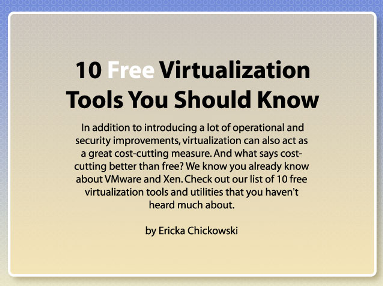
Baseline: 10 Free Virtualization Tools You Should Know

February 28, 2008 by Robin Wauters Leave a Comment

Baseline published an interesting list of “10 free virtualization tools you should know” on its website.

virtualization-free-tools1.png

The list in full:

  1. OpenVZ (Parallels) – also check out our video interview with Werner Fisher from Thomas-Krenn.AG on OpenVZ
  2. FreeVPS (Positive Software)
  3. Sun xVM (Sun Microsystems, who wants to equip Web 2.0 startups with “SAMP”)
  4. VirtualBox (innotek, recently acquired by Sun)
  5. PlateSpin Power Recon (PlateSpin, recently acquired by Novell)
  6. Vizioncore vOptimizer Free Ware (Vizioncore, recently acquired by Quest)
  7. Virtual Iron Single Server Edition (Virtual Iron)
  8. Enomalism Virtualized Management Dashboard – VMD (Enomaly)
  9. Microsoft Virtual Server Migration Toolkit – VSMT (Microsoft) – also check out our video interview with Mike Neil, Virtual Machine Technologies Product Unit Manager at Microsoft
  10. Moka5 LivePC Engine (Moka5)

Filed Under: Uncategorized Tagged With: Baseline, BaselineMag, Enomalism Virtualized Management Dashboard, Enomalism VMD, Enomaly, free, FreeVPS, freeware, innotek, microsoft, Microsoft Virtual Server Migration Toolkit, Microsoft VSMT, Mike Neil, Moka5, Moka5 LivePC Engine, Novell, openvz, Parallels, PlateSpin, PlateSpin Power Recon, Positive Software, quest, quest software, SAMP, sun, sun microsystems, Sun xVM, Virtual Iron, Virtual Iron Single Server Edition, VirtualBox, virtualisation, virtualization, Vizioncore, Vizioncore vOptimizer, Vizioncore vOptimizer Free Ware, Werner Fisher

Another Virtualization Company Raises Funding; This Time Pano Logic Is Getting $ 12 Million

January 29, 2008 by Robin Wauters Leave a Comment

After Virtual Iron and CiRBA , it’s now Pano Logic announcing fresh funding to the tune of $ 12 million. This is the desktop virtualization company’s second round, which was led by New York-based Goldman Sachs.

Other participants included Foundation Capital, which has an office in Menlo Park (where Pano Logic is based).

The company said it uses existing server virtualization technologies to create a new approach to client/desktop computing that lowers total cost of ownership while increasing security, management and mobility.

Founded in 2006, Pano Logic also has an office in Toronto, Canada.

[Via BusinessJournal ]

Filed Under: Featured, News Tagged With: CiRBA, financing, Funding, Goldman Sachs, investment, Pano Logic, PanoLogic, server virtualization, Virtual Iron, virtualisation, virtualization

  • « Go to Previous Page
  • Go to page 1
  • Interim pages omitted …
  • Go to page 3
  • Go to page 4
  • Go to page 5
  • Go to page 6
  • Go to Next Page »

Primary Sidebar

Tags

acquisition application virtualization Cisco citrix Citrix Systems citrix xenserver cloud computing Dell desktop virtualization EMC financing Funding Hewlett Packard HP Hyper-V IBM industry moves intel interview kvm linux microsoft Microsoft Hyper-V Novell oracle Parallels red hat research server virtualization sun sun microsystems VDI video virtual desktop Virtual Iron virtualisation virtualization vmware VMware ESX VMWorld VMWorld 2008 VMWorld Europe 2008 Xen xenserver xensource

Recent Comments

  • C program on Red Hat Launches Virtual Storage Appliance For Amazon Web Services
  • Hamzaoui on $500 Million For XenSource, Where Did All The Money Go?
  • vijay kumar on NComputing Debuts X350
  • Samar on VMware / SpringSource Acquires GemStone Systems
  • Meo on Cisco, Citrix Join Forces To Deliver Rich Media-Enabled Virtual Desktops

Copyright © 2025 · Genesis Sample on Genesis Framework · WordPress · Log in

  • Newsletter
  • Advertise
  • Contact
  • About