• Skip to primary navigation
  • Skip to main content
  • Skip to primary sidebar
Virtualization.com

Virtualization.com

News and insights from the vibrant world of virtualization and cloud computing

  • News
  • Featured
  • Partnerships
  • People
  • Acquisitions
  • Guest Posts
  • Interviews
  • Videos
  • Funding

virtualization

Neocleus Raises $11,4 M in Series B Funding

June 19, 2008 by Robin Wauters Leave a Comment

Neocleus, a startup yet to release a product who recently unveiled its ‘endpoint virtualization’ strategy, seems to have been convincing enough in validating its approach to investors. The company has raised $11.4M in Series B funding (PDF) in a round led by Battery Ventures and Gemini Israel Funds, its original investors.

Neocleus applies virtualization to desktops and laptops delivering the flexibility, manageability and security needed to address different user scenarios within a dynamic, dispersed enterprise. The company’s solutions, which include a Xen-based open source Type 1 bare-metal hypervisor for endpoints, aim to enable critical IT tasks to operate in isolated, trusted virtual environments with complete access to the capabilities offered by the underlying endpoint hardware.

Neocleus was founded in 2006 by industry veterans Ariel Gorfung (CEO) and Etay Bogner (CTO) and launched last May with the announcement of the Desktop Hypervisor Framework, an endpoint hypervisor enhancement to the Xen server hypervisor that the company will be contributing to the open source community.

Most recently Neocleus announced Trusted Edge, the first in a suite of virtual software appliances that allows for secure access to corporate resources – for employees, customers and partners – regardless of the endpoint’s location or state of security.


Filed Under: Featured, Funding Tagged With: Ariel Gorfung, Battery Ventures, Desktop Hypervisor Framework, endpoint hypervisor, endpoint virtualization, Etay Bogner, financing, Funding, Gemini Israel Funds, Neocleus, open source, Series B funding, Trusted Edge, virtualisation, virtualization, Xen

openQRM 4.0 (Beta), Going Strong

June 18, 2008 by Kris Buytaert Leave a Comment

Matt Rechenburg has just announced the beta version of openQRM 4.0.

Not even that long after Qlusters decided to set the project free, the openQRM team has changed directions in a way Qlusters never would have allowed.

openQRM 4.0 is a major rewrite of the openQRM functionality in PHP. The openQRM team has been listening to the community and learned that contributions will be much easier if the tool would be rewritten in a scripting-based language. They decided to keep the platform as simple as possible.

Plugin support now is a lot easier, rather than having to reconfigure and enable plugins from the command line, one can now enable plugins from the webGUI (similar to the Drupal modules)

The old openQRM provided a lot of proprietary libraries and tools that were already available on a typical Linux distribution. From now on, openQRM will use the tools available from the distribution.

The goal of openQRM hasn’t changed , the focus of the project is still on on rapid-, appliance-based deployment, virtualization and storage management.

Still no news from the Qlusters side however, and their site obviously needs an update.

Filed Under: Guest Posts, News Tagged With: matt rechenburg, openqrm, openQRM 4.0, openQRM 4.0 beta, qlusters, virtualisation, virtualization, vmware, Xen

CiRBA Releases Version 5.0 of Its Virtualization Analysis Platform

June 18, 2008 by Robin Wauters Leave a Comment

CiRBA, provider of Data Center Intelligence software, today announced the release of Version 5.0 of its virtualization and consolidation analysis software. With Version 5.0, CiRBA aims to enable organizations to build dynamic models of their virtual and physical infrastructure to continually identify opportunities to improve performance, optimize VM placements, and minimize operational risk.

CiRBA

“Version 5.0 underscores the fact that all the details that go into planning virtualized infrastructure must also be factored in on a daily basis when managing virtual environments,” said Andrew Hillier, CIRBA CTO and Co-Founder. “All business-level constraints, technical compatibilities, workload personalities, and risk tolerances need to be respected every time an environment undergoes changes. And because virtual environments are constantly changing, CiRBA’s latest release provides the dynamic analysis needed to bring all of this together to optimize utilization and minimize operational risk, while at the same time keeping an eye on minimizing power consumption and maximizing financial returns.”

Using CIRBA Version 5.0, organizations build unique dynamic models of existing IT environments. These models provide a consolidated view of the critical business, technical, configuration, and workload data typically stored in disparate systems. Pre-packaged and customizable analysis templates are applied to these models in order to provide the intelligence required to transform an environment and continually assess the impact of change within virtualized infrastructure.

Because the analysis is rule-driven, the options for analysis are virtually unlimited and are generally categorized according to the type of transformation being considered such as P2P, P2V or V2V, or by the requirements of an individual’s role or focus, such as capacity planning, risk management or compliance reporting.

CiRBA Version 5.0 also introduces integrated financial analysis by enabling the results of an analysis to be directly inserted into any Excel-based financial model. CiRBA 5.0 includes a default model that provides a comprehensive TCO/ROI calculation, factoring in both capital and operational savings, applying hardware, power, facilities and staff costs to analysis results to determine the true financial profile of each strategy being considered.

Filed Under: News Tagged With: CiRBA, CiRBA 5.0, CiRBA Version 5.0, Data Center Intelligence, virtualisation, virtualization, virtualization analysis

Microsoft Ships Application Virtualization 4.5 Release Candidate

June 18, 2008 by Robin Wauters 2 Comments

Fresh after sharing the new short name for Microsoft Application Virtualization (SoftGrid became App-V), the MAV team has released the version 4.5 Release Candidate of the software.

So what’s new?

HTTP streaming. We now support streaming virtual applications from an IIS server (version 6 or 7). This will provide dramatic performance and scalability improvements for customers with large App-V deployments. In addition, the use of a more familiar protocol will make some deployments easier and more straight forward.

New Sequencer UI. We have greatly simplified the use of the Sequencer. There is now a single wizard for creating a new package and advanced settings have been put into an optional screen. In addition, enhancements have been made that will make editing packages even easier.

Dynamic Suite Composition (DSC) for MSI packages
. We introduced two great features with our Beta release – Dynamic Suite Composition and the ability to create MSI packages directly from the Sequencer. DSC allows the flexibility to control virtual application interaction. Creating MSI packages directly from the sequencer eliminates the need for a server environment when deploying virtual applications. But, it was a little difficult to use both DSC and MSI together with the Beta release. With the RC release, you can now dynamically suite two MSI packages together by following a few simple steps.

Improved integration with SCCM 2007 R2
. With the upcoming release of the Release Candidate version of SCCM 2007 R2, the ability to deploy virtual applications via SCCM will be seamless for SCCM administrators. Virtual applications can now be streamed via HTTP so that deployments can scale. Also, a new wizard will make the process of sending out package upgrades to users simple and straightforward.

Reporting
. Application usage information is now recorded locally on each client and then sent to a App-V Management Server during Publishing Refresh. This means that offline usage of applications or usage of applications when streaming from different sources is now all accounted for properly in the App-V database. We are also providing new guidance so that customers can run their own customized reports.

New Manageability tools
. We’ve added a OpsMgr 2007 Management Pack to improve the monitoring capabilities of your App-V servers. We’ve added a ADM template to make it simpler to manage common client configurations via group policy. Finally, we’ve created a VSS Writer so that backups of the App-V server can leverage the latest technology.

Client cache improvements. The maximum size of the client cache has been increased to 1 TB. We also introduced a feature that allows for least recently used applications to be removed from cache should it become full and a user is trying to add a new application. Also, we’re created some perfmon counters to make it easier to monitor the state of the cache.

New MSI package capability. As mentioned above, the ability to create MSI packages directly from the Sequencer was introduced in our Beta release. However, the application was required to be used in an “offline” way, such that no connectivity to servers was needed. Customers told us they like the ability to do just the publishing of application shortcuts, icons and file type associations via the MSI, but they wanted the ability to still stream applications to their clients and to deliver package updates this way, too. With the RC release, this is now possible via a new command line parameter that does just this publishing activity.

Accessibility
. The product is now Section 508 compliant, bringing App-V in line with other Microsoft products.

Documentation. As part of the RC, we have updated the online help that is included with the product. In addition, we are releasing a Planning and Deployment Guide and a FAQ for Upgrading to Microsoft Application Virtualization 4.5.

You can download App-V 4.5 from Microsoft Connect. You need a Windows Live ID.

Filed Under: News Tagged With: App-V, App-V 4.5 Release Candidate, application virtualization, microsoft, Microsoft App-V, Microsoft App-V 4.5 Release Candidate, Microsoft Application Virtualization, Microsoft SoftGrid, SoftGrid, virtualisation, virtualization

ScaleMP vSMP Foundation Standalone Now Supports Supermicro SuperBlade Server Platform

June 17, 2008 by Robin Wauters Leave a Comment

ScaleMP today announced the expansion of its vSMP Foundation Standalone software product line to support the Supermicro SuperBlade server platform. Using its virtualization technology, ScaleMP enables the aggregation of up to ten Intel dual-processor blades to build a shared memory symmetric multiprocessor (SMP).  The company says customers will benefit from 80 Intel Xeon processing cores and up to 640 GB of memory, providing one of the densest high-end x86 system on the market today.

ScaleMP

According to the press release, ScaleMP’s vSMP Foundation Standalone aggregation platform provides end customers with:

  • Large memory resource with up to 1TB of memory
  • Shared memory system coupled with up to 128 cores
  • Ease of use and lowest Total Cost of Ownership (TCO) for High Performance Computing (HPC) applications by aggregating multiple cluster nodes to a single system.

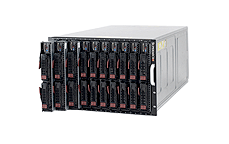
Supermicro Superblade

“Supermicro is pleased to see the ScaleMP leading-edge virtualization take advantage of the Supermicro SuperBlade,” said Alex Hsu, chief sales and marketing officer of Supermicro. “Our 10-blade SuperBlade system can scale from 2 to 20 processors (up to 80 cores), and up to 640 GB of RAM in a modular fashion, providing one of the densest high-end x86 systems on the market today in a space- and energy-efficient package, and making this solution very appealing to our customers.”

“ScaleMP teamed with Supermicro to deliver a high-end system that breaks new barriers in high-end computing,” said Shai Fultheim, Founder and CEO of ScaleMP.  “This solution is very versatile and can address complex IT requirements from running commercial off-the-shelf HPC applications to homegrown applications that are compute- or memory-intensive, while providing reduced system management and operational complexity through a single image of the operating system.”

The SuperBlade from Supermicro touts enhanced system density in a 7U chassis, comes with an integrated InfiniBand switch, and can be housed in a 19” industry-standard rack, reducing the server footprint in the data center.

Filed Under: News, Partnerships Tagged With: ScaleMP, ScaleMP vSMP Foundation Standalone, SMP, Superblade, Supermicro, Supermicro Superblade, virtualisation, virtualization, vSMP Foundation Standalone, X86, x86 virtualization

Trustware Introduces BufferZone Pro 3.0

June 17, 2008 by Robin Wauters Leave a Comment

Trustware, provider of application virtualization security technologies, recently unveiled a new version of its security software application, BufferZone Pro 3.0.

Trustware

While BufferZone Pro is mostly known for creating a virtual “buffer zone” around Internet facing applications, BufferZone Pro 3.0 adds a new feature called “privacy zone”. Beginning with Version 3.0, users are now able to both encapsulate their browser session and create a list of trusted Web sites used for confidential transactions such as banking, online trading or Intranet sites. Once defined, these trusted sites will always open within the “privacy zone,” thereby preventing identity thieves from stealing or gaining access to sensitive information such as social security numbers, banking information, or passwords. With BufferZone Pro 3.0, consumers can safely browse their favorite Web sites, as well as shop and bank online, without being afraid.

Based on virtualization technology, BufferZone Pro claims it creaties an impenetrable barrier that isolates Internet activity like Web browsing, instant messaging and peer-to-peer downloads, from the actual underlying PC’s operating system. This approach eliminates the need for file and traffic scanning as well as analysis of malicious code. Similarly, BufferZone Pro requires no signatures or security updates to perform its work. Its “set and forget” approach not only provides constant, always on protection, but also acts as an ideal partner for desktop firewalls and existing anti-virus solutions.

BufferZone Pro 3.0 for Windows XP is available immediately. Its suggested retail price of $39.95 includes one year of service and maintenance. BufferZone 3.0 for Windows Vista is available as a free beta version.

Filed Under: News Tagged With: application virtualization security, BufferZone, BufferZone Pro, BufferZone Pro 3.0, Trustware, Trustware BufferZone, virtsec, virtualisation, virtualization, virtualization security

  • « Go to Previous Page
  • Go to page 1
  • Interim pages omitted …
  • Go to page 137
  • Go to page 138
  • Go to page 139
  • Go to page 140
  • Go to page 141
  • Interim pages omitted …
  • Go to page 206
  • Go to Next Page »

Primary Sidebar

Tags

acquisition application virtualization Cisco citrix Citrix Systems citrix xenserver cloud computing Dell desktop virtualization EMC financing Funding Hewlett Packard HP Hyper-V IBM industry moves intel interview kvm linux microsoft Microsoft Hyper-V Novell oracle Parallels red hat research server virtualization sun sun microsystems VDI video virtual desktop Virtual Iron virtualisation virtualization vmware VMware ESX VMWorld VMWorld 2008 VMWorld Europe 2008 Xen xenserver xensource

Recent Comments

  • C program on Red Hat Launches Virtual Storage Appliance For Amazon Web Services
  • Hamzaoui on $500 Million For XenSource, Where Did All The Money Go?
  • vijay kumar on NComputing Debuts X350
  • Samar on VMware / SpringSource Acquires GemStone Systems
  • Meo on Cisco, Citrix Join Forces To Deliver Rich Media-Enabled Virtual Desktops

Copyright © 2025 · Genesis Sample on Genesis Framework · WordPress · Log in

  • Newsletter
  • Advertise
  • Contact
  • About