• Skip to primary navigation
  • Skip to main content
  • Skip to primary sidebar
Virtualization.com

Virtualization.com

News and insights from the vibrant world of virtualization and cloud computing

  • News
  • Featured
  • Partnerships
  • People
  • Acquisitions
  • Guest Posts
  • Interviews
  • Videos
  • Funding

News

SIMtone Takes Carrier-Grade Virtualization Services International

June 24, 2008 by Robin Wauters Leave a Comment

SIMtone Corporation today announced the launch of SIMtone International, the company’s newly established international headquarters in Switzerland. SIMtone International is already working with a number of International Telecom and Cable Service Providers to deliver all types of carrier-grade virtual computing services for the enterprise, SMB and consumer markets.

SIMtone

“The widespread availability and accessibility of very high quality wireless and wireline broadband services throughout Europe is now enabling Network Operators to commercially deliver a broad range of value-added services such as virtual PCs,” explained Mario Dal Canto, SIMtone Corporation’s Chairman of the Board and Chief Executive Officer. “SIMtone makes virtualization simple, and enables carriers to develop, deploy and deliver new services inexpensively, securely and seamlessly to any connected device on-demand and on-the-fly. We enable a game-changing opportunity for Network Operators to decommoditize their pipes, reduce churn, optimize network utilization, lower costs and increase ARPU with services people need rather than just want. SIMtone is the perfect complement to wireless and wireline broadband connectivity services, and allows telecom, cable and wireless operators to deliver converged mobile services simply and safely everywhere.”

Earlier this year, SIMtone unveiled its virtualization platform and a virtual cloud computer, the SIMtone Virtual PC, at Mobile World Congress in Barcelona, Spain. The SIMtone Virtual PC is the first computer-in-the-cloud that delivers a full laptop-like user experience, including high performance screen/sound and full USB functionality, on any Internet connected device, on-demand and on-the-fly.

The telecom market in Europe is progressive and committed to delivering a range of virtual services, such as Virtual PCs bundled with broadband Internet access. According to IDC’s Quarterly Server Tracker, virtualization was a driving force as the EMEA server market reached $4.4 billion in revenues in 1Q08, up 4.8 percent over 1Q07.

SIMtone International already has more than 10 employees in Europe. The company has a technology development center in Ireland and a representative office in Spain and is in the process of establishing its European operation support center on the shores of Lake Leman in Switzerland.

Filed Under: News Tagged With: carrier-grade virtualization, Mario Dal Canto, Network Operators, SIMtone, SIMtone Corporation, SIMtone International, SIMtone Virtual PC, virtual cloud computer, Virtual PC, virtualisation, virtualization

Radiant Logic Releases RadiantOne Virtual Directory Server (VDS) 5.0

June 24, 2008 by Robin Wauters Leave a Comment

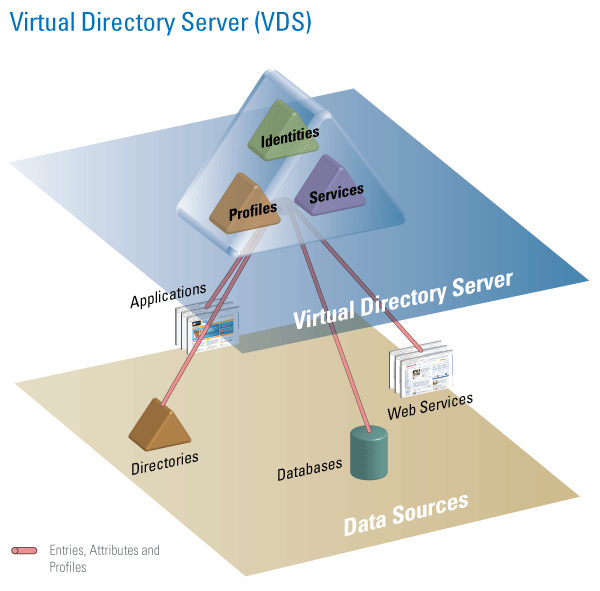
Radiant Logic, provider of virtual directory solutions, today announced the rollout of its latest release, RadiantOne Virtual Directory Server (VDS) 5.0. This “wizard-driven” solution aims to simplify the deployment of identity integration for Web Single Sign-On and Federation.

Radiant Logic

As the newest component of the RadiantOne Identity and Context Virtualization Platform, RadiantOne VDS 5.0 is designed to analyze the steps of identity integration, divide those steps into different tasks and provide tools to solve each task. The result is a wizard-based virtual directory focused on use cases and practical deployments, rather than just tools.

RadiantOne VDS 5.0 turns the complex process of identity integration into a simple, use case driven, point and click operation.

“We are providing our customers with a field tested solution based on virtualization that is not only easy to deploy and risk free, but also the most complete on the market,” said Michel Prompt, CEO of Radiant Logic.

RadiantOne VDS 5.0 features a three-step wizard, designed to connect all backend sources to the virtual directory within minutes. Customers can quickly aggregate and/or integrate identity data from any data source and extend it with additional attributes for authorization. The Virtual Directory Server then leverages this identity information by making it appear as one common virtual LDAP v3 compliant directory that is fully compatible with SUN/RedHat/Netscape directories.

Thz new release also includes a specific set of scenario/wizard driven templates for the deployment of CA SiteMinder, Web SSO, EMC/RSA ClearTrust and IBM TAM.

Radiant Logic VDS

[Source: PR Inside]

Filed Under: News Tagged With: Michel Prompt, RadiantOne Identity and Context Virtualization Platform, RadiantOne VDS 5.0, RadiantOne Virtual Directory Server (VDS) 5.0, RadiantOne Virtual Directory Server 5.0, VDS 5.0, virtual directory, Virtual Directory Server, Virtual Directory Server (VDS) 5.0, virtualisation, virtualization

VMware Debuts VAssert, A New Workstation API

June 24, 2008 by Robin Wauters Leave a Comment

VMware just blogged about VAssert (programming guide – PDF), a new API debuting in Workstation 6.5 (beta) that uses the Record and Replay functionality they’ve been talking about for some time now. VAssert (Virtual Assertions) is a relative of your standing programming ASSERT debugging tool, but by delaying assert-checking until later when the exact machine instructions are replayed, it can be “very fast”.

VMware engineers Weiming Zeng and Min Xu demonstrate VAssert within Apache here.

Filed Under: News Tagged With: Apache, API, ASSERT, Min Xu, Record and Replay, VAssert, Virtual Assertions, virtualisation, virtualization, vmware, VMware VAssert, VMWare Workstation, VMware Workstation 6.5, Weiming Zeng, Workstation 6.5

Hyperic Launches CloudStatus, Cloud Management Software Deluxe

June 23, 2008 by Robin Wauters 3 Comments

In an impressive effort to make the cloud more transparent, open source cloud management software vendor Hyperic has launched CloudStatus.com, a web service (in beta) that lets a user peek in on the various compute clouds to see how things are running.

CloudStatus

CloudStatus measures service availability, latency and throughput for cloud-based infrastructure and application services. The initial release provides metrics for Amazon’s Elastic Compute Cloud (which runs on the Xen hypervisor), Simple Storage Service, SimpleDB, Simple Queue Service and Flexible Payment Service. Hyperic does so by sending a software agent to make requests against various cloud services, which obviously leads to a few questions about the viability of the service.

EC2

As Stacey Higginbotham puts it on GigaOm:

“It’s a decent idea, but my worry is that Amazon or another cloud provider could shut the service down, either by offering their own status service or by stopping the Hyperic agent. Given the rush to provide dashboards, application-testing products and other services on top of established computing services, I’m eager to see how startups keep their footing in the clouds.”

The Hyperic team also blogged about the release featuring a promotion video which we’re happy to share with you.

Filed Under: News Tagged With: Amazon, Amazon EC2, Amazon Elastic Compute Cloud, Amazon Web Services, cloud computing, cloud computing services, cloud management software, CloudStatus, ec2, Flexible Payment Service, Grid Computing, Hyperic, Hyperic CloudStatus, open source, Simple Queue Service, Simple Storage Service, SimpleDB, utility computing, virtualisation, virtualization

Embotics Releases V-Commander 2.0, Aims To Simplify Virtualization Lifecycle Management

June 23, 2008 by Robin Wauters 1 Comment

Embotics, which bills itself as a “Virtualization Lifecycle Management Company”, today released V-Commander 2.0 at the Gartner IT Infrastructure, Operations and Management Summit 2008.

Embotics

The new version of V-Commander reduces risks and costs by preventing virtual sprawl, automating lifecycle management and extending management systems for enterprise CIOs, CSOs, IT operations staff and security professionals. Learn more about the product in our video interviews with Jean-Marc Seguin, Chief Architect with Embotics (we’ve embedded the clip below) and the company’s founder and CEO, Jay Litkey.

V-Commander 2.0 aims to simplify virtual machine (VM) management within IT environments. Its features include:

  • Expanded Policy Capabilities – Increased capacity for new policies enables expanded zones and VM grouping, as well as additional policy actions for the different stages of the VM lifecycle.
  • Improved Reporting Capabilities – Facilitates unlimited custom reporting as well as task oriented reports that identify costs associated with expired, offline and unauthorized VMs.
  • Additional Enterprise Features – Provides easier installation and configuration workflow by enabling automatic VM identification tagging and the ability to associate and assign policies to groups as opposed to individual VMs.

[Source: BusinessWire]

Filed Under: News Tagged With: Embotics, Embotics V-Commander, Embotics V-Commander 2.0, gartner, Gartner IT Infrastructure, Jay Litkey, Jean-Marc Seguin, Operations and Management Summit 2008, V-Commander, V-Commander 2.0, virtual machine management, virtualisation, virtualization, Virtualization LifeCycle Management, virtualization management, vm management

DynamicOps Releases Virtual Resource Manager

June 23, 2008 by Robin Wauters Leave a Comment

DynamicOps, the recently launched venture-backed spinout of Credit Suisse, today formally released (PDF) Virtual Resource Manager, software that is designed to simplify, automate and accelerate the deployment and management of virtual machines to give companies true business agility.

DynamicOps

According to the official statement, the software has been used in production for more than two years in four large-scale, complex data centers at Credit Suisse, managing thousands of virtual machines (VM).

Virtual Resource Manager (VRM) lets companies determine how to use physical and virtual compute assets, where to allocate resources, and what access to give to business units and individuals, all within a company’s corporate governance and compliance requirements.

VRM boasts proven scalability which meets the virtualization challenges of the most demanding enterprises. VRM’s open architecture works with virtualization tools and technologies from Citrix, Microsoft, Sun, and VMWare and is compatible with Windows and Linux operating systems and a host of other data center products already in use by many large companies.

“The unique self-service capability allows business lines to instantly provide new IT environments, and at the same time, allows central IT to maintain proper controls and policies,” explained Leslie Muller, the driving force behind the product development at Credit Suisse, and now CTO at DynamicOps. “VRM provisions servers, desktops, applications, and tools as a single package for our clients, providing faster access to custom environments and resources at a fraction of the cost. It also helps IT employees develop applications and products faster to increase company revenues.”

Filed Under: News Tagged With: Credit Suisse, Credit Suissie, DynamicOps, DynamicOps Virtual Resource Manager, DynamicOps VRM, Leslie Muller, Virtual Resource Manager, virtualisation, virtualization, VRM

  • « Go to Previous Page
  • Go to page 1
  • Interim pages omitted …
  • Go to page 189
  • Go to page 190
  • Go to page 191
  • Go to page 192
  • Go to page 193
  • Interim pages omitted …
  • Go to page 240
  • Go to Next Page »

Primary Sidebar

Tags

acquisition application virtualization Cisco citrix Citrix Systems citrix xenserver cloud computing Dell desktop virtualization EMC financing Funding Hewlett Packard HP Hyper-V IBM industry moves intel interview kvm linux microsoft Microsoft Hyper-V Novell oracle Parallels red hat research server virtualization sun sun microsystems VDI video virtual desktop Virtual Iron virtualisation virtualization vmware VMware ESX VMWorld VMWorld 2008 VMWorld Europe 2008 Xen xenserver xensource

Recent Comments

  • C program on Red Hat Launches Virtual Storage Appliance For Amazon Web Services
  • Hamzaoui on $500 Million For XenSource, Where Did All The Money Go?
  • vijay kumar on NComputing Debuts X350
  • Samar on VMware / SpringSource Acquires GemStone Systems
  • Meo on Cisco, Citrix Join Forces To Deliver Rich Media-Enabled Virtual Desktops

Copyright © 2025 · Genesis Sample on Genesis Framework · WordPress · Log in

  • Newsletter
  • Advertise
  • Contact
  • About