• Skip to primary navigation
  • Skip to main content
  • Skip to primary sidebar
Virtualization.com

Virtualization.com

News and insights from the vibrant world of virtualization and cloud computing

  • News
  • Featured
  • Partnerships
  • People
  • Acquisitions
  • Guest Posts
  • Interviews
  • Videos
  • Funding

News

Hitachi Moves Forward With Virtage Embedded Virtualization

June 25, 2008 by Robin Wauters Leave a Comment

Hitachi yesterday announced that it would add Intel’s 9100 series Itanium chips to its high-end BladeSymphony 1000 systems, as well as its lower-end BladeSymphony 320 servers. Additionally, Hitachi will begin offering the latest dual-core Intel Xeon 5200 series processors along with Intel’s quad-core Xeon 5400 chips with both sets of BladeSymphony systems.

Hitachi is looking to leverage its legacy mainframe technology, especially virtualization, to offer an alternative in a crowded field that is full of systems aimed at data center consolidation projects.

Virtage

What Hitachi is offering is called Virtage, an embedded hardware virtualization technology that provides an abstraction layer that decouples the physical system from the operating system to provide utilization and additional flexibility. Since the virtualization is built into the hardware itself, it is more reliable and secure than virtualization based on a hypervisor, according to Hitachi.

Hitachi doesn’t have a lot of market share though. In the latest survey by IDC (confirmed by Gartner as well), HP was first in overall server revenue with more than $3.7 billion in global sales, and the company also controlled 46.9 percent of the worldwide $1.2 billion blade market during the first quarter of 2008.

Meanwhile, Hitachi did not finish in either the top five in the United States or in the worldwide market, where HP, IBM, Dell, Sun Microsystems and Fujitsu/Fujitsu Siemens all dominate.

[Source: eWeek]

Filed Under: News Tagged With: abstraction layer, BladeSymphony 1000, BladeSymphony 320, embedded virtualization, hardware virtulalization, Hitachi, Hitachi Data Systems, Hitachi Virtage, intel, Intel Xeon, virtage, virtualisation, virtualization

ProxMox, The Open Source Virtual Environment You Didn’t Know

June 24, 2008 by Robin Wauters Leave a Comment

Jason Perlow over at ZDNet Blogs today wrote an interesting article about ProxMox, a Vienna, Austria-based Open Source turnkey virtualization server provider we weren’t aware of until this day. Proxmox Virtual Environment (VE) is basically an easy to use Open Source virtualization platform for running Virtual Appliances and Virtual Machines.

ProxMox

ProxMox VE, which is is licensed under GPLv2, boasts:

  • Pre-built Virtual Appliances
  • Install and manage with a view clicks
  • Selection of products for the use in the enterprise

Proxmox VE is optimized for performance and usability. For maximum flexibility, the following virtualization technologies are installed by the bare metal ISO-installer. It leverages two virtualization platforms, OpenVZ and KVM.

As Jason writes:

In a nutshell, ProxMox VE is a bare-metal install CD that contains a highly-tweaked version of Debian Etch that is optimized for use as a virtualization server, using a modified Linux kernel which includes all the support needed for KVM and OpenVZ. The system runs completely headless and in a light configuration — the entire install CD is only 250MB. To take advantage of ProxMox VE, you’ll want a 64-bit CPU that supports the Intel VT or AMD-V instruction sets, such as recent Core Duo, Xeon, AMD64 Athlon X2 or Opteron chips. You’ll also want at least 2GB of RAM to run a few virtual machines/virtual environments comfortably.

Read the rest of the article here.

Filed Under: News Tagged With: GPLv2, open source, ProxMox, ProxMox VE, ProxMox Virtual Environment, virtual appliances, virtual machines, virtualisation, virtualization

Cisco Talks Up Data Center 3.0 Initiative, Wants To “Demistify Virtualization”

June 24, 2008 by Robin Wauters 2 Comments

Cisco Systems today announced updates to several of its key products to accelerate applications in Data Center 3.0, Cisco’s vision for a virtualized data center tied together by a unified network fabric.

Cisco

Today’s announcements at Cisco Live also featured new tools and training to help networking professionals master the complexity of virtualized data centers. In essence, the company is rolling out a host of software and services designed to expand what data center administrators can do with virtualization.

“Real-time collaborative applications, energy concerns and the need to achieve greater efficiency from assets are driving IT managers to transform their data centers through new technologies,” said John McCool, senior vice president and general manager, Cisco Data Center, Switching and Services Group, and co-chair of the Cisco EcoBoard . “By providing virtualization technologies across the data center, Cisco aims to help businesses achieve the agility and resiliency they need to compete on a global scale.”

Where’s the beef, you ask?

The announcements coming out of Cisco include the release of the company’s WAAS (Wide Area Application Services) software version 4.1, which offers virtualized application hosting services, application acceleration and video deliver for branch offices, and Cisco’s VFrame Data Center release 1.2 for infrastructure provisioning with Cisco’s ACE (Application Control Engine) and VMware’s ESX Server software.

In addition, Cisco is releasing version 3.1 of ACE for the ACE 4710 application switch, which offers up to 4 gigabits-per-second of throughput. The company also is announcing the Cisco Data Center 3.0 professional programs and services for support customers and partners with data center deployments. Included in the services offerings is Cisco’s new Data Center Efficiency Program, part of the company’s Data Center Assurance Program 4.0, a Web-based tool that enables users to analyze power use in the data center and identify power and cooling technologies most useful in their facilities.

WAAS 4.1, VFrame 1.2 and the ACE Appliance will be available in the third quarter.

[Source: The Register]

Filed Under: Featured, News Tagged With: ACE 3.1, Cisco, Cisco ACE, Cisco ACE 3.1, Cisco Data Center 3.0, Cisco Live, Cisco Systems, Cisco VFrame Data Center 1.2, Cisco virtualization, Cisco WAAS, Cisco WAAS 4.1, Cisco Wide Area Application Services, Data Center 3.0, Data Center Assurance Program 4.0, Data Center Efficiency Program, John McCool, network virtualization, VFrame Data Center 1.2, virtualisation, virtualization, virtualized data center, WAAS, WAAS 4.1, Wide Area Application Services

Hyper9 Comes Out Of Stealth, Focuses On Letting You Find And Manage Virtual Machines

June 24, 2008 by Robin Wauters 1 Comment

Hyper9, formerly known as InovaWave, provider of search-based software for virtual environment management, today announced its first product, carrying the same name as its parent company. Hyper9 will be free to download in September.

Hyper9

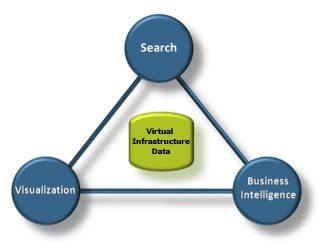
Hyper9, a privately held company headquartered in Austin, Texas, leverages a “Google-like” search engine to access both real-time and historical data on everything from the guest operating system to the physical infrastructure, then presents that data via a “next-generation” user interface. As a result, Hyper9 claims this approach supports faster troubleshooting, comprehensive monitoring and detailed reporting on the performance, configuration and utilization of virtual environments.

“Just as virtualization is transforming traditional computing, Hyper9 is ready with a truly scalable, flexible and intuitive approach to managing these dynamic environments,” said Chris Ostertag, president and CEO of Hyper9, Inc. “Hyper9’s unique architecture ensures that it can adapt to and accommodate the continually changing nature of virtual environments even as they gravitate to more hybrid states.”

The initial Hyper9 virtual appliance is designed to work only with the VMware ESX environment. Later versions will work with additional hypervisors, the company announced.

Hyper9

Filed Under: News Tagged With: Chris Ostertag, Hyper 9, Hyper9, Hypervisor, management, search, virtual machines, virtualisation, virtualization, vm management, vmware, VMware ESX

iWave Software Debuts Automator, Will It Please IT Administrators?

June 24, 2008 by Robin Wauters Leave a Comment

iWave Software, a 15-year old maker of IT integration software, today announced its entry into the IT process automation market with the introduction of iWave Automator.

iWave Software

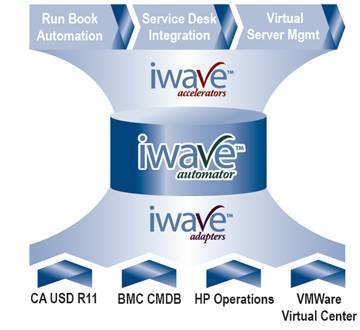
iWave Automator is a platform designed to automate data center support processes (run book automation) and to integrate IT system management (ITSM) applications. iWave Automator aims to enable IT organizations to automate, standardize and enforce best practices, lowering their operating costs and improving application availability, while maintaining compliance in their virtualized and physical data centers.

iWave Automator says it provides IT administrators with two options for automating their virtual or physical data center environments. Administrators can use iWave’s graphical process design environment to create automations specific to their organization’s unique business needs or implement iWave Accelerators, pre-built IT automation workflows that automotive specific tasks using ITIL compliant processes.

iWave Automator

The platform consists of the following components:

  • iWave Adapters: iWave offers over 40 pre-built adapters for IT service management (ITSM) applications. iWave Adapters support all of the popular ITSM applications that span the ITIL Service Support disciplines including service desks, event, problem, change, configuration and release management.
  • iWave Accelerators: iWave Accelerators are pre-built workflows that administrators can download and import into their iWave Automator environments. iWave Accelerators help administrators automate common IT management tasks including virtual server management, configuration and compliance management.
  • iWave Designer: A graphical user interface that provides administrators the tools required to create IT process automation workflows and integrations quickly and easily.
  • iWave Management Console: A Web-based console that provides administrators the ability to monitor the health of the iWave Automator environment as well as their ITSM workflows and integrations.

Filed Under: News Tagged With: automation, IT automation, IT integration, IT integration software, IT process automation, ITSM, iWave, iWave Accelerators, iWave Adapters, iWave Automator, iWave Designer, iWave Management Console, iWave Software, run book automation, virtualisation, virtualization

Novell Upgrades PlateSpin PowerConvert To Version 7.0

June 24, 2008 by Robin Wauters 1 Comment

PlateSpin, since March 2008 a Novell company, today announced the launch of PlateSpin PowerConvert Version 7.0 with new backup and recovery features and expanded multi-platform support to help enterprises migrate and protect server workloads across heterogeneous physical and virtual IT environments.

PlateSpin

In addition to providing enhanced SUSE Linux Enterprise support, PlateSpin PowerConvert now provides broader support for Red Hat Enterprise Linux, as well as support for critical 64-Bit Microsoft Windows Server-based workloads and Citrix XenServer environments. PowerConvert provides the flexibility to optimize data centers by decoupling server workloads from the underlying hardware and streaming them over the network between physical servers, blade infrastructures, virtual hosts and image archives.

“Since Novell’s acquisition of PlateSpin in March, the two organizations have worked closely to put in place a data center strategy and product roadmap to help customers achieve an agile enterprise in which business services can span physical and virtual environments,” said Stephen Pollack, chief executive officer of PlateSpin, a Novell company. “To build the next-generation data center infrastructure, organizations need enterprise-caliber multi-platform workload portability, robust and scalable workload protection and reliable policy-based orchestration, PlateSpin PowerConvert 7.0 is designed to help customers achieve this flexibility and maximize their investment in virtualization.”

These are the new PowerConvert 7.0 features, according to the press release:

  • Linux “Anywhere-to-Physical” Migrations – Powerful physical-to-physical (P2P) and virtual-to-physical (V2P) capabilities enable migration of Linux workloads across physical or virtual boundaries for 32-bit SUSE Linux Enterprise Server from Novell and Red Hat Enterprise Linux, giving customers the ability to accelerate data center initiatives including server consolidation, hardware lease migration and data center relocation.
  • Windows 64-Bit Support – Windows 64-Bit physical-to-virtual (P2V) migration for critical Windows Server 2003 workloads with support for various transfer methods, including Take Control, Live File Transfer and Snapshot for VMware ESX 3.x, 3.5 and Citrix XEN Enterprise 4.1, offers customers an effective migration option in a single solution.
  • Enhanced Citrix XenServer Support – Support for anywhere-to-virtual (X2V) and virtual-to-image (V2I) workload migrations for Citrix XenServer Enterprise 4.1 including 32-bit Windows XP, 2000, 2003 and 64-Bit Windows Server 2003 allows customers to accelerate and simplify integration and maximize their IT investment.
  • Incremental Imaging Capabilities – Flexible imaging support brings greater workload protection while enabling significant savings in terms of staffing time, bandwidth and storage costs. Superior image import and export capabilities and automation enable organizations to more easily create and manage an image-based repository of server workloads for backup and disaster recovery and reduce imaging costs.
  • Enterprise-class Speed and Reliability – Dramatically improved transfer speeds for workload migrations over a wide range of network types from Gigabit Ethernet networks to high-latency WAN environments — all with reliable enterprise-class workload migration functionality including Server Sync(TM), job automation and post-migration testing capabilities that minimize downtime while maximizing the integrity of the workload migration. PowerConvert’s enterprise-caliber reliability reduces overall migration project times, lowers business risk and accelerates time to value for large- scale data center initiatives.

[Source: PR Newswire]

Filed Under: News Tagged With: Novell, PlateSpin, PlateSpin PowerConvert, PlateSpin PowerConvert 7.0, PlateSpin PowerConvert Version 7.0, PowerConvert 7.0, PowerConvert Version 7.0, Stephen Pollack, virtualisation, virtualization

  • « Go to Previous Page
  • Go to page 1
  • Interim pages omitted …
  • Go to page 188
  • Go to page 189
  • Go to page 190
  • Go to page 191
  • Go to page 192
  • Interim pages omitted …
  • Go to page 240
  • Go to Next Page »

Primary Sidebar

Tags

acquisition application virtualization Cisco citrix Citrix Systems citrix xenserver cloud computing Dell desktop virtualization EMC financing Funding Hewlett Packard HP Hyper-V IBM industry moves intel interview kvm linux microsoft Microsoft Hyper-V Novell oracle Parallels red hat research server virtualization sun sun microsystems VDI video virtual desktop Virtual Iron virtualisation virtualization vmware VMware ESX VMWorld VMWorld 2008 VMWorld Europe 2008 Xen xenserver xensource

Recent Comments

  • C program on Red Hat Launches Virtual Storage Appliance For Amazon Web Services
  • Hamzaoui on $500 Million For XenSource, Where Did All The Money Go?
  • vijay kumar on NComputing Debuts X350
  • Samar on VMware / SpringSource Acquires GemStone Systems
  • Meo on Cisco, Citrix Join Forces To Deliver Rich Media-Enabled Virtual Desktops

Copyright © 2025 · Genesis Sample on Genesis Framework · WordPress · Log in

  • Newsletter
  • Advertise
  • Contact
  • About