
• Skip to primary navigation
  • Skip to main content
  • Skip to primary sidebar
Virtualization.com

Virtualization.com

News and insights from the vibrant world of virtualization and cloud computing

  • News
  • Featured
  • Partnerships
  • People
  • Acquisitions
  • Guest Posts
  • Interviews
  • Videos
  • Funding

Featured

Virtualization Congress 2008: Cancelled, Or Merely Postponed?

September 24, 2008 by Robin Wauters 6 Comments

When the industry blog Virtualization.info announced its first event, the completely independent Virtualization Congress 2008, back in March, we wrote that it would prove to become one of the most interesting events of the year. The congress was to be held from 14 to 16 October at the ExCel centre in London.

Now it seems the event has been postponed, at least according to the event website. VMblog earlier reported that the event was actually cancelled due to ‘low registration numbers and a tough macro-economic climate’. It couldn’t have helped a lot that there was a similar event going on in London only 2 weeks before Virtualization Congress, namely VM08, which to date has not been cancelled and seems to have much of the same topics and sponsors as the congress did.

We have an e-mail in for a confirmation and more clarity on the matter, we’ll update this post as soon as we get a response.

UPDATE: we got an e-mail back saying “the number of delegates that were registered when we decided to cancel (around 300) was too low to match the sponsors expectations and cover the conference costs expenses. Thus we decided to cancel this edition.”. The event has effectively been postponed, with no clarification on a later date so far.

Whatever the reason may be behind the cancellation / delay, we would like to give Alessandro Perilli, who writes about the industry with great passion and knowledge, a heads-up. Organizing an event of this size is no easy feat. Next to blogging, I organize a conference of my own about the European Web 2.0 industry (Plugg) and I know how stressing it can be and how much effort, time and money goes into the organization prior to the event.

We wish Alessandro all the best for the future.
Filed Under: Featured, News Tagged With: Alessandro Perilli, cancellation, postponed, virtualisation, virtualization, Virtualization Congress, Virtualization Congress 2008, Virtualization.info, VM08

Parallels Readying Attack on VMware Fusion With Desktop 4

September 22, 2008 by Robin Wauters Leave a Comment

AppleInsider has taken a close look at a few features of the upcoming Parallels Desktop 4, which will be Parallels’ answer to the latest release of VMware Fusion 2.0.

“Those aware of the changes say the new release will be Parallels’ first to make good on promise made in early January that it would enable virtualization of Mac OS X Server on Macs already running the operating system, making use of a change in licensing terms with Leopard’s release late last year that permits more than one copy to run at the same time.

Such features have been frequently requested by IT administrators, who on Linux and Windows have already been able to segregate individual apps away from the main operating system in the event of a crash or a security breach.”

Ars Technica adds:

“Desktop 4’s performance will also be beefed up by adding DirectX 9 and OpenGL 2 support, an improved virtualization engine, and support for multiple cores and more RAM.

A makeover for the new version of Parallels Desktop is also in the cards, including a redesigned and simplified interface and more Terminal-based controls. In addition, the team is working on improving the ACPI interface (used for shutdowns and sleeping), and should be adding virtual machine resizing and 64-bit support. Based on those features, the software shouldn’t have a hard time catching up to Fusion, but I hope the team has something else waiting in the wings.”

Parallels

Filed Under: Featured, News Tagged With: Apple, Desktop 4, desktop virtualization, Fusion, Fusion 2.0, Parallels, Parallels Desktop, Parallels Desktop 4, Parallels Desktop for Mac, VDI, virtualisation, virtualization, vmware, VMWare Fusion, VMWare Fusion 2.0

The Virtual Infrastructure Evolves Into The Virtual Datacenter OS

September 16, 2008 by Lode Vermeiren 3 Comments

More and more details on what VMware calls the “Virtual Datacenter OS” are starting to come out of VMworld. The new CEO, Paul Maritz, is expected to elaborate on this new strategy in today’s keynote. (update: check our live blog coverage)

(Update 2: also check the coverage on Between The Lines and Virtually Speaking, both ZDNet blogs)

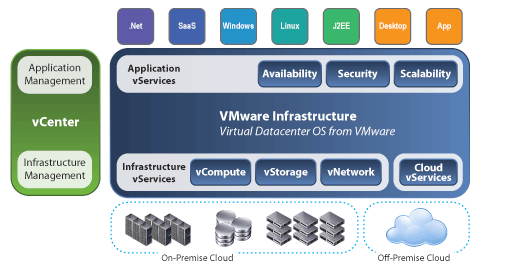
The VDC-OS is not a new product per se, but an umbrella name for a set of products and features, much like VMware Virtual Infrastructure is composed of ESX server, VirtualCenter and features like DRS, HA and VMotion.

VDC-OS is a natural evolution from the “virtual infrastructure” approach, which no longer only includes the virtualization servers and their shared storage and networking, but also the “next layer” in the virtualization stack, both upwards and downwards: VDC-OS no longer stops at the guest OS level, but provides application services as well, and in the other direction goes beyond the local network and is aware of the bigger picture.

The building blocks that make up VDC-OS will sound very familiar to beta testers of ESX 4.0 and technology partners. They include some new features, recent acquisitions and better integrated versions of the current product line-up, as well as third-party add-ons bearing the VMware Ready logo. All of these are called “vServices”.

The three big areas of vServices VMware identifies are:

  • Application vServices – Availability, Security, Scalability
  • Infrastructure vServices – vCompute, vStorage, vNetwork and vCloud
  • Management vServices – vCenter (the new name for VirtualCenter)

The new and current features in depth:

Application Services
Availability:

  • HA, VMotion, Storage VMotion, NIC/HBA teaming
  • VMware Fault tolerance, formerly known as “Continuous availability” – which allows a VM to run on two hosts simultaneously, using lock-stepping of CPU instructions. (new)
  • vCenter Data Recovery – built-in disk-based backup and recovery of VMs and the files within them, including data deduplication. (new)

Security

  • ESXi, a stripped-down hypervisor in only 32 MB of code, to reduce the attack surface
  • VMware vSafe (first announced at VMworld Europe), with third party support add-ons from IBM, Checkpoint, Radware and McAfee, who will announce their first products today (new)

Scalability

  • DRS
  • Hot add of virtual CPU, memory and PCIe devices like network adapters (new)
  • Very large VMs with 8 virtual CPUs and 256 GB of RAM (new)

Infrastructure Services

vCompute

  • CPU/Memory optimization with hardware assists, page sharing and memory ballooning
  • DRS
  • VMDirectPath – enabling wirespeed network access to VMs (new)
  • Paravirtualized SCSI – providing more iops per second at lower latency (new)

vStorage

  • VMFS
  • Linked clones (first demonstrated at VMworld 2007 in San Francisco) – allows multiple VMs to run from the same base disk (new)
  • Storage VMotion
  • Thin Provisioning (new)
  • APIs to closer work together with storage arrays (new)

vNetwork

  • more offload technologies to reduce virtualization overhead
  • Distributed vNetwork virtual switches (new)
  • Third-party virtual switches – the first one to be announced today by Cisco (new)

Cloud Services (vCloud)

  • VMotion and Storage VMotion (within the “internal cloud”)
  • VMware vCloud (new)
  • Network vMotion – preserving network and security policies when a virtual machine is being migrated (new)
  • vApp – an encapsulation of a VM and its policies and service levels, based on OVF (new)

Management

vCenter replaces VirtualCenter, and integrates the add-on products today known as Stage Manger, Lab Manager and the likes. It integrates withing other management frameworks from the likes of IBM and CA.

  • vCenter AppSpeed – performance monitoring and remediation to guarantee service levels. (new)
  • vCenter Orchestrator – to automate repetitive workflows
  • vCenter CapacityIQ – proactive capacity planning for entire VI environments
  • vCenter Chargeback – to allow IT departments or cloud service providers to charge based on VM usage
  • vCenter ConfigControl – called “update manager on steroids” by VMware, a central way to configure and update the virtual data center
  • Host Profiles – to standardize the setup of ESX hosts using templates

Watch out for more announcements by VMware and its partners in the coming hours and days.

Filed Under: Featured, News Tagged With: ESX 4.0, ESX Server, Paul Maritz, VDC-OS, Virtual Datacenter OS, virtualcenter, virtualisation, virtualization, vmware, VMware ESX 4.0, VMWare ESX Server, VMware Virtual Datacenter OS, vmware virtualcenter, VMware vServices, vServices

vMAN Over At DMTF Is Immune To Kryptonite And Now Powered by OVF Version 1.0

September 16, 2008 by Toon Vanagt 2 Comments

Like superheroes with a weak spot (remember Superman and green Kryptonite), large providers of green data center technologies and virtualization software had an Achilles’ heel with their vendor lock-in, which scared away quite a few prospects. Today the major players have all agreed to drop their distinct proprietary formats and aim to adopt the Open Virtualization Format 1.0 as soon as possible (most are already compliant upon release). We first learned about OVF during our interview with Ian Pratt and the release of this open standard is a great step forward. The short lead time of ‘only’ one year proves the industry has understood that open standards are the way to go.

Above is our exclusive video interview recorded at VMworld in Las Vegas, where DMTF president Winston Bumpus revealed the release of OVF 1.0 and their larger Virtualization Management Initiative (vMAN). vMAN provides IT managers the freedom to deploy pre-installed, pre-configured solutions across heterogeneous computing networks and to manage those applications through their entire lifecycle. This Initiative delivers much-needed open industry standards to the management of virtualized environments. Ultimately, the group’s goal is to eliminate the need for IT managers to separately install, configure and manage interdependencies between virtualized operating systems and applications, by enabling automated management of the virtual machine lifecycle.

This new specification created by Dell, HP, IBM, Microsoft, VMware and XenSource is about to become an industry standard and aspires to help ensure portability, integrity and automated installation/configuration of virtual machines. We did not have the time to transcribe the interview yet, but already took a few of Winston Bumpus’ quotes from the DMTF press release.

“With the increasing demand for virtualization in enterprise management, the new spec developed through this industry-wide collaboration dove-tails nicely into existing virtualization management standardization activity within the DMTF…
OVF extends the work we have underway to offer IT managers automation of critical, error-prone activities in the deployment of a virtualized infrastructure.”

By collaborating on the development of the OVF specification, the DMTF group aims to make it easier for IT organizations to pre-package and certify software packaged as virtual machine templates for deployment in their virtualized infrastructure and to facilitate the secure distribution of pre-packaged virtual appliances by ISVs and virtual appliance vendors.

Filed Under: Featured, Interviews, People, Videos Tagged With: 1.0, Bumpus, DMTF, ESX, HP, Hyper-V, IBM, interview, microsoft, Open Virtual Machine Format, ovf, OVF 1.0, OVF releaseDell, release, video, video interview, virtualisation, virtualization, vmware, VMWorld, Winston Bumpus, Xen, xensource

vCloud: VMware To Be Cloud Computing Provider Too, But Inside Your Private DC (And Not Tomorrow)

September 15, 2008 by Toon Vanagt 3 Comments

Many of the 14.000 attendants to VMworld will be happy to learn they are not going to be out of their jobs soon. Especially with cloud providers threatening to reduce corporate IT departments, completely virtualized datacenters are believed to be the future. VMware intends to keep those datacenters under their corporate client’s control on standardized X86 hardware.

(Update: link to the ‘Virtual Datacenter OS for VMware‘ product page and its Cloud vServices)

(Update 2: the link to the official press release, more comments below and a mention on Between The Lines)

Will vCloud be introduced as a cure against outsourcing to third party data centers? It is VMware’s aspiration to offer every business the flexible infrastructure associated with Amazon, Google and Salesforce. However without the need to offer excess computing power to external clients. VMware is not alone with this vision as this is very close to the network grail George Kurian at Cisco envisions:

What is most important in the virtualization world is to not to think about your data center as traditional silos of storage, server, network, firewall, application… We need to bring virtualization into the network… If you think about networking speeds and latency getting faster and lower respectively, you can, in essence, really extend virtualization to all aspects of IT systems. Down the road we see the opportunity to drive things like processor virtualization, memory virtualization, as interconnect speeds go up dramatically and latencies reduce over the next two to three years.

VMware’s new CEO Paul Maritz (who was an early believer in cloud computing) will use this vCloud announcement (not a product release) to warm up the 14,000 people expected at its annual conference in Las Vegas this week. According to a well researched article by Patrick Thibodeau over at Computer World:

… the planned cornerstone product is VMware’s Virtual Datacenter Operating System (VDC-OS) for managing the underlying systems, or “internal cloud.” Desktops and laptops are part of this virtualization umbrella, with their operating systems running in a virtual machine on the client computer that is managed back from the data center. VMware also wants to make it possible for IT managers to seamlessly tap into the resources of third-party hosting providers in the same way they can now move server resources inside their data center. It calls this new technology vCloud. VMware’s product set, including its VDC-OS, is limited to x86 architectures. That’s why Bogomil Balkansky, VMware’s senior director of product marketing cited Google as the example of IT’s Parthenon, and not the data center of some other Fortune 100 company. Google has standardized on x86. Most other large companies and many mid-sized firms also have environments that include RISC-based servers, Unix operating systems and midrange systems running Cobol-based applications that have been developed over decades — not on the new systems that Google has bought and built in its 10 short years….
Charles King, an analyst at Pund-IT Inc. in Hayward, Calif., believes VMware’s approach will raise interesting questions for hardware vendors, in particular, about its long-term impact on their products. If all x86 systems are treated as virtual pools, the underlying hardware may be of less consequence, he said.

The initiative has broad support from partners across the industry, including BT, Rackspace, SAVVIS, Sungard, T-Systems, and Verizon Business.

Intel will not be shocked by that conclusion as it will gladly ship those six core processors. Neither will HP be panicking as it has been succesfully integrating its own virtualization suites across multiple platforms (X86, Integrity) and continues to extend its Opsware capabilities. And Sun went open source with its xVM Server as outgrowth of the Xen project that even supports SPARC and Solaris.

We are very curious if “vCloud” as a product name is going to survive the release cycles and the vetting by their marketing department. It also has to be noted that vCloud is specifically intentend to be an Operating System for all aspects of the virtual datacenter. We suggest to rather name it the VDC-framework, as it seems to contain sets of services to be extended in very standardized ways (APIs & SDKs) and no direct interaction with the underlying hardware. The Xen model has proven to be very successful with such ‘extensions’ by third party ISVs.

We could not help to notice that the domain name vCloud.com redirects to VoiceCloud.com, which is powered by that omni-present cloud provider: Amazon Web Services.

VMware’s partners do learn there is some good news to with plenty of room to hook on those new API sets and offer their tools for managing heterogeneous hypervisor environments or as Balkansky boldly puts it:

“Our strategy for now is to provide richer capabilities for our operating systems rather than provide some shallow capabilities for other platforms”.

Update: More interesting links on this VMworld keynote surprise spoiler:

  • Virtual Datacenter OS: official release from VMware
  • VMware’s Virtual Datacenter OS by Scott Lowe
  • VMware Tries to Expand Throughout the Data Center by James Niccolai at PCworld

Filed Under: Featured, News Tagged With: cloud, cloud computing, Cloud vServices, Paul Maritz, vCenter, vCloud, vCloud Initiative, VDC-OS, Virtual Datacenter Operating System, Virtual Datacenter Operating System for VMware, Virtual Datacenter OS, Virtual Datacenter OS from VMware, Virtual Private Data Center, virtualisation, virtualization, vmware, VMWorld, VPDC

Video interview with George Kurian, Vice President and General Manager of the Application Delivery Business Unit at Cisco (Part 2/2)

September 14, 2008 by Toon Vanagt 1 Comment

In this second part of our interview with George Kurian, he explains about the capabilities of VFrame; being Cisco’s system’s management and provisioning that is aimed at the virtualized network and helps to put the virtual puzzle together.

Cisco recognizes the data center as a heterogeneous multivendor environment and plans to supports 3rd party technologies in the future. Cisco sees the notion of what a computer is today, getting truly blended closely with the network as interconnect speeds go up dramatically over the next two to three years.

Despite a fast moving environment Virtualization also offers IT professionals a significant career opportunity.

What is most important in the virtualization world is to not to think about your data center as traditional silos of storage, server, network, firewall, application…we need to bring virtualization into the network…we talked about both the Catalyst switches as well as the Nexus family and recently, our entire application delivery portfolio; application switching LAN acceleration techniques have got virtualization technology integrated into them. The second is …to bring networking intelligence into the virtual machine environment itself. So the ability to provide failover, traffic management, switching securities, and load balancing, those technologies that historically sat at the physical interface between the server and the network. The port now moved into the virtual machine and that’s really the technology roadmap for the next twelve months…

At Virtualization.com we are curious, if Cisco is going to make related products announcements at VMworld 2008.

Read the full transcript below or return to the first part.

0:05 Cisco has also announced VFrame? What type of capabilities does that offer?

George Kurian: VFrame which a system’s management and provisioning tool which we announced at Cisco Live a year ago, really helps to put together the virtualized network that compliments the virtual server environment. As we talked about to make virtualization real and operationally efficient, you need to have a virtualized network to compliment the virtual server and one of the things that our data center customers were telling us about is: ‘what’s most important in the virtualization world is to not to think about your data center as traditional silos of storage, server, network, firewall, application’. What they really are looking for is the service, which is putting all these virtual elements together. Now, VFrame especially with the VFrame 1.2 release, which we announced at Cisco Live this week, really completes putting together the virtual network environment. It’s got support for virtual LANs as well as virtual firewalls and recently, virtual load balancers as well as virtual storage. That really gives you a complete networking environment and then…

1:21 And also how to manage that?

Kurian: Yes.

1:23 Is that policy-based management?

Kurian: Policy-based provisioning tools and template-based provisioning models and what’s also interesting in the VFrame 1.2 release is we married that capability also now with the virtual server environment where VFrame 1.2 has tight integration with the VMware control center that allows you now to use the same policy-based provisioning model for VMware ESX servers.

1:49 Right. Are you trying to support other hypervisor, Xen, Hyper-V?

Kurian: Yeah. We absolutely recognized that the data center is a heterogenous multivendor environment. So, we’ll support other technologies in the future.

2:02 You just talked about the classic silos that are breaking up and do you see that the network manager and operator need broader skills to match all those new fields ? It is no longer just about the server and the firewalls and securities, storage. It’s all merging into the network.

Kurian: Absolutely. We see that virtualization offers all IT professionals a significant career opportunity to advance their own careers, and for the networking professionals themselves, we see that virtualization if you take advantage of the trend allows you to advance your career.

2:45 Do you have a role there? Could you help them or are you planning to…?

Kurian: Absolutely. Yes. At Ciscowe recognized to make virtualization work and be successful, our networking professionals need a much deeper understanding of the server storage and even application environments so that they can break through these silos. One of the things that we announced at Cisco Live this week was an augmentation to both our CCIE certification for our networking professionals that allows them to take advantage of new training and tools and get themselves data center CCIE certified. So in essence, they move from being a device and element management professional to actually a data center architect. The second was a series of programs for our channel partners so that they can also take advantage of these opportunities to be able to position themselves from being networking solution providers to really data center architects and solution providers. So, it’s called the data center network infrastructure program that we’ve made available now to our channel partners.

4:00 What about security evolutions, because today many organizations use VLANs to manage LAN security between the virtual machines, how do you see this evolve?

Kurian: There’re two aspects of what we see. I think the first is, as we talked about it, we need to bring into the switches and routers and security devices, the ingredients of virtualization. So, we need to bring virtualization into the network that phase is well underway. As we talked about both the Catalyst switches as well as the Nexus family and recently, our entire application delivery portfolio; application switching LAN, acceleration techniques have got virtualization technology integrated into them. The second is the phase that we are embarking upon and where we make very significant announcements over the next twelve months is to bring now networking intelligence into the virtual machine environment itself. So the ability to provide failover, traffic management, switching securities, and load balancing, those technologies that historically sat at the physical interface between the server and the network. The port now moved into the virtual machine and that’s really the technology roadmap for the next twelve months. So, stay posted for a lot of exciting announcements.

5:25 I think anything that will help the people in managing infrastructure is going to be curious from which management software is really going to be able to control all of these new features.

Kurian: Yeah. I think what we see, architecturally is a unified policy management model where you can implement policy for your physical servers and also extend that into the virtual domain and then from the product construct, you really see software extensions to our switching platforms.

5:59 How do you see the future of virtualization evolve? Where would you think is ahead of them in this field?

Kurian: I’d only think what we see are a couple of important things. I think the first is if you think about networking speeds and latency getting faster and faster and lower and lower respectively, you can, in essence, really extend virtualization to all aspects of IT systems. So, we do see down the road the opportunity to drive things like processor virtualization, memory virtualization, as interconnect speeds and latencies go up dramatically over the next two to three years. So, really the notion of what the computer gets truly blended closely with the network. In addition, I think when we see virtualization, we also see it extended into the application domain because today what we see is the IT infrastructures virtualize but on top of that, you’re having relatively monolithic and static applications, but what we see down the road there is that you can literally have any application be delivered to any device across any network.

7:15 George, thanks a lot for your insights and all the things you’ve told us about virtualization here at Cisco and we look forward to all those product announcements over the next few months.

Kurian: Keep posted. It’s an exciting time.

Filed Under: Featured, Interviews, People, Videos Tagged With: Catalyst 6500, Cisco, Ethernet, Fiber Channel, General Catalyst, George Kurian, Infiniband, interview, ITF, Kurian, Nexus, Nexus 5000, Nexus 7000, Toon Vanagt, unified fabric, VFrame, video, video interview, virtualisation, virtualization, X86

  • « Go to Previous Page
  • Go to page 1
  • Interim pages omitted …
  • Go to page 37
  • Go to page 38
  • Go to page 39
  • Go to page 40
  • Go to page 41
  • Interim pages omitted …
  • Go to page 56
  • Go to Next Page »

Primary Sidebar

Tags

acquisition application virtualization Cisco citrix Citrix Systems citrix xenserver cloud computing Dell desktop virtualization EMC financing Funding Hewlett Packard HP Hyper-V IBM industry moves intel interview kvm linux microsoft Microsoft Hyper-V Novell oracle Parallels red hat research server virtualization sun sun microsystems VDI video virtual desktop Virtual Iron virtualisation virtualization vmware VMware ESX VMWorld VMWorld 2008 VMWorld Europe 2008 Xen xenserver xensource

Recent Comments

  • C program on Red Hat Launches Virtual Storage Appliance For Amazon Web Services
  • Hamzaoui on $500 Million For XenSource, Where Did All The Money Go?
  • vijay kumar on NComputing Debuts X350
  • Samar on VMware / SpringSource Acquires GemStone Systems
  • Meo on Cisco, Citrix Join Forces To Deliver Rich Media-Enabled Virtual Desktops

Copyright © 2025 · Genesis Sample on Genesis Framework · WordPress · Log in

  • Newsletter
  • Advertise
  • Contact
  • About