• Skip to primary navigation
  • Skip to main content
  • Skip to primary sidebar
Virtualization.com

Virtualization.com

News and insights from the vibrant world of virtualization and cloud computing

  • News
  • Featured
  • Partnerships
  • People
  • Acquisitions
  • Guest Posts
  • Interviews
  • Videos
  • Funding

News

BakBone Software Introduces NetVault: Backup VMware Plugin

September 22, 2008 by Robin Wauters Leave a Comment

BakBone Software, a provider of heterogeneous integrated data protection solutions, announced that it is providing VMware data protection with a solution that protects both individual and entire groups of VMware ESX Servers, requires no scripting and is integrated with VMware technology and techniques.

BakBone’s NetVault: Backup VMware Plugin offers integration through the NetVault: Backup user interface, providing a way to provide VMware data protection. While other solutions on the market require complex scripting to work properly with VMware Consolidated Backup (VCB), BakBone incorporates these capabilities into a point-and-click user interface , the company said.

The NetVault: Backup VMware Plugin gives administrators integration with supported devices, including a VTL, SAN, NDMP or locally-attached drives. It offers granularity for Windows on VMware by allowing customers to backup and restore individual files within virtual machines and empowers storage administrators to create backup policies without the need to understand VCB internals or create complex scripts.

Filed Under: News Tagged With: BakBone, BakBone NetVault: Backup VMware Plugin, BakBone Software, Netvault, Netvault: Backup, Netvault: Backup 8.1, NetVault: Backup GUI, NetVault: Backup VMware Plugin, virtualisation, virtualization, vmware, VMware ESX, VMWare ESX Server, VMware Plugin

Celio REDFLY Mobile Companion Aims to ‘Revolutionize’ Mobile Virtualization

September 22, 2008 by Robin Wauters Leave a Comment

Celio‘s REDFLY Mobile Companion provides a larger screen and keyboard enabling workers to expand their smartphones into fully functioning mobile terminals, and the company claims it is revolutionizing the Mobile Virtualization and Remote Access industry with this ability.

The company’s flagship product is a new device that extends the Windows Mobile smartphone platform to a larger display, keyboard, and touchpad mouse using REDFLY’s universal software and hardware technology.

REDFLY gives mobile terminal functionality to the smartphone without increasing Total Cost of Ownership, the security risk of data loss or network access because all data and applications remain on the smartphone. Smartphone users can access a virtualized desktop or applications via their phone using a portable and wireless device with an 800 x 480 pixel screen, full keyboard, touchpad and eight hours of battery life.

Filed Under: News Tagged With: Celio, Celio Corp, Celio Mobile Companion, Celio REDFLY, Celio REDFLY Mobile Companion, mobile terminals, mobile virtualization, REDFLY, REDFLY Mobile Companion, remote access, smartphone, smartphones, virtualisation, virtualization

Compellent Technologies Adds Support for Oracle VM

September 22, 2008 by Robin Wauters Leave a Comment

Compellent Technologies today announced support for Oracle VM server virtualization software. Compellent’s advanced virtualization creates a powerful storage infrastructure, delivering high performance, reduced cost of ownership, simplified storage management and an ideal platform for Oracle VM. More information about the partnership can be found here.

Oracle VM server virtualization software supports both Oracle and non-Oracle applications, and offers scalable, low-cost server virtualization. Oracle VM’s next generation architecture supports the use of virtualization-aware paravirtualized guest operating systems to allow more efficient, lower overhead operations in areas critical to performance such as memory and I/O management. Oracle VM consists of open source server software and provides an easy-to-use graphical interface for creating and managing virtual server pools across an enterprise. Key Oracle products including Oracle Database, Oracle Fusion Middleware and Oracle Applications are certified with Oracle VM.
Compellent is part of the Oracle Unbreakable Linux program, and will extend that support to include Oracle VM. Compellent’s innovative software applications, including Thin Provisioning, Remote Replication and Automated Tiered Storage, allow data to be easily accessible, easily replicated and dynamically expanded in less time than traditional storage solutions.

Filed Under: News, Partnerships Tagged With: Compellent, Compellent Oracle, Compellent Technologies, oracle, Oracle Applications, Oracle Database, Oracle Fusion Middleware, Oracle Unbreakable Linux, Oracle VM, Oracle VM Server, virtualisation, virtualization

VMworld 2008 – VMware CTO Dr. Stephen Herrod Keynote liveblog

September 17, 2008 by Lode Vermeiren 4 Comments

After the liveblog of CEO Paul Maritz’s keynote yesterday, we’re here again, ready for the keynote by VMware CTO Dr. Stephen Herrod.

[7.45] The room is filling up already, nice music pumping through the soundsystem. Watch this space for live updates.

[8.03] The keynote starts with a video with customer quotes. First up: Qualcomm.

Hill Air Force Base apparently uses VMware as well, as does eBay. (They actually have a testimonial up at one of the lounges on the Solutions Exchange floor.

Metro Health uses VDI, is very satisfied with the instant access it provides.
Via Health is another healthcare customer, already treating the internal infrastructure as an internal cloud.

[8.06] Dr. Stephen Herrod, CTO, takes the stage.
Stephen Herrod

[8.07] They struggled choosing a name for the VDC OS. They took the name from their customers. The VDC OS is a continuation of the VMware roadmap.

Running through the three infrastructure components. (cpu/storage/network)

vCompute: yesterday Intel migration on FlexMigration / Enhanced VMotion Compatibility

[8.10] Over the past few years, they managed to go up to 4 VCPUs, 64 GB per VM, 9 GB/s network throughput and 100.000 IOPS. Near future: 8 VCPUs, 256 GB per VM, 40 GB/s and 200.000 IOPS.

[8.11] vCompute: bigger resource pools, up to 64 nodes per cluster, up to 4096 cpu cores

[8.12] DPM (Distributed Power Management) becomes more important as resource pools grow and capacity becomes abundant.

Showing a collective 50% savings when running a simulated workload with VMmark.

vStorage: lots of partners for SRM today.

[8.14] vStorage; started with VMFS. Recently: Storage VMotion, coming soon between protocols.

New features: Thin provisioning and linked clones. This is also possible in lots of storage arrays. They want to integrate with this arrays, to take advantage of the better performance of built-in features. vStorage API to make this possible.

[8.16] vNetwork: Attacking network visibility, QOS and scalability. Originally they focused on single servers, then they moved the attention to shared storage. Next up is shared networking.

[8.18] Today: virtual switch, needs to be configured per server. Doesn’t scale configuration-wise. State needs to move around with virtual machines. Answer: vNetwork distributed switch – a vSwitch that spans servers. Configure once, and use on every ESX host.

[8.19] Network vMotion: move the network state along with machines. Open API, making the first third party vSwitch possible: Cisco Nexus 1000V, a vSwitch with Cisco CLI.

[8.20] Moving up to application layer. VMware wants applications to behave better virtually than physically.

[8.21] vApp containers: Evolution of appliances, based on OVF, supporting multi-tiered applications. Necessary to easily move apps to the cloud.

vApp

[8.22] VMware is “obsessed with availaility”. Protection against planned and unplanned downtime. (VMotion, multipathing, teaming, HA, …) Wrapping this all together is Site Recovery Manager.

[8.23] Unplanned application downtime: VMware Fault Tolerance. (First demoed last year by Mendel Rosenblum, then called “Continuous Availability”)

[8.25] FT demo on stage by Mark Vaughn, customer from First American Corp who’s been using it in beta.

[8.27] Three ESX servers. Machine running on 1st, which is taken down. Keeps running on 2nd, and gets re-protected on 3rd server.

Demoing with jackpot application, powering off server, VM keeps running on second server.
FT demo
Very simple interface. Single click to protect a VM. Technology based on VMotion, called vLockstep.

[8.31] Moving up to Security vServices.

[8.32] All these features need good management. vCenter (new name for VirtualCenter). Fitting together with partner offerings.

Going over the different parts announced monday (see our post on VDC-OS for details.)

[8.37] More details on vCenter AppSpeed, based on Beehive acquisition. Dynamically adjust VM settings to meet QOS requirements. Demo with Asaf Wexler, Beehive founder.

[8.41] Demo of AppSpeed, now integrated with vCenter. Deep analysis of application behaviour, even multi-tiered. AppSpeed detects certain clicks in a web app that lead to database load, adjusting resources for database server as needed.

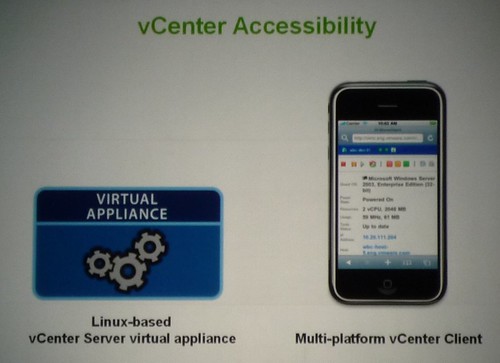
[8.45] Finally. vCenter Server virtual appliance, based on Linux. Applause in the crowd. (That’s what I’ve been telling them for more than 2 years by the way… lv)

Also working multiplatform clients. (iPhone, Blackberry, Mac, Linux)

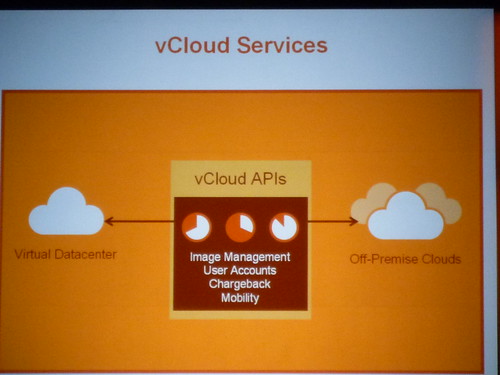
[8.47] Short overview of the vCloud initiative.

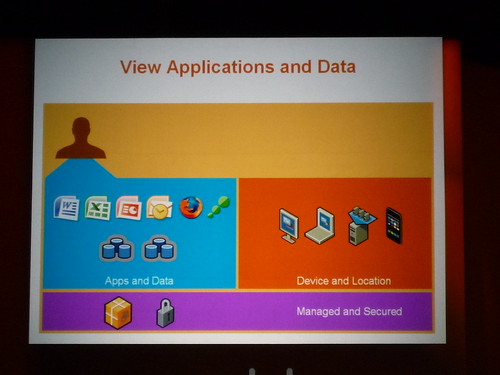
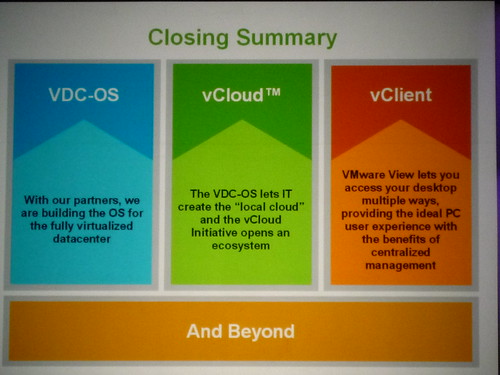
[8.50] Moving to vClient, the VMware View initiative. Apps and Data are no longer tied to physical devices, let alone location. The work “desktop” no longer fits the bill.

Adapting the user experience depending on location, network and device. Announcement yesterday of Teradici collaboration yesterday, for better RDP protocol.

[8.58 ] Repeating VMware has always been focused on the desktop as well. Started with Workstation in 1999, Unity in Fusion and Workstation 6.5, … The better (“fatter”) the client, the richer the experience should be.

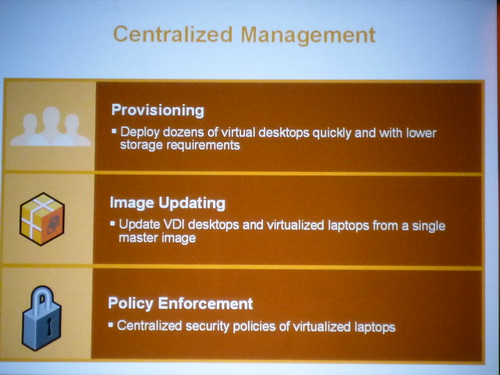
[8.59 ] Desktop management: Provisioning, Image updating and Policy enforcing. Demo of VMware View by Jerry Chen. View composer uses linked clones and templates to quickly deploy virtual desktops.


[9.04] VMware View can also manage physical desktop/laptops (using a “client hypervisor”) to deploy policies or applications. Installing apps by dragging Thinapps on top of VMs. Policies are deployed by modifying the master VM. Demo using Google Chrome. (Deploy app, deploy desktops, revoke access.)

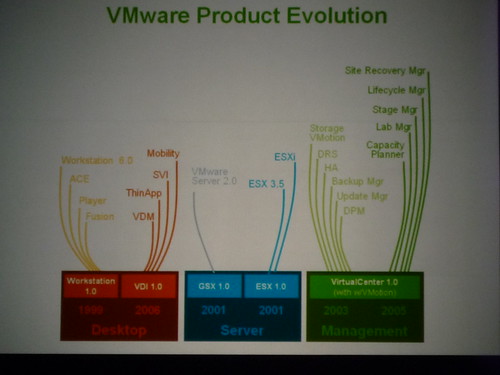
[9.11] Wrapping up with product evolution over the last 10 years, and the next initiatives.


Thanks again for following, that wraps up our live keynote coverage of VMworld 2008.

For more updates, follow me on Twitter, my site Lodev.name or contact me on LinkedIn

Filed Under: News Tagged With: vmware vmworld keynote liveblog

Ladies and Gentlemen, Place Your Bets on Citrix/Microsoft News Friday Or Listen To This (Direct) VMware Customer

September 17, 2008 by Toon Vanagt 2 Comments

At the VMworld Press & Analyst Event in the panoramic Ghost Bar, we took a good look at the skyline of Las Vegas. After a few cocktails we ran into Aaron Andrews, Director Distributed Systems Windows at First American who was very open in sharing his extensive virtualization experience and expressed his personal views. Even without the drinks, this was quite a refreshing experience after a long day of corporate lingo and marketing speech in the VMworld exhibition booths.

A few notable quotes:

Education is the toughest business in any virtualization project.

Getting users to understand that it is not their hardware, but ours. They are using it as a ‘unit of consumption.

Break the barriers between all the disciplines, such as security, networking, storage, virtualization windows, Linux…

We looked at everybody: KVM, Xen, Microsoft and VMware. We choose to standardize on VMware about ten months ago. We selected them, because there is somebody I can call. At that point Microsoft answered: ‘what are you talking about’…

At VMware, there is always somebody I can call: ‘you guys are in trouble, I am gonna kick your ass’…They are very responsive to that…. That is also why Microsoft and VMware are finally in that Server Virtualization Validation Program (SVVP) together.

We had our challenges over the years with VMware vSwitch and now with the Cisco releases I can ask what is going on to Cisco.

Multi-platform VM migration is missing it the Virtualization vendor offering, despite OVF, being released.
Déja vu: The new mainframe is back…

By the time it got completely dark, Aaron’s bold statements had attracted the attention of Mike Mitsch, the general Manager of the NEC Enterprise Servers – IT Platform Group. Being in Las Vegas their discussion ended in a bet on a much speculated announcement regarding Citrix and Microsoft this Friday. Mike Neil at Microsoft can be reassured that Mike Mitsch chooses his side…
The bookmakers in Sin City are ready and so are we. Where do you put your money?

Filed Under: News

The Virtual Infrastructure Evolves Into The Virtual Datacenter OS

September 16, 2008 by Lode Vermeiren 3 Comments

More and more details on what VMware calls the “Virtual Datacenter OS” are starting to come out of VMworld. The new CEO, Paul Maritz, is expected to elaborate on this new strategy in today’s keynote. (update: check our live blog coverage)

(Update 2: also check the coverage on Between The Lines and Virtually Speaking, both ZDNet blogs)

The VDC-OS is not a new product per se, but an umbrella name for a set of products and features, much like VMware Virtual Infrastructure is composed of ESX server, VirtualCenter and features like DRS, HA and VMotion.

VDC-OS is a natural evolution from the “virtual infrastructure” approach, which no longer only includes the virtualization servers and their shared storage and networking, but also the “next layer” in the virtualization stack, both upwards and downwards: VDC-OS no longer stops at the guest OS level, but provides application services as well, and in the other direction goes beyond the local network and is aware of the bigger picture.

The building blocks that make up VDC-OS will sound very familiar to beta testers of ESX 4.0 and technology partners. They include some new features, recent acquisitions and better integrated versions of the current product line-up, as well as third-party add-ons bearing the VMware Ready logo. All of these are called “vServices”.

The three big areas of vServices VMware identifies are:

  • Application vServices – Availability, Security, Scalability
  • Infrastructure vServices – vCompute, vStorage, vNetwork and vCloud
  • Management vServices – vCenter (the new name for VirtualCenter)

The new and current features in depth:

Application Services
Availability:

  • HA, VMotion, Storage VMotion, NIC/HBA teaming
  • VMware Fault tolerance, formerly known as “Continuous availability” – which allows a VM to run on two hosts simultaneously, using lock-stepping of CPU instructions. (new)
  • vCenter Data Recovery – built-in disk-based backup and recovery of VMs and the files within them, including data deduplication. (new)

Security

  • ESXi, a stripped-down hypervisor in only 32 MB of code, to reduce the attack surface
  • VMware vSafe (first announced at VMworld Europe), with third party support add-ons from IBM, Checkpoint, Radware and McAfee, who will announce their first products today (new)

Scalability

  • DRS
  • Hot add of virtual CPU, memory and PCIe devices like network adapters (new)
  • Very large VMs with 8 virtual CPUs and 256 GB of RAM (new)

Infrastructure Services

vCompute

  • CPU/Memory optimization with hardware assists, page sharing and memory ballooning
  • DRS
  • VMDirectPath – enabling wirespeed network access to VMs (new)
  • Paravirtualized SCSI – providing more iops per second at lower latency (new)

vStorage

  • VMFS
  • Linked clones (first demonstrated at VMworld 2007 in San Francisco) – allows multiple VMs to run from the same base disk (new)
  • Storage VMotion
  • Thin Provisioning (new)
  • APIs to closer work together with storage arrays (new)

vNetwork

  • more offload technologies to reduce virtualization overhead
  • Distributed vNetwork virtual switches (new)
  • Third-party virtual switches – the first one to be announced today by Cisco (new)

Cloud Services (vCloud)

  • VMotion and Storage VMotion (within the “internal cloud”)
  • VMware vCloud (new)
  • Network vMotion – preserving network and security policies when a virtual machine is being migrated (new)
  • vApp – an encapsulation of a VM and its policies and service levels, based on OVF (new)

Management

vCenter replaces VirtualCenter, and integrates the add-on products today known as Stage Manger, Lab Manager and the likes. It integrates withing other management frameworks from the likes of IBM and CA.

  • vCenter AppSpeed – performance monitoring and remediation to guarantee service levels. (new)
  • vCenter Orchestrator – to automate repetitive workflows
  • vCenter CapacityIQ – proactive capacity planning for entire VI environments
  • vCenter Chargeback – to allow IT departments or cloud service providers to charge based on VM usage
  • vCenter ConfigControl – called “update manager on steroids” by VMware, a central way to configure and update the virtual data center
  • Host Profiles – to standardize the setup of ESX hosts using templates

Watch out for more announcements by VMware and its partners in the coming hours and days.

Filed Under: Featured, News Tagged With: ESX 4.0, ESX Server, Paul Maritz, VDC-OS, Virtual Datacenter OS, virtualcenter, virtualisation, virtualization, vmware, VMware ESX 4.0, VMWare ESX Server, VMware Virtual Datacenter OS, vmware virtualcenter, VMware vServices, vServices

  • « Go to Previous Page
  • Go to page 1
  • Interim pages omitted …
  • Go to page 154
  • Go to page 155
  • Go to page 156
  • Go to page 157
  • Go to page 158
  • Interim pages omitted …
  • Go to page 240
  • Go to Next Page »

Primary Sidebar

Tags

acquisition application virtualization Cisco citrix Citrix Systems citrix xenserver cloud computing Dell desktop virtualization EMC financing Funding Hewlett Packard HP Hyper-V IBM industry moves intel interview kvm linux microsoft Microsoft Hyper-V Novell oracle Parallels red hat research server virtualization sun sun microsystems VDI video virtual desktop Virtual Iron virtualisation virtualization vmware VMware ESX VMWorld VMWorld 2008 VMWorld Europe 2008 Xen xenserver xensource

Recent Comments

  • C program on Red Hat Launches Virtual Storage Appliance For Amazon Web Services
  • Hamzaoui on $500 Million For XenSource, Where Did All The Money Go?
  • vijay kumar on NComputing Debuts X350
  • Samar on VMware / SpringSource Acquires GemStone Systems
  • Meo on Cisco, Citrix Join Forces To Deliver Rich Media-Enabled Virtual Desktops

Copyright © 2025 · Genesis Sample on Genesis Framework · WordPress · Log in

  • Newsletter
  • Advertise
  • Contact
  • About