
• Skip to primary navigation
  • Skip to main content
  • Skip to primary sidebar
Virtualization.com

Virtualization.com

News and insights from the vibrant world of virtualization and cloud computing

  • News
  • Featured
  • Partnerships
  • People
  • Acquisitions
  • Guest Posts
  • Interviews
  • Videos
  • Funding

Featured

New EMC Virtual Matrix Architecture Good News for Virtual Data Center Storage Scalability

April 15, 2009 by Robin Wauters Leave a Comment

EMC today unveiled a new approach to high-end data storage with an innovative new architecture purpose-built to support virtual data centers. EMC also announced the first storage system based on this architecture, which will serve as a cornerstone of virtual computing infrastructures that are transforming the technology landscape.

The new EMC Virtual Matrix Architecture integrates industry-standard components with EMC Symmetrix capabilities to deliver massive scalability – enabling systems that scale to hundreds of thousands of terabytes of storage and tens of millions of IOPS (input/output per second) supporting hundreds of thousands of VMware and other virtual machines in a single federated storage infrastructure. It is the first storage architecture that combines the performance and efficiency of a scale-up architecture and the cost-effective flexibility of a scale-out architecture. It was designed and built from the ground up to break the physical boundaries of data center storage, incorporates automation to simplify storage management, enables resources to be scaled on demand and uses less energy per terabyte of data stored than traditional high-end storage systems.

Full details about the new architecture and new systems are available here.

The first storage system based on this innovative new architecture is the EMC Symmetrix V-Max system, which is available immediately. It is the world’s largest high-end storage array and uses multi-core processors to lower power costs and improve IOPS per dollar. Combined with the latest generation Enterprise Flash, Fibre Channel and SATA drives, the Symmetrix V-Max system allows users to cost effectively meet the widest range of storage requirements for high performance and high capacity in a single system. It joins the market-leading EMC Symmetrix DMX-4 system and expands EMC’s high-end portfolio. Together they represent the two newest high-end storage architectures on the market today.

The high-availability Symmetrix V-Max Engine at the center of the new system is a flexible building block that features multiple redundant Quad-core Intel(R) Xeon(R) processors with up to 128 GB (gigabytes) of memory and up to 16 host and 16 drive channel connections. The Virtual Matrix Architecture allows Symmetrix V-Max Engines to interconnect and share resources. This enables a Symmetrix V-Max system to scale to 1024 GB (gigabytes) of global memory, with twice as many front-end and back-end connections compared to the industry-leading Symmetrix DMX-4 systems. The ability to interconnect and share resources to easily and linearly scale out is a key customer requirement as virtual machines and applications are dynamically added and shifted.

The Symmetrix V-Max system provides more than three times the performance, twice the connectivity and three times more usable capacity than Symmetrix DMX-4 systems and uses significantly less power per terabyte and per IOP. As part of EMC’s Early Adopter Program, more than 30 of the new systems have already been shipped to customers with some of the world’s largest data centers, including EMC’s own state-of-the-art production data center.

New Automated Management Tools

In virtualized environments, there are significant benefits to consistent and rapid provisioning of storage to multiple physical servers and server clusters. The Symmetrix V-Max system automates storage provisioning, reducing the time and complexity of provisioning by 95 percent. Integration with numerous VMware features enables both server and storage resources to be provisioned on demand, with centralized management, reporting and control. In addition, EMC ControlCenter(R) support for both the Symmetrix V-Max storage system and VMware will increase visibility and automate reporting across the virtual server and storage environments.

In tiered storage environments, Symmetrix V-Max systems enable data to be non-disruptively relocated to different storage tiers and RAID protections, including ultra- high performing Enterprise Flash Drives, traditional Fibre Channel disk drives and high-capacity SATA disk drives based on business requirements. The Virtual Matrix Architecture allows customers to relocate more data in less time and with less impact to overall performance than any competitor, while also maintaining local and remote replication activities to ensure continuous protection for today’s “24 by forever” data centers.

EMC also announced Fully Automated Storage Tiering (“FAST”), its innovative automation technology. Leveraging the Virtual Matrix Architecture’s unprecedented data relocation capabilities, FAST will automate the movement of data across multiple storage tiers based upon business policies, predictive models and real-time access patterns. This will further accelerate the adoption of Enterprise Flash Drives by enabling customers to more effectively leverage Flash performance together with the cost-effective capacities of SATA hard drives for improved return on investment and lower total cost of ownership. This new technology will be available on Symmetrix V-Max systems later this year.

The New Symmetrix V-Max Tiered Storage System

The first new Symmetrix model based on the Virtual Matrix Architecture is the Symmetrix V-Max storage system, the world’s largest high-end storage array, featuring:

  • Up to 128 Intel Xeon processor cores
  • Up to 1 TB (terabyte) of global memory
  • Fibre Channel/FICON/Gigabit Ethernet/iSCSI connectivity
  • Latest generation Flash/Fibre Channel/SATA drive support
  • Scale to 2,400 drives
  • Maximum usable, protected capacity of 2 PBs (petabytes)

Accelerated Data Migrations For Improved Efficiency and Agility

To help customers take advantage of the full capabilities of the new Virtual Matrix Architecture, EMC Global Services introduced a new EMC Migration Suite of tools and services to accelerate migration processes and execute migrations to the new architecture up to 50 percent faster and more efficiently. The EMC Migration Suite leverages comprehensive and unique best practices and EMC E-Lab(TM) interoperability testing to minimize risk, time and complexity.

EMC Proven Solutions for Major Data Center Applications

The unique features of the Symmetrix V-Max systems provide customers with new efficient ways to address the needs of their most critical data center applications, including those from Microsoft, Oracle and SAP. EMC has an initial set of EMC Proven Solutions that help accelerate implementation of VMware, Microsoft, and Oracle applications with Symmetrix V-Max systems, with additional solutions under development. These documented best practices and services from industry experts take advantage of the full capabilities of the new Virtual Matrix Architecture to maximize resources at the lowest possible cost.

Innovative Financing Options

EMC Global Financial Services offers innovative financing options for Symmetrix V-Max systems that can help customers further lower their total cost of ownership.

The Symmetrix V-Max system is generally available today.
Filed Under: Featured Tagged With: data storage, EMC, emc corporation, EMC Symmetrix V-Max, EMC Symmetrix V-Max system, EMC Virtual Matrix Architecture, high-end data storage, Symmetrix V-Max, Symmetrix V-Max Engine, virtualisation, virtualization, vmware

Citrix Debuts Beta Of All New XenServer

April 13, 2009 by Robin Wauters Leave a Comment

According to Virtualization.info, Citrix has just opened the beta program for the next version of XenServer, code-named Project George, which will be entirely free. Citrix says that the beta will be open until the end of this month.

The most interesting capabilities:

  • Active Directory integration. Specify the AD domain to use for authentication by the pool and use your AD credentials to connect to the pool via XenCenter and ssh. You control which AD users/groups are allowed access.
  • Workload balancing. Guest and host performance metrics are used to create star ratings for individual VM placement and balancing recommendations for resource pools to achieve optimal performance.
  • LVHD. Fast cloning and snapshots are now supported on all SR types through integration of our software VHD stack and LVM-based Storage Repositories (SRs).
  • StorageLink integration. CLI-only support for a new StorageLink Gateway SR that adds native standards-based support for HP MSA, HP EVA, EMC Clariion, and NetApp storage arrays over iSCSI and Fibre Channel with automated initiator/fabric/array management.
  • Expanded guest OS support. RHEL 5.3, Debian Lenny, and SLES 11 Linux guests.

Filed Under: Featured Tagged With: beta, citrix, citrix project george, Citrix Systems, citrix xenserver, citrix xenserver 5.1, citrix xenserver beta, project george, virtualisation, virtualization, xenserver, xenserver 5.1

HP Announces Enhancements to its Business Service Automation Software Suite

April 10, 2009 by Robin Wauters Leave a Comment

HP today announced new enhancements to its Business Service Automation (BSA) software suite to help customers better manage and reduce operational costs associated with virtualized data centers.

Enhancements within the HP BSA software suite include updated versions of:

  • HP Storage Essentials, a standards-based storage resource management software, helps customers manage the increased storage requirements of virtualized data centers by optimizing capacity allocation and utilization.
  • HP Operations Orchestration, a run book automation software that automates incident resolution, change orchestration and routine maintenance tasks in the data center. This new release allows customers to reduce operational costs by better provisioning and repurposing servers and storage without service downtime.

HP also launched HP BSA Essentials, an online community and subscription services offering that helps customers maximize the value of their HP BSA software investments.

HP Storage Essentials software helps customers lower costs for managing, visualizing and reporting on heterogeneous storage infrastructure. It can automatically baseline, configure and provision storage resources to match changes in virtual infrastructure. Using HP Storage Essentials, customers have reduced the amount of time required to provision storage by up to 90 percent.

New enhancements to HP Storage Essentials software help customers:

  • Optimize storage capacity allocation and utilization by allowing IT organizations to discover and map VMware hosts to storage and storage area network (SAN) dependencies. This enables IT staff to remove storage from virtual machines that are not being fully utilized, making it available to areas that need it most.
  • Improve storage administration efficiency and reduce task errors by automatically provisioning storage to a VMware hypervisor or guest operating system.
  • Deliver better business service visibility and automated change execution across application, server and storage domains through new integrations with HP Operations Orchestration workflow software and across the HP BSA software suite.

HP Operations Orchestration software saves customers time and money associated with managing routine IT operations by standardizing processes. The software automates incident resolution, change orchestration and maintenance tasks in the data center.

New enhancements to HP Operations Orchestration software help customers:

  • Provision and repurpose additional servers and storage capacity without service downtime through an automated workflow.
  • Reduce virtual server deployment time from hours to minutes through enhanced integration with the HP BSA suite.
  • Manage heterogeneous virtualization technologies with a single solution through new integrations with VMware Virtual Infrastructure, Citrix XenServer and Microsoft Hyper-V.

HP BSA Essentials helps customers maximize the benefits of automation and virtualization. The online portal connects customers to BSA Essentials Subscription Services and the BSA Essentials Community.

  • BSA Essentials Subscription Services provide access to security alerts and updates to regulation policy templates used for compliance auditing. This helps customers reduce risk by assessing and correcting security or policy violations that affect the technology infrastructure.
  • The BSA Essentials Community allows customers to find updated product information, share best practices and get new content, such as virtualization management workflows for HP Operations Orchestration software.

HP BSA Essentials is available now here. Access is available to HP BSA software customers with a current maintenance contract. HP Software Professional Services provides consulting services for BSA software to help customers maximize the value of their BSA virtualization solution.

HP Operations Orchestration and HP Storage Essentials software are available now from HP and select channel partners.

Filed Under: Featured Tagged With: automation software, Business Service Automation, Business Service Automation Software, Business Service Automation Software Suite, Hewlett Packard, HP, HP BSA Essentials, HP Operations Orchestration, HP Storage Essentials, storage resource management software, virtualisation, virtualization

IDC: Virtual Server Management Software Revenues to Reach $2.3 Billion in 2013 Thanks To Large-Scale Deployments

April 10, 2009 by Robin Wauters Leave a Comment

The ramp up of large-scale virtual server implementations around the world will drive tremendous demand for a newly defined competitive market – virtual server management software – for distributed systems (principally Windows, Unix, and Linux platforms), according to new research from IDC.

IDC says the worldwide distributed virtual server management software market had revenues of $871 million in 2008 and will approach $2.3 billion in 2013; a compound annual growth rate (CAGR) of 21.3% over the forecast period.

Additional findings from IDC’s research include the following:

  • Many customers have not yet integrated virtual and physical resource management processes or aligned virtual server management activities with IT Infrastructure Library (ITIL).
  • Over the next five years, the distributed virtual server management software market will evolve and mature, creating significant opportunities for new competitors.
  • A strong spirit of “coopetition” will permeate this market over the next several years.

This study, Worldwide Distributed Virtual Server Management Software 2009-2013 Forecast: A First Look (IDC #217485), presents IDC’s preliminary top-down sizing of the worldwide distributed virtual server management software market in 2008 and a forecast of worldwide growth in this market for 2009-2013. This analysis is IDC’s first sizing and forecast for this emerging competitive market. Only top-line total market data is shown in this study. The study specifically excludes software related to mainframe, storage, network, or desktop virtualization management. Vendor market share data, as well as data for geographic regions, will be provided in subsequent IDC publications.

Filed Under: Featured Tagged With: growth, IDC, mary johnston turner, predictions, research, study, system management software, virtual server, virtual server management, virtual server management software, virtualisation, virtualization

Virtualization Security Startup HyTrust Launches With $5.5 Million In Series A Funding

April 8, 2009 by Toon Vanagt Leave a Comment

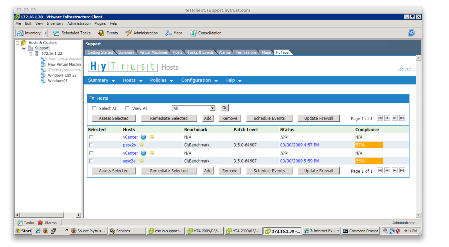
HyTrust is entering the virtualization arena today with HyTrust Appliance, which serves as a central point of control, management and visibility for virtualized environments. The company also announced it’s launching with venture capital backing to the tune of $5.5 million, a Series A funding round which was led by Trident Capital and joined by Epic Ventures.

VirtSec nowadays is less about those familiar ‘pure’ security functions like FireWalls (FW) or Intrusion Detection (IDS), but much more about the configuration control and compliance of virtualized environments. HyTrust claims to provide such centralized control, compliance,directory integration and security – requirements that become mission critical as virtual infrastructures scale up and production applications get virtualized. Readers of this blog, probably already know that in addition to immediate cost savings, virtualization enables a more flexible and dynamic infrastructure that can quickly morph to meet changing needs of any organization.

The fresh HyTrust single point of control seems to be competing with Reflex Virtualization Management Center (VMC),  Third Brigade Deep Security and an established suite of products from Catbird V-Security such as VMShield, HypervisorShield and VMPolicyCompliance. However during our interview with Eric Chiu (CEO HyTrust), he was confident that HyTrust is different by “really focusing on the underlying virtual infrastructure itself. HyTrust authenticates traffic across 5 VMware application interfaces and centrally enforces policies through role based access control. HyTrust single point of control and hypervisor security really ensures what is allowed to happen and what not.” Questioned on the introduction of a yet another single point of failure or potential security flaw, Chiu was confident that HyTrust “is even more secure than VMware vCenter, since our appliance runs on a hardened Linux OS, without command line interface and its use is strictly limited to the provided User Interface.” It goes without saying that known malicious penetration attempts, scans and probes were tested too. Apart form the current exclusive support for VMware ESX, Chiu confirmed to Simon Crosby they would come up with support for Citrix XenServer and also Microsoft Hyper-V later this year. “Our go-to-market strategy started with the VMWare enterprise datacenter customers, but we are already in talk with 3 leading Vmware cloud providers.” When it comes to cloud computing,  Chiu sees 2 main scenario’s. First the ‘internal cloud’-approach (aka located in-house, owned & internally managed by an organization), where HyTrust can provide a purpose built lasso around such corporate cloud environment. The second approach involves external cloud providers (located off-premise & managed by a third party provider) and could still make customers achieve compliance in an easy way by implementing Hytrust as a virtual appliance into that cloud offering.

Due to significantly higher rate of change in virtual infrastructure, automated controls are necessary to ensure that security and operational readiness is on par with that of physical environments. In addition, given the spread of virtualization, companies are now being faced with meeting regulatory compliance of their virtual infrastructure. HyTrust allows enterprises to meet these needs and answer the demands of auditors and their solution was created to proactively address the new challenges presented.

Rather than retroactively building necessary safeguards while sensitive data is put at risk, HyTrust, which has three patents pending, allows organizations to build a manageable virtual infrastructure foundation from the ground up. Additionally, to comply with regulations or security standards such as HIPAA, SOX and PCI/DSS, HyTrust gives enterprises the ability to demonstrate that adequate processes and enforcement controls are in place, configuration changes are consistent, and confidential information is secure. The HyTrust Appliance is the only product that addresses virtualization infrastructure control, including all four requirements outlined.

Backed by positive reactions from 12 trial customers, Eric Chiu is confident that he has gotten ‘at the right place, at the right time with the right solution’.

Pricing for the HyTrust Appliance (Enterprise Edition) is based on the number of protected VMware ESX hosts (on a per CPU/socket basis) and HyTrust Appliance license. Protection license for a 2 CPU VMware ESX host is $1,000; the HyTrust virtual appliance is $3,000; and the physical appliance is $7,500. Maintenance and support is charged on 25% of the annual license basis. HyTrust will soon make available the new HyTrust Appliance: Community Edition —a free virtual appliance available for download via the Web. Due out at the end of April, Community will allow protection for up to 3 hosts and offers an excellent way for smaller companies to bring automated virtualization best practices into their environments. HyTrust launched with a direct customer approach, but was already contacted by integrators and resellers eager to distribute licenses. Hytrust is expected to develop such hybrid distribution model in the third quarter of 2009.

Next to its venture capital investors, HyTrust is launching with an impressive list of technology partners, including VMware, Symantec, Cisco Systems and Citrix Systems.

Filed Under: Featured, Funding Tagged With: Epic Ventures, hytrust, hytrust appliance, HyTrust Appliance Enterprise Edition, Trident Capital, virtual appliance, virtualisation, virtualization

IBM Walks Away From Talks Over Potential Sun Acquisition

April 6, 2009 by Robin Wauters 1 Comment

IBM has withdrawn its $7 billion bid for Sun Microsystems today (Sunday), reports the NY Times, who confirmed the collapse of the talks based on a statement from an unnamed source while several other media, including the Wall Street Journal and ZDNet, were still speculating. The New York Times correctly points out this leaves Sun free to pursue other opportunities for selling itself.

Since last year, Sun executives had been meeting with potential buyers. I.B.M. stepped up, seeing an opportunity to add to its large software business, acquire valuable researchers and consolidate the market for larger, so-called server computers that corporations use in their data centers.

In their talks, I.B.M. and Sun had a contract to deal with each other exclusively. Now, Sun is free to pursue other suitors, including I.B.M. rivals like Hewlett-Packard and Cisco Systems. Cisco recently entered the market for server computers.

It will be interesting to watch the market react to this on Monday morning.

Filed Under: Featured Tagged With: acquisition, Cisco, Cisco Systems, deal, HP, i.b.m., IBM, international business machines, sun, sun microsystems, virtualisation, virtualization

  • « Go to Previous Page
  • Go to page 1
  • Interim pages omitted …
  • Go to page 26
  • Go to page 27
  • Go to page 28
  • Go to page 29
  • Go to page 30
  • Interim pages omitted …
  • Go to page 56
  • Go to Next Page »

Primary Sidebar

Tags

acquisition application virtualization Cisco citrix Citrix Systems citrix xenserver cloud computing Dell desktop virtualization EMC financing Funding Hewlett Packard HP Hyper-V IBM industry moves intel interview kvm linux microsoft Microsoft Hyper-V Novell oracle Parallels red hat research server virtualization sun sun microsystems VDI video virtual desktop Virtual Iron virtualisation virtualization vmware VMware ESX VMWorld VMWorld 2008 VMWorld Europe 2008 Xen xenserver xensource

Recent Comments

  • C program on Red Hat Launches Virtual Storage Appliance For Amazon Web Services
  • Hamzaoui on $500 Million For XenSource, Where Did All The Money Go?
  • vijay kumar on NComputing Debuts X350
  • Samar on VMware / SpringSource Acquires GemStone Systems
  • Meo on Cisco, Citrix Join Forces To Deliver Rich Media-Enabled Virtual Desktops

Copyright © 2025 · Genesis Sample on Genesis Framework · WordPress · Log in

  • Newsletter
  • Advertise
  • Contact
  • About