
• Skip to primary navigation
  • Skip to main content
  • Skip to primary sidebar
Virtualization.com

Virtualization.com

News and insights from the vibrant world of virtualization and cloud computing

  • News
  • Featured
  • Partnerships
  • People
  • Acquisitions
  • Guest Posts
  • Interviews
  • Videos
  • Funding

vmware

Optimize Your Virtual Data Center: Radware Announces VirtualDirector

September 15, 2008 by Robin Wauters Leave a Comment

Radware, provider of integrated application delivery solutions for networking, today announced its new optimization solution for the virtualized environment, VirtualDirector, as part of a larger initiative – Radware’s Business-Smart Data Center strategy – designed to ensure the alignment of key business drivers for the next generation data center.

The core of Radware’s Business-Smart Data Center strategy is providing its customers with tailor-made application infrastructure solutions for next generation data centers to help them overcome IT complexities and ensure cost effective procurement and full investment protection.

The launch of VirtualDirector is the first in a series of announcements that will be made over the next 18 months. VirtualDirector is an optimization solution for the virtualized data center – providing adaptive and dynamic allocation of resources based on business events, to guarantee SLAs and improving response time of applications. VirtualDirector aligns data center operations with business policies by dynamically allocating resources on demand to automatically serve customer’s best needs for SLAs in a virtualized
environment, a key area of investment for companies today. In addition, to save costs, VirtualDirector optimizes the use of data center resources to further generate energy and cooling savings.

Moving forward and with the arrival of more cloud-based services, VirtualDirector’s tight integration with Radware`s ADC solution provides a comprehensive set of features that enable companies to optimize all of their virtualized datacenters, globally. In cases where the local resources cannot provide the desired QoE for specific applications, the solution redirects the traffic of the specific applications to a cloud based service provider or to a secondary data center. By redirecting traffic to a remote location, local resources are freed to serve the rest of the applications while remote resources are utilized, as needed, to add capacity and support the desired QoE.

VirtualDirector, integrated with VMware VirtualCenter, is available now for ordering. Pricing is available upon request.
Filed Under: News Tagged With: optimization, optimization solution, Radware, Radware VirtualDirector, virtual data center, VirtualDirector, virtualisation, virtualization, vmware, vmware virtualcenter

vCloud: VMware To Be Cloud Computing Provider Too, But Inside Your Private DC (And Not Tomorrow)

September 15, 2008 by Toon Vanagt 3 Comments

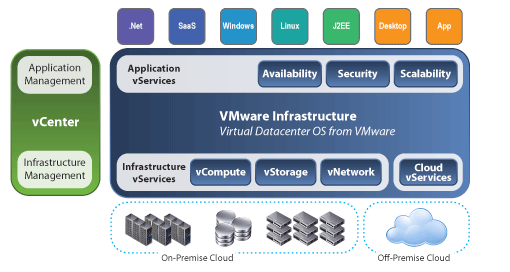
Many of the 14.000 attendants to VMworld will be happy to learn they are not going to be out of their jobs soon. Especially with cloud providers threatening to reduce corporate IT departments, completely virtualized datacenters are believed to be the future. VMware intends to keep those datacenters under their corporate client’s control on standardized X86 hardware.

(Update: link to the ‘Virtual Datacenter OS for VMware‘ product page and its Cloud vServices)

(Update 2: the link to the official press release, more comments below and a mention on Between The Lines)

Will vCloud be introduced as a cure against outsourcing to third party data centers? It is VMware’s aspiration to offer every business the flexible infrastructure associated with Amazon, Google and Salesforce. However without the need to offer excess computing power to external clients. VMware is not alone with this vision as this is very close to the network grail George Kurian at Cisco envisions:

What is most important in the virtualization world is to not to think about your data center as traditional silos of storage, server, network, firewall, application… We need to bring virtualization into the network… If you think about networking speeds and latency getting faster and lower respectively, you can, in essence, really extend virtualization to all aspects of IT systems. Down the road we see the opportunity to drive things like processor virtualization, memory virtualization, as interconnect speeds go up dramatically and latencies reduce over the next two to three years.

VMware’s new CEO Paul Maritz (who was an early believer in cloud computing) will use this vCloud announcement (not a product release) to warm up the 14,000 people expected at its annual conference in Las Vegas this week. According to a well researched article by Patrick Thibodeau over at Computer World:

… the planned cornerstone product is VMware’s Virtual Datacenter Operating System (VDC-OS) for managing the underlying systems, or “internal cloud.” Desktops and laptops are part of this virtualization umbrella, with their operating systems running in a virtual machine on the client computer that is managed back from the data center. VMware also wants to make it possible for IT managers to seamlessly tap into the resources of third-party hosting providers in the same way they can now move server resources inside their data center. It calls this new technology vCloud. VMware’s product set, including its VDC-OS, is limited to x86 architectures. That’s why Bogomil Balkansky, VMware’s senior director of product marketing cited Google as the example of IT’s Parthenon, and not the data center of some other Fortune 100 company. Google has standardized on x86. Most other large companies and many mid-sized firms also have environments that include RISC-based servers, Unix operating systems and midrange systems running Cobol-based applications that have been developed over decades — not on the new systems that Google has bought and built in its 10 short years….
Charles King, an analyst at Pund-IT Inc. in Hayward, Calif., believes VMware’s approach will raise interesting questions for hardware vendors, in particular, about its long-term impact on their products. If all x86 systems are treated as virtual pools, the underlying hardware may be of less consequence, he said.

The initiative has broad support from partners across the industry, including BT, Rackspace, SAVVIS, Sungard, T-Systems, and Verizon Business.

Intel will not be shocked by that conclusion as it will gladly ship those six core processors. Neither will HP be panicking as it has been succesfully integrating its own virtualization suites across multiple platforms (X86, Integrity) and continues to extend its Opsware capabilities. And Sun went open source with its xVM Server as outgrowth of the Xen project that even supports SPARC and Solaris.

We are very curious if “vCloud” as a product name is going to survive the release cycles and the vetting by their marketing department. It also has to be noted that vCloud is specifically intentend to be an Operating System for all aspects of the virtual datacenter. We suggest to rather name it the VDC-framework, as it seems to contain sets of services to be extended in very standardized ways (APIs & SDKs) and no direct interaction with the underlying hardware. The Xen model has proven to be very successful with such ‘extensions’ by third party ISVs.

We could not help to notice that the domain name vCloud.com redirects to VoiceCloud.com, which is powered by that omni-present cloud provider: Amazon Web Services.

VMware’s partners do learn there is some good news to with plenty of room to hook on those new API sets and offer their tools for managing heterogeneous hypervisor environments or as Balkansky boldly puts it:

“Our strategy for now is to provide richer capabilities for our operating systems rather than provide some shallow capabilities for other platforms”.

Update: More interesting links on this VMworld keynote surprise spoiler:

  • Virtual Datacenter OS: official release from VMware
  • VMware’s Virtual Datacenter OS by Scott Lowe
  • VMware Tries to Expand Throughout the Data Center by James Niccolai at PCworld

Filed Under: Featured, News Tagged With: cloud, cloud computing, Cloud vServices, Paul Maritz, vCenter, vCloud, vCloud Initiative, VDC-OS, Virtual Datacenter Operating System, Virtual Datacenter Operating System for VMware, Virtual Datacenter OS, Virtual Datacenter OS from VMware, Virtual Private Data Center, virtualisation, virtualization, vmware, VMWorld, VPDC

Sneak Preview on VMworld 2008 and its artwork (video).

September 15, 2008 by Toon Vanagt 1 Comment

VMworld 2008 under construction
Virtualization.com made it to Sin City. As of tomorrow and after a partner day, over 14.000 fellow Virtualization geeks will start gathering in The Venetian in Las Vegas for the latest vendor news and extensive networking activities. Virtualization.com is most interested in your stories from the datacenter trenches to the desktop victories. So feel free to share those lessons learnt when you see Toon Vanagt passing by with his camera.

We look forward to the real product innovations (is Cisco going to surprise us?). Judging from the amount of PR announcements we received, you can surely bet on a Virtualization product avalanche rolling over Las Vegas next week. VMWare is expected to release/announce ESX v4.0, with plenty of exiting features (continuous availability, alarms on physical hardware faults, 64bit kernel and COS and more). Information overdose guaranteed, especially with absent competitors, trying to spoil the VMware annual party, by hijacking some of that overal media focus on Virtualization.

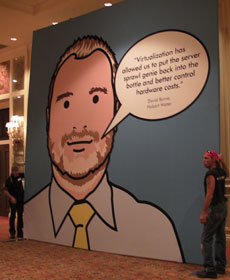
VMware hired the prestigious design agency Cahan & Associates and they came up with edgy creations that underline customer ‘references/quotes’ and are supposed to make us all connect at a very human level. If you are into ‘minimalist cool’ and like the artwork too, you will be happy to learn that you can order your own illustration styled photo at YouAreArt. Simply sent your picture, receive a draft after 2 weeks, give the artist feedback and get an original canvas within another 2 weeks.
For the DIY die-hards or those with graphic insight, there is good news too, as they can easily assemble their own illustration styled avatar at FaceYourManga for free.

VMworld promises to be even bigger than last time (wear comfy shoes!) and all sorts of contractors and vendors are very busy gearing up The Venetian’s many meeting rooms: setting up banners, signs, booths, networks, registration desks, 38 Wifi hotspots, labs, etc…

Try not to spend all your money on the gambling floor, as over 200 exhibitors would like you to buy some of their latest products too 🙂

Here is to a great VMworld 2008 and a lot of fun!

Filed Under: News, Rumors, Videos Tagged With: Artwork, avatar, Face Your Manga, Las Vegas, Toon Vanagt, virtualisation, virtualization, vmware, VMWorld, VMWorld 2008, You are art, YouAreArt

Video interview with Nick Van Der Zweep, Virtualization Director at HP (Part 2/4)

September 14, 2008 by Toon Vanagt 2 Comments

In this second part of our lengthy video interview with Nick Van Der Zweep, Director for Virtualization at HP, we get further introduced to how HP defines virtualization and how it differentiates from its competitors.

Nick also shares what typical Virtualization problems his clients are grappling with and what skill set is needed in IT departments to overcome the pitfalls.

Read the full transcript below, return to part 1 or go ahead to part 3

0:12 HP has one of the most complete virtualization solutions offerings. How are these portfolios integrated?
Nick Van Der Zweep:  That’s really where we started with some of our management software as I mentioned in the Integrity space back in 1999-2000.We had high availability and partitioning and pay-as-you-go and instant capacity in management software and we glued it all together so that we produce one-user interspace to that environment.  Just recently, we announced and started shipping last month Inside Dynamics which takes that software, makes it available to go to Integrity, ProLiant, X86.  One management footprints Systems Inside Manager which is known across the industry as one management software for ProLiant, Integrity, Discovery, fault management and from there it manages all the hypervisors up there, we can…

1:08  Does it do deployment automatically?
Van Der Zweep:  So, we’ve got deployment built in to it so through a WRAP Deployment Packet of deployed into bare-metal and they’re deployed to virtual machines. We support Citrix, VMware, Microsoft and so we took that software that higher level of management software Inside Dynamic VSC which represent VSC in the integrity space and really glued it together. What’s really interesting right now is that we can provide hypervisor-like capabilities even to bare metal machines and that interface brings that all together.  You can’t even tell if you’re working on bare-metal machine versus a VMware hypervisor. You can do moves from moving application from place to place within the infrastructure and whether be bare metal or its using VMware behind the scenes so definitely heavy integrated.
2:05  I’m very interested to know how HP views its competitive landscape in the virtualization industry?
Van Der Zweep:  I think, we are extremely well positioned in the industry to be able to help our customers in the whole virtualization space and then also help HP and our shareholders as well. And because we’ve got the capabilities of covering this from desktop to the data center, we have a huge what we call a personal systems group where we sell desktops, Thin clients, Blade PCs, virtual desktop environments. So we are heavily invested in that side of the technology as well as the server side technology as well.  Storage virtualization, server virtualization, we have a huge multi-billion dollar software organization within HP to deliver infrastructure management, our Opsware/Mercury capabilities are layered on top of that as well.  So, we’ve got a technological portfolio that I think is a number one bar in the industry that anybody looks at.  And then the services portfolio to be able to help customers, architectural data centers, to data center transformations, look at everything from power cooling environmental pieces of the puzzle because that’s comes in to virtualization very quickly as well as you know because we can design the data centers, and as well help people and customers to do installation support and ITIL practice because as you go into a shared environment and now your employees are sharing resources.  Well you better standardize the jobs across the data centers. So the people who are doing server administration are all doing it the same way, not doing it one way for SAP environment and another way for their Exchange environment, because it’s all shared infrastructure.
3:59 Do you think we need a new skill set out there? Now their tasks are merging: for the networking people and security people and storage people. They’re really now have to talk together?
Van Der Zweep:  They absolutely do.  So, there are two things that happen that we focus on that.  I think it’s really happening to the industry. One is standardizing their roles and responsibilities so that and their interlocks so that they can talk to each other.  But then again we do things that simplify the processes, automate the processes.  If you look at the likes of Opsware or even our Blade environment, we added something called virtual connect to our Blade environment putting in a virtual fabric, a virtual back plain.  Now, what we’re able to do with Virtual Connect Blades and Inside Dynamics is move a Microsoft Exchange environment running on one blade through a point and click, move it to another Blade in another enclosure. If you try to do that today within a typical datacenter, you’ve got to call up the server guy to install that on the new Blade.  You have to call the network guy up and have them move the VLAN information from that node to that node and you have to call up the SAN storage guy to say “I’m going to reroute all the SAN in order to make that movement happen”.  Whether or not you have hypervisors or not, you got to set all of these up three people which means a week worth of work.  We can do it point and click everything is automated.  All the steps happened and it’s done.  So, it’s a matter of working better together from a people perspective but also delivering technologies that bust through the processes of the past and automate them as well.
5:43  What are the typical issues that your customers are grappling with today?
Van Der Zweep:  The typical issues that they grapple with today certainly is out of macro level cost, how do we drive down cost agility, how do I be more responsive to the business so that when they say, “Hey I’m one of deploy infrastructure or new application or scale up I want to do that today.  I don’t want to do that in a month,” and then service levels.  People are constantly saying I’m moving towards more of an environment where instead of that it’s just one mission critical system on that one server that keeps the business running, everything is kind of connected together with the applications that we have today, services oriented architectures and such where you’ve got ten or hundreds of pieces of infrastructure that are working in concept which each other and you have to have a high availability to everything and so they are want to get that built in without complex clustering.
6:45  What about the greener side of ITs, there is also a lot of buzz around the green data centers, do you find that your customers –due to boosting energy costs- are looking for for cheap electricity bills and renewable energy sources and are they actually looking at what is this server consuming and if that’s being underutilized to have like lesser power  being consumed?
Van Der Zweep:  Absolutely.  So, we have customers especially in the enterprise based that have data centers that within the next what three, four, five years they do not have enough power to handle the growth where is that they’re having within that environment.  Well, they’d have to build an entire new data centers and that’s cost thing. And they don’t feel good about it from an environmental perspective and the cost that they pay to the utilities.  So they’re concerned about that. So virtualization can help there with the software that I described with Inside Dynamics, what we built into this release is that we’ve put in  the ability to do consolidation and it will automatically come back to you with scenarios. Here is your current scenario, and this is exactly how many kilowatts you’re using per month and you enter into it.  You tell what your rates are, so it says you’re paying three hundred and fifty dollars a month for these systems for energy. And then it comes back and says, “Well here is the new environment consolidated using virtualization.”  And we can actually tell you its hundred fifteen dollars a month is your exact energy cost that you would be paying versus today versus option A or maybe option B or C that was exciting when we were in Barcelona demonstrating this and we had four people deep and four people wide sitting in front of one screen looking at this and one person is going I need you to put in my rates for Sweden and share this because I got to bring this home.  It’s a hot area.

Filed Under: Interviews, People, Videos Tagged With: citrix, Discovery, Hewlett Packard, HP, HP virtualization, Inside Dynamics, Integrity, interview, Nick Van Der Zweep, Proliant, Toon Vanagt, Van Der Zweep, video, video interview, virtualisation, virtualization, virtualization management software, vmware

CiRBA Packages Analysis Templates Comparing Hyper-V and VMware Based Solutions

September 11, 2008 by Robin Wauters Leave a Comment

CiRBA today announced the availability of packaged analysis templates that enable organizations to compare the impact of implementing Windows Server 2008 Hyper-V versus VMware-based virtualization.

Using CiRBA’s analysis, organizations can quickly examine the suitability of each hypervisor for a given environment, understand consolidation ratios, longer term management considerations, and financial returns associated with each platform. CiRBA’s analysis templates for Hyper-V and VMware-based virtualization are driven by specialized Rulesets for each platform in combination with the solution’s advanced utilization analysis.

CiRBA provides cross-platform, multi-dimensional analysis that enables organizations to safely and cost-effectively consolidate heterogeneous environments and maximize efficiency within virtualized infrastructure through dynamic capacity management.

CiRBA’s comparative analysis templates for Hyper-V and VMware provide an opportunity for organizations to leverage vendor agnostic analysis, empirical data, and organization-specific business and technical constraints to determine the optimal solution for any given environment.

As with other Rulesets in the CiRBA product, CiRBA customers can access these new analysis features through CiRBA Central, a central repository of analysis rules that allows organizations to stay up to date on the latest best practices in data center optimization. CiRBA Powered Partners will also have access to these rules in order to help guide their clients through the selection of the optimal technology for their environment.

Filed Under: News Tagged With: analysis templates, CiRBA, Hyper-V, packaged analysis templates, virtualisation, virtualization, vmware, Windows Server 2008, Windows Server 2008 Hyper-V

VMware Fusion Helped CERN Not Destroy The World With Large Hardron Collider Project

September 11, 2008 by Robin Wauters Leave a Comment

VMware has announced physicists at CERN, the legendary European Organization for Nuclear Research and the world’s leading laboratory for particle physics, use VMware Fusion to share Linux-based computer code via VMware virtual machines running on Apple hardware.

Virtual machines created with VMware Fusion are used by the physicists working on the experiments that run on the world’s largest particle accelerator, Large Hadron Collider (LHC). The LHC is the world’s most powerful particle accelerator, producing beams seven times more energetic than any previous machine and around 30 times more intense when it reaches design performance. Housed in a 27-kilometre tunnel, the LHC has operating temperature of 1.9 degrees above absolute zero (-271°C). By studying collisions at higher energies than ever before, physicists will make further progress in understanding the mysteries of how our Universe is made and how it came to be.

With VMware Fusion, physicists use Macintosh hardware to run Linux-based software which links to LHC Computing Grid – a network of more than 150 computing centres with approximately 40,000 CPUs, handling 15 petabytes of new data each year. This Grid, which provides computing power for some of the organization’s most advanced experiments, can be accessed from CernVM, a customized Linux operating system running in a lightweight VMware virtual machine deployed on a range of PC and Mac workstations and laptops.

Filed Under: News, Partnerships Tagged With: Apple, CERN, CERN LHC, European Organization for Nuclear Research, laboratory, Large Hadron Collider, LHC, linux, Macintosh, virtualisation, virtualization, vmware, VMWare Fusion

  • « Go to Previous Page
  • Go to page 1
  • Interim pages omitted …
  • Go to page 31
  • Go to page 32
  • Go to page 33
  • Go to page 34
  • Go to page 35
  • Interim pages omitted …
  • Go to page 69
  • Go to Next Page »

Primary Sidebar

Tags

acquisition application virtualization Cisco citrix Citrix Systems citrix xenserver cloud computing Dell desktop virtualization EMC financing Funding Hewlett Packard HP Hyper-V IBM industry moves intel interview kvm linux microsoft Microsoft Hyper-V Novell oracle Parallels red hat research server virtualization sun sun microsystems VDI video virtual desktop Virtual Iron virtualisation virtualization vmware VMware ESX VMWorld VMWorld 2008 VMWorld Europe 2008 Xen xenserver xensource

Recent Comments

  • C program on Red Hat Launches Virtual Storage Appliance For Amazon Web Services
  • Hamzaoui on $500 Million For XenSource, Where Did All The Money Go?
  • vijay kumar on NComputing Debuts X350
  • Samar on VMware / SpringSource Acquires GemStone Systems
  • Meo on Cisco, Citrix Join Forces To Deliver Rich Media-Enabled Virtual Desktops

Copyright © 2026 · Genesis Sample on Genesis Framework · WordPress · Log in

  • Newsletter
  • Advertise
  • Contact
  • About