
• Skip to primary navigation
  • Skip to main content
  • Skip to primary sidebar
Virtualization.com

Virtualization.com

News and insights from the vibrant world of virtualization and cloud computing

  • News
  • Featured
  • Partnerships
  • People
  • Acquisitions
  • Guest Posts
  • Interviews
  • Videos
  • Funding

virtualization

Replicate Technologies Leaves Stealth Mode

November 10, 2008 by Robin Wauters Leave a Comment

Replicate Technologies is leaving stealth mode today with the launch of its first product, Replicate Datacenter Analyzer (RDA). You can get a free trial here.

Their website says:

RDA enables datacenter administrators to prevent downtime by providing predictive fault identification and prescriptive guidance for fault resolution. Available as an OVF virtual appliance for VMWare Infrastructure 3, you can be up and running in less than 30 minutes.

Key features of RDA 1.0 include:

  • Active Discovery – which deploys virtual appliances to discover and model the combined virtual and physical datacenter systems, assessing the unified infrastructure for configuration fault issues using more than 20 pre-packaged analyses for datacenter security, resiliency and connectivity.
  • Predictive Analysis – which discovers and diagnoses latent issues in the unified datacenter using a catalog of Knowledge Modules that encode best practice and expert guidance for the resolution of identified faults.
  • Resolution Guidance – which delivers expert guidance, based on RDA’s Knowledge Modules, in the form of drill-down analysis which highlights the root problem, in order to quickly identify and prioritize important issues and expedite repair.
  • Knowledge Modules – which includes modules covering Ethernet which can prove security isolation and validate resiliency in physical and virtual environments; Host Configuration for service console firewall, iSCSI NIC and physical cabling; and, VM migration for maintenance mode, hot and cold migration and Distributed Resource Scheduler (DRS) mobility. The catalog of Knowledge Modules will be continually expanded and updated.
Filed Under: News Tagged With: launch, RDA, Replicate Datacenter Analyzer, Replicate RDA, Replicate Tech, Replicate Technologies, Replicate Technologies RDA, stealth, virtualisation, virtualization

VMware Releases ESX Server 3.5 Update 3

November 10, 2008 by Robin Wauters 2 Comments

VMware has released ESX Server 3.5 Update 3. You can the release notes here, and request a free trial here.

Jump right to this section to find out what’s new.

Filed Under: News Tagged With: ESX Server 3.5, virtualisation, virtualization, vmware, VMWare ESX Server, VMware ESX Server 3.5, VMware ESX Server 3.5 Update 3, VMware Infrastructure 3

AMD / Red Hat Pull Off A Live Migration of VMs Across Vendor Platforms

November 10, 2008 by Robin Wauters 1 Comment

AMD, in collaboration with Red Hat, today demonstrated for the first time “live migration” of a virtual machine across vendor platforms. Live migration enables the movement of running virtual machines (VMs) from one physical server to another without disrupting service to the end user, something that, till now, has only been demonstrated across systems based on one vendor’s platforms. Today’s live migration demonstration moves a live VM from an dual socket Intel Xeon DP Quad Core E5420-based system to a system based on the forthcoming 45nm Quad-Core AMD Opteron processor, utilizing Red Hat’s high-performance open source virtualization software. See the demonstration on the AMD Unprocessed YouTube Channel or here.

Update: also, read the blog post from Margaret Lewis (Product Marketing Director at AMD) on the announcement.

Industry interest in live migration has grown as virtualization technology has become more widely adopted. Live Migration of VMs across physical servers is a vital component of data center management that enables IT managers to move VMs as necessary in order to perform tasks such as upgrading or conducting maintenance of a server, balancing the server load and proactively managing the server availability to avoid downtime or lost data. The demonstration illustrates AMD’s approach to an open and collaborative relationship with its partners to meet customer demands.

Filed Under: Featured, Partnerships Tagged With: amd, live migrating, live migration, red hat, vendor platforms, virtual machine, virtual machines, virtualisation, virtualization, VM, VMs

Industry Moves: Tony Asaro Out As Chief Strategy Officer For Virtual Iron

November 10, 2008 by Robin Wauters Leave a Comment

According to Alessandro, Virtual Iron just lost its Chief Strategy Officer Tony Asaro, although it seems he’s remaining a Senior Advisor to the company. We reported on his hiring nearly 8 months ago.

Asaro used to be a senior analyst and consultant for the Enterprise Strategy Group (ESG), in which role he worked as a trusted advisor to technology start-ups, emerging vendors and multi-billion dollar companies.

Sandeep Bhangi, Vice President of Corporate Development & Strategic Alliances, will be assuming his role from now on.

Filed Under: People Tagged With: industry moves, Sandeep Bhangi, strategy, Tony Asaro, Virtual Iron, Virtual Iron Software, VirtualIron, virtualisation, virtualization

VMware Takes Virtualization To Mobile Phones

November 10, 2008 by Robin Wauters Leave a Comment

VMware today announced plans to bring virtualization to mobile phones through the new VMware Mobile Virtualization Platform (MVP), reports The New York Times and plenty of others. Built on innovative technology acquired from Trango Virtual Processors in October 2008, VMware MVP should help handset vendors reduce development time and get mobile phones with value-added services to market faster. In addition, end users will benefit by being able to run multiple profiles – for example, one for personal use and one for work use – on the same phone.

We didn’t know about the acquisition of Trango VP, but we did write about the company before.

“VMware is excited to extend the benefits of virtualization, which we pioneered for x86 hardware, to the mobile phone market,” said Paul Maritz, president and chief executive officer of VMware. “By abstracting the applications and data from the hardware itself, we expect that virtualization will not only enable handset vendors to accelerate time to market but can also pave the way for innovative applications and services for phone users. We look forward to working closely with our partners to bring new mobile solutions to market faster.”

VMware MVP is a thin layer of software that will be embedded on a mobile phone that decouples the applications and data from the underlying hardware. It will be optimized to run efficiently on low-power-consuming and memory-constrained mobile phones. The MVP is planned to enable handset vendors to bring phones to market faster and make them easier to manage.

As NYTimes writes:

You can bet that Intel, an investor in VMware, will back the technology. The chip maker has a new line of mobile device processors sold under the Atom brand.

Filed Under: Featured, News Tagged With: mobile, mobile phones, mobile virtualisation, mobile virtualization, Mobile Virtualization Platform, MVP, Paul Maritz, virtualisation, virtualization, vmware, VMware Mobile Virtualization Platform, VMware MVP

Can We Stop Hyping The Cloud Yet ?

November 5, 2008 by Kris Buytaert 2 Comments

The past six to nine months we’ve seen the rapid invasion of the Cloud, Cloud Computing or a variant including Cloud. We’ve had different Barcamp style Cloudcamps, there are bloggers rebranding their virtualization blog to a cloudblog and there are new aggregators popping that gather all cloudy news.

Now let’s face it, there is absolutely nothing new on the horizon.
The cloud terminology has been coined by the marketing people, you know the weird folks in suits that are a bit uncomfortable at campstyle events, yep those guys. Oh well.. not all of them are like that 🙂

When Amazon had an overstock of machines in the summer of 2002 they launched Amazon Web Services and for a lot of people that was the start of what today they call Cloud Computing. Their Server as a Service , the Elastic Compute Cloud, also known as “EC2”, The idea that you can launch a Virtual Machine somewhere remotely, manage it via an API and Pay As You Use .

So in came the abbreviations, SAAS, Software as a Service, the new business model for a lot of software vendors, PAAS , Platform As A Service, the new service for the ISP’s. And SOSAAS, Same Old Software as a Service

But the strange thing is that the idea wasn’t Amazon’s in the first place.

If you would read the following project description :
“The project is building a public infrastructure for wide-area distributed computing. We envisage a world in which execution platforms will be scattered across the globe and available for any member of the public to submit code for execution. The sponsor of the code will be billed for all the resources used or reserved during the course of execution. This will serve to encourage load balancing, limit congestion, and hopefully even make the platform self-financing.”

You’d think Amazon wouldn’t you ? Wrong bet, The above text is coming straight from the Xenoservers project at the University of Cambridge yes, the project that eventually lead to the development of the Xen Virtual Machine Monitor, on which coincidentally Amazon EC2 is based.

But was this the first form of distributed deployment of user resources. ?
Reuven, Mr Cloud, thinks not ,

Even way back then the criminal syndicates had developed “service oriented architectures” and federated id systems including advanced encryption. It has taken more then 10 years before we actually started to see this type of sophisticated decentralization to start being adopted by traditional enterprises.

So the script kiddies had a whole cloud of dynamically on demand deployable instances of hosts where they could deploy their malware. No Pay As You Go, and certainly no fuzz about which licenses needed to be bought.

Just as in today’s Clouds, on of the reasons why the cloud is getting so popular is that people using it don’t have to think about how many extra software licenses, the biggest part of it’s underlying technology is Open Source, not a non scalable, proprietary platform

The cloud to me is the mix of Virtualization, Scalability, Automation , Open Source, Large Scale Deployment , playing the puppetmaster, and High Availability .. and let it be the Virtualization part and the Management of Virtual environments which I cover for Virtualization.com

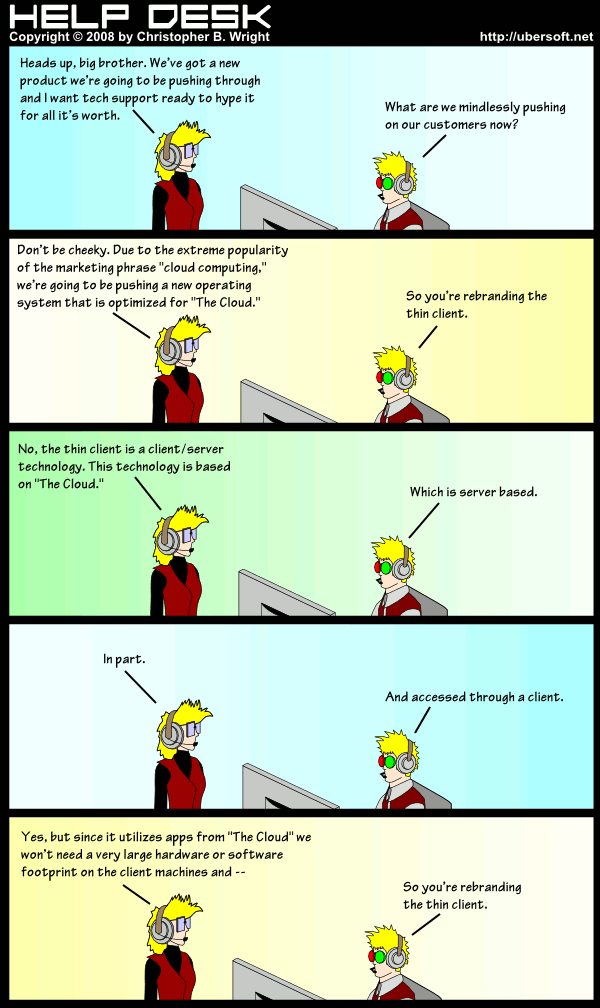
So yes you’ll be reading more cloud news here, as after all part of it is just plain old Virtualization, or SAAS, or Thin Client

Thin Cloud Computing

Filed Under: Guest Posts Tagged With: Amazon EC2, cloud, PaaS, SaaS, sosaas, virtualization, Xen, xenoservers

  • « Go to Previous Page
  • Go to page 1
  • Interim pages omitted …
  • Go to page 69
  • Go to page 70
  • Go to page 71
  • Go to page 72
  • Go to page 73
  • Interim pages omitted …
  • Go to page 206
  • Go to Next Page »

Primary Sidebar

Tags

acquisition application virtualization Cisco citrix Citrix Systems citrix xenserver cloud computing Dell desktop virtualization EMC financing Funding Hewlett Packard HP Hyper-V IBM industry moves intel interview kvm linux microsoft Microsoft Hyper-V Novell oracle Parallels red hat research server virtualization sun sun microsystems VDI video virtual desktop Virtual Iron virtualisation virtualization vmware VMware ESX VMWorld VMWorld 2008 VMWorld Europe 2008 Xen xenserver xensource

Recent Comments

  • C program on Red Hat Launches Virtual Storage Appliance For Amazon Web Services
  • Hamzaoui on $500 Million For XenSource, Where Did All The Money Go?
  • vijay kumar on NComputing Debuts X350
  • Samar on VMware / SpringSource Acquires GemStone Systems
  • Meo on Cisco, Citrix Join Forces To Deliver Rich Media-Enabled Virtual Desktops

Copyright © 2025 · Genesis Sample on Genesis Framework · WordPress · Log in

  • Newsletter
  • Advertise
  • Contact
  • About