
• Skip to primary navigation
  • Skip to main content
  • Skip to primary sidebar
Virtualization.com

Virtualization.com

News and insights from the vibrant world of virtualization and cloud computing

  • News
  • Featured
  • Partnerships
  • People
  • Acquisitions
  • Guest Posts
  • Interviews
  • Videos
  • Funding

OS

Preinstalled Hypervisors And The Future of Operating Systems

March 5, 2008 by Kris Buytaert Leave a Comment

Jay Lyman from The 451 Group (also check out the interview we did with John Abbott, Chief Analyst & Research Director at The 451 Group) wonders about the future of Linux distributions in the virtualization arena.

Now that VMWare announced that it will embed its ESX 3i hypervisor in different server platforms from HP, Dell, Fujitsu-Siemens and IBM, the question pops up how Operating System Vendors will deal with this change of platform.

VMWare certainly isn’t the only one with those plans, since Ian Pratt from XenSource mentionned exactly the same during his Fosdem talk.

How do the OS vendors react to this new feature ? According to Lyman’s blog post, Red Hat claims

it is hardware vendors such as AMD and Intel that will create that standard virtualization layer and capability.

and

Novell indicates VMware may be taking somewhat of a risk, though, since OEMs like HP will look to upsell to their own software to create and manage VMs, which ESX 3i can’t do.

A hypervisor still needs management tools, so that the guest OS’s can be initiated, stopped and migrated. Applications aren’t running on hypervisors (yet); they need an operating system for IO, Memory Management and Network stacks at least for the foreseeable future.

On a longer term, we’ll have applications running natively on the hypervisor for sure. But today Operating System vendors are hoping for a uniform and better way to support different available and upcoming hypervisors and off course those lightweight systems will also benefit from these improvements.

If I were in the Operating System market I wouldn’t worry yet at this pointis , just as with all other features that hardware vendors are selling it is still ‘only’ a feature. When ordering a Dell you can choose between different CPU’s, different hard disks, different Operating Systems and most likely in the near future, different hypervisors as well.

Filed Under: Featured, Guest Posts, People Tagged With: 451 Group, amd, Dell, fosdem, Fujitsu-Siemens, HP, Hypervisor, Ian Pratt, IBM, jay lyman, John Abbott, Novell, operating systems, OS, red hat, The 451 Group, vmware, Xen, xensource

A Look At Cloudo, Another Attempt To Popularize The WebOS

February 22, 2008 by Robin Wauters Leave a Comment

virtualization-cloudo.jpg

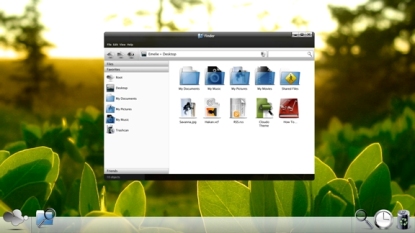
Recently, a new web-based operating systems (WebOS) launched its private beta suite in another attempt to bring the desktop to the browser. Its name is Cloudo, it was made in Sweden and it was previously a part of Xindesk which has now separated itself into two entities, the other being an open widget platform dubbed WidgetPlus.

There are a number of web-based operating systems already on the market, e.g. G.ho.st, Jooce, YouOS, eyeOS and DesktopTwo to name but a few, and Cloudo doesn’t bring a lot of new things to the table yet: it features file hosting, virtual desktop widgets, applications, e-mail and contact management and eventually a full suite of programs you’d expect from a regular desktop OS. You can sign up for the beta here.

virtualization-cloudo-desktop1.jpg

Virtualization may be big in the business market, but is a web-based OS really something consumers are waiting for?

[Sources: Web 2.0 weblog and TechCrunch (trackback)]

Filed Under: News Tagged With: Cloudo, DesktopTwo, eyeOS, G.ho.st, Ghost, Jooce, operating system, OS, virtualisation, virtualization, Web OS, WebOS, Xindesk, youOS

Next Microsoft Virtual Server slips to 2007

March 29, 2006 by Robin Wauters Leave a Comment

Microsoft has delayed an update for Microsoft Virtual Server until early 2007.

Reported by Stephen Shankland at Cnet News.Com in an interview with James Ni, group product manager for server virtualization at Microsoft.

” The Service Pack 1 update to Virtual Server 2005 R2 will include support for two chip features, Intel’s Virtualization and Advanced Micro Devices’ Virtualization, that ease the task. Previously it had been scheduled to arrive in the fourth quarter, but a Microsoft representative confirmed the slip on Tuesday.

The postponement comes on the heels of Microsoft’s delays of Windows Vista and Office 2007. “Quality always takes priority over timeline,” the Microsoft representative said.

Microsoft’s top competitors have suffered similar setbacks. Market leader VMware had planned to release its next top-end ESX Server product, version 3.0, by the end of March but gave itself three more months. The other major competitor, the open-source Xen project, had planned to release its version 3.0 by August 2005 but in fact didn’t release it until December. ”

….

“The beta version of SP1 still is scheduled to arrive in the second quarter, said James Ni, group product manager for server virtualization at Microsoft.

The new version also will include Volume Shadow Services, which lets all a computer’s virtual machines be backed up simultaneously, Ni said. The feature also permits the graceful restart of all those virtual machines, letting customers rely on the software without having to worry as much about the consequences of server failure.

“Basically, it allows us to do a snapshot of all the virtual machines running on a host. Then you can use something like Virtual Server with Data Protection Manager to create good backup and recovery,” Ni said. “You can recover the entire host and all the virtual machines running in a very orchestrated fashion.”

Microsoft faces major competition in the market from EMC subsidiary VMware and increasingly the Xen project that’s being built into forthcoming versions of Suse Linux Enterprise Server and Red Hat Enterprise Linux.

Microsoft is working hard for a piece of the action, however. In December, it cut prices of Virtual Server 2005 R2 from $999 to $199 for the Enterprise Edition and $499 to $99 for the Standard Edition. The Standard Edition runs on servers with up to four processors, while Enterprise is for larger machines.

At the same time, though, market leader VMware is making its own moves. It released its Player software for free, which lets people download and try out virtual machines preconfigured with software, and made its GSX Server product into the free VMware Server. That product competes directly with Microsoft Virtual Server; VMware still charges for its higher-end ESX Server.

Much of Microsoft’s attention is directed toward the future with a successor, the Microsoft hypervisor, code-named Viridian. Virtual Server requires Windows as a foundation, but hypervisors are lower-level software. ESX Server and Xen both employ the hypervisor approach.

One major change coming with Viridian will be support for 64-bit virtual machines, Ni said. That will catch Microsoft up with Xen and VMware, which support 64-bit virtual machines today.

Viridian isn’t likely to debut until 2008 at the earliest, however. It’s designed to work with the upcoming Longhorn Server, a server-oriented version of Windows Vista that’s scheduled to arrive in 2007, but it’s more likely to arrive with a service pack sometime 18 to 24 months afterward, Ni said.

“We’re not committing to whether the hypervisor is part of the initial release or not. Right now, from a scheduling perspective, it doesn’t look like it,” Ni said.

Read the full article at source.

Filed Under: News Tagged With: EMC, intel, microsoft, microsoft virtual server, OS, virtualisation, virtualization, vmware

Microsoft Longhorn Datacenter Server will have no virtualization licensing costs

January 12, 2006 by Robin Wauters Leave a Comment

Today virtualization is expensive for licensing. Microsoft asks people to license every OS installed on virtual machines, even if powered off. But something is changing.

Since the release of Windows Server 2003 R2 Microsoft started approaching a per-use licensing model instead of a per-installation model. So that now Windows Server 2003 R2 Enterprise Edition owners can run up to 4 virtual machines with same OS at no additional costs.

This trend is going be stronger in the near future: the next Microsoft operating system for servers, codename Longhorn, actually in beta, will permit to use infinite virtual machines with same OS onboard at no additional costs, buying the Datacenter edition.
So if you have a performing hardware able to run 100 VMs, you’ll still have to pay just 1 Longhorn Datacenter Server license.

This is what Scott Bekker reported on a Redmondmag December 2005 article.

This move could slighty reduce customers feeling open source competing products (Xen) are a better investment.

Filed Under: News Tagged With: Longhorn, Longhorn Datacenter Server, microsoft, OS, Scott Bekker, virtualization, windows server 2003, windows server 2003 R2, Xen

  • « Go to Previous Page
  • Go to page 1
  • Go to page 2

Primary Sidebar

Tags

acquisition application virtualization Cisco citrix Citrix Systems citrix xenserver cloud computing Dell desktop virtualization EMC financing Funding Hewlett Packard HP Hyper-V IBM industry moves intel interview kvm linux microsoft Microsoft Hyper-V Novell oracle Parallels red hat research server virtualization sun sun microsystems VDI video virtual desktop Virtual Iron virtualisation virtualization vmware VMware ESX VMWorld VMWorld 2008 VMWorld Europe 2008 Xen xenserver xensource

Recent Comments

  • C program on Red Hat Launches Virtual Storage Appliance For Amazon Web Services
  • Hamzaoui on $500 Million For XenSource, Where Did All The Money Go?
  • vijay kumar on NComputing Debuts X350
  • Samar on VMware / SpringSource Acquires GemStone Systems
  • Meo on Cisco, Citrix Join Forces To Deliver Rich Media-Enabled Virtual Desktops

Copyright © 2025 · Genesis Sample on Genesis Framework · WordPress · Log in

  • Newsletter
  • Advertise
  • Contact
  • About