
• Skip to primary navigation
  • Skip to main content
  • Skip to primary sidebar
Virtualization.com

Virtualization.com

News and insights from the vibrant world of virtualization and cloud computing

  • News
  • Featured
  • Partnerships
  • People
  • Acquisitions
  • Guest Posts
  • Interviews
  • Videos
  • Funding

Search Results for: simon crosby

Does Shift happen ?

April 30, 2010 by Kris Buytaert Leave a Comment

Last week’s announcement of RHEL 6 Beta not including Xen anymore probably is the start of a new era in open source virtualization. While the signs were on the wall since RedHat acquired Qumranet it has never been more visible.

The tone has been set …in the same week RedHat announces RHEL6 Beta with only KVM support, Canonical announces 12000 UEC Deployments. UEC is Ubuntu Enterprise Cloud , it’s their Eucalyptus implementation, or should we say integration ?
12000 deployments of UEC sounds like a lot, maybe a bit too much to believe today … ,

It’s probably too early to say that there are more KVM than Xen deployments today (certainly taking into account Amazon’s giant Xen deployments ) , but when talking to different ISP’s and Cloud Vendors you feel that there is a trend towards preferring KVM over Xen.

The biggest argument for KVM today is the fact that you can turn any recent Linux box into a Virtual Machine container with a couple of comands. The fact that KVM is part of the Linux Kernel and doesn’t require you to add extra components to your distibution makes it a lot easier to deploy and validate as opposed to a Xen setup that still needs extra changes and isn’t in the main kernel.

Today main reason why people are still considering Xen in some projects is legacy hardware not having a VT chipset yet … lots of older hardware can be put to good use with the performance that Xen’s paravirtualization brings .

When given choice of KVM / Xen or VirtualBox for their future Open Source virtualization deploymetns, Almost 50% of the people questioned plan on using KVM for their next deployment, as opposed to only about 30% planning to use Xen.

So at first KVM was being ignored, then being laughed at for not being a dedicated hypervisor but being part fo the Operating System .. and now apparently it’s time for the fight … and what a fight .

With much sadness we read Simon Crosby’s FUDitorial about RedHat’s KVM adoption.

When people start calling OEL a “superior enterprise version of RHEL” a red light starts flashing for me , so is Oracle planning to acquire Citrix any time soon ? As the only way to explain Simon talking about RHEL not being available for download and no sources being availble at all, I can think off is that he is already thinking about how to please his next employer.. Simon’s reaction tries to make the RedHat move look insignificant for some, for others it might be the drop that makes them really switch to KVM as it clearly is full of FUD regarding to RedHat

Oracle was betting heavily on Xen, Sun was also putting a lot of effort into xVM, however the Sun xVM effort seems to wander off towards more VirtualBox efforts. Obviously Citrix won’t head towards KVM anyh time soon .. but the big question is .. what will the masses do ?
Filed Under: Guest Posts, News Tagged With: citrix, kvm, linux, Xen, xenserver, xensource

Virtualization Security Startup HyTrust Launches With $5.5 Million In Series A Funding

April 8, 2009 by Toon Vanagt Leave a Comment

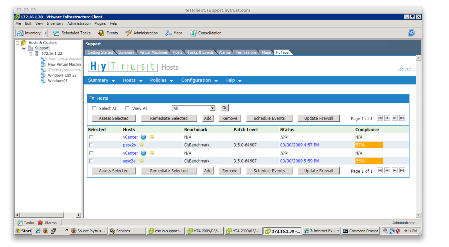
HyTrust is entering the virtualization arena today with HyTrust Appliance, which serves as a central point of control, management and visibility for virtualized environments. The company also announced it’s launching with venture capital backing to the tune of $5.5 million, a Series A funding round which was led by Trident Capital and joined by Epic Ventures.

VirtSec nowadays is less about those familiar ‘pure’ security functions like FireWalls (FW) or Intrusion Detection (IDS), but much more about the configuration control and compliance of virtualized environments. HyTrust claims to provide such centralized control, compliance,directory integration and security – requirements that become mission critical as virtual infrastructures scale up and production applications get virtualized. Readers of this blog, probably already know that in addition to immediate cost savings, virtualization enables a more flexible and dynamic infrastructure that can quickly morph to meet changing needs of any organization.

The fresh HyTrust single point of control seems to be competing with Reflex Virtualization Management Center (VMC),  Third Brigade Deep Security and an established suite of products from Catbird V-Security such as VMShield, HypervisorShield and VMPolicyCompliance. However during our interview with Eric Chiu (CEO HyTrust), he was confident that HyTrust is different by “really focusing on the underlying virtual infrastructure itself. HyTrust authenticates traffic across 5 VMware application interfaces and centrally enforces policies through role based access control. HyTrust single point of control and hypervisor security really ensures what is allowed to happen and what not.” Questioned on the introduction of a yet another single point of failure or potential security flaw, Chiu was confident that HyTrust “is even more secure than VMware vCenter, since our appliance runs on a hardened Linux OS, without command line interface and its use is strictly limited to the provided User Interface.” It goes without saying that known malicious penetration attempts, scans and probes were tested too. Apart form the current exclusive support for VMware ESX, Chiu confirmed to Simon Crosby they would come up with support for Citrix XenServer and also Microsoft Hyper-V later this year. “Our go-to-market strategy started with the VMWare enterprise datacenter customers, but we are already in talk with 3 leading Vmware cloud providers.” When it comes to cloud computing,  Chiu sees 2 main scenario’s. First the ‘internal cloud’-approach (aka located in-house, owned & internally managed by an organization), where HyTrust can provide a purpose built lasso around such corporate cloud environment. The second approach involves external cloud providers (located off-premise & managed by a third party provider) and could still make customers achieve compliance in an easy way by implementing Hytrust as a virtual appliance into that cloud offering.

Due to significantly higher rate of change in virtual infrastructure, automated controls are necessary to ensure that security and operational readiness is on par with that of physical environments. In addition, given the spread of virtualization, companies are now being faced with meeting regulatory compliance of their virtual infrastructure. HyTrust allows enterprises to meet these needs and answer the demands of auditors and their solution was created to proactively address the new challenges presented.

Rather than retroactively building necessary safeguards while sensitive data is put at risk, HyTrust, which has three patents pending, allows organizations to build a manageable virtual infrastructure foundation from the ground up. Additionally, to comply with regulations or security standards such as HIPAA, SOX and PCI/DSS, HyTrust gives enterprises the ability to demonstrate that adequate processes and enforcement controls are in place, configuration changes are consistent, and confidential information is secure. The HyTrust Appliance is the only product that addresses virtualization infrastructure control, including all four requirements outlined.

Backed by positive reactions from 12 trial customers, Eric Chiu is confident that he has gotten ‘at the right place, at the right time with the right solution’.

Pricing for the HyTrust Appliance (Enterprise Edition) is based on the number of protected VMware ESX hosts (on a per CPU/socket basis) and HyTrust Appliance license. Protection license for a 2 CPU VMware ESX host is $1,000; the HyTrust virtual appliance is $3,000; and the physical appliance is $7,500. Maintenance and support is charged on 25% of the annual license basis. HyTrust will soon make available the new HyTrust Appliance: Community Edition —a free virtual appliance available for download via the Web. Due out at the end of April, Community will allow protection for up to 3 hosts and offers an excellent way for smaller companies to bring automated virtualization best practices into their environments. HyTrust launched with a direct customer approach, but was already contacted by integrators and resellers eager to distribute licenses. Hytrust is expected to develop such hybrid distribution model in the third quarter of 2009.

Next to its venture capital investors, HyTrust is launching with an impressive list of technology partners, including VMware, Symantec, Cisco Systems and Citrix Systems.

Filed Under: Featured, Funding Tagged With: Epic Ventures, hytrust, hytrust appliance, HyTrust Appliance Enterprise Edition, Trident Capital, virtual appliance, virtualisation, virtualization

Citrix Open Sources VHD

February 19, 2009 by Kris Buytaert Leave a Comment

Simon Crosby just posted a blog announcing that Citrix is Open Sourcing the VHD support , their implementation of the of the Microsoft VHD virtual hard disk format to the Xen community for inclusion in the open source code base.

VHD is what XenServer uses to store file-based images, and according to Simon this code is considerably more robust and efficient than the qcow implementation that is in the tree today.

Simon lists different reasons for doing this

He states

First the various Xen implementations from the Linux vendors vary wildly in their support for virtual hard disk images, and the performance of their implementations.
Thus far we have yet to see any good implementations of VHD in the Linux vendor category. Cluttering users’ storage with raw image files without any of the benefits of the built-in capabilities for snapshotting, cloning etc that are fundamental primitives in any production virtualization environment, is just a bad idea. ,

Second, since the majority of VMs will be in the VHD format in future, we want to enable the ISV ecosystem to adopt the format and quickly deliver a rich set of add-on capabilities that allow users to be more productive in their virtual environments. VHD is more than just a VM format used by Hyper-V – it’s a delivery format from Microsoft for future versions of Windows. The format is documented publicly and the specification is available under the Microsoft Open Specification Promise program.

And to finish of he hopes the free implementation of the VHD format will accelerate the adoption of Windows in the cloud, I`m wondering how people plan on manage their Licence sprawl, but that’s just me 🙂

So which Virtualization vendor didn’t announce they would be Open Sourcing anything yet this year ? 🙂

Filed Under: News

The Xen of Oracle, or was it the Oracle of Xen ?

December 19, 2008 by Kris Buytaert 1 Comment

The Xen Blog has the news that Oracle joined the Xen Advisory Board.

“Having Oracle join the Xen Advisory Board is a significant milestone for the Xen.org community and Xen hypervisor,” said Ian Pratt, founder of the xen project and Chairman of Xen.org. “With Oracle’s industry leadership and enterprise market experience, the Xen.org community is further strengthened, ensuring a continued leadership position as the open source hypervisor of choice.”

“As a leading contributor to the Open Source community, Oracle is pleased to join the Xen Advisory Board,” said Wim Coekaerts, vice president Linux Engineering, Oracle. “With development projects such as enhancing Oracle Cluster File System 2 with features useful for virtualization, memory management changes with the hcache and hswap projects and integrating the Linux data integrity project into Xen, Oracle continues to focus on enhancing Xen with enterprise-class features.”

Together with Wim “Seklos” Coekaerts , comes Dan “I’ll replace you with a small shell script” Magenheimer, formerly of HP and the leader of the Itanium Xen port as an Oracle Observer, and Kurt Hackel, who leads the Oracle VM dev team.

Throughout 2008, Oracle has already significantly increased its contribution to the Xen.org community, including a focus on the new Xen debugger, a new implementation effort on the Xen API, timer testing, new memory caching algorithms, and updates to support Oracle software running on the Xen hypervisor. These contributions from Oracle are valuable to the Xen customer base as they provide enhancements to the Xen hypervisor’s capabilities in the enterprise and cloud computing space. These features are also important to the development community as the new Xen debugger delivers greater insight into the hypervisor’s state during development testing, allowing for faster bug identification and fixes.

Simon Crosby comments on Oracle earlier involvement “Whereas Oracle Unbreakable Linux is a derivative of Unfakable Enterprise Linux” (in other words, RHEL) the Xen in Oracle VM comes directly from the upstream Xen.org code base, and not via an intermediate distro. This means that Oracle VM tracks the xen.org upstream code base more closely than OEL can track kernel.org. Oracle has already offered a valuable set of set of patches and contributions to the project, and will host the next Xen Developer Summit.”

Simon also isn’t that keen on the way Oracle has been supporting applications within VM’s in the past but hopes that with Oracle joining the Xen Project Advisory board they will learn about the business of partnering from the community and the ISV ecosystem.

Filed Under: Guest Posts, Partnerships, People Tagged With: citrix, linux, oracle, RHEL, seklos, Simon Crosby, unbreakable, unfakable, wim coekaerts, Xen, xensource

Phoenix Technologies Talks Up HyperSpace Hypervisor at IDF

August 20, 2008 by Robin Wauters Leave a Comment

Phoenix Technologies today announced that the first open demonstrations of Phoenix FailSafe, its anti-theft and data protection firmware-based product, and its embedded virtualization platform, Phoenix HyperSpace, are being held at the Intel Developer Forum (IDF) August 19-21, 2008 in San Francisco.

At IDF, Phoenix also unveiled Phoenix MicroCore, Phoenix’s newest BIOS designed for the new Intel Atom processor for netbooks and nettops.

Update: a LinuxWorld keynote given by Simon Crosby unveils that the engine behind HyperCore is actually Xen. The presentation also revealed that other major vendors are using Xen for their upcoming desktop hypervisors.

Phoenix HyperCore is an embedded hypervisor which allows an independent Linux-based operating system called HyperSpace to run specialized core services side-by-side with Windows Vista. The HyperSpace platform provides a unique computing environment called ManageSpace that PC designers and security innovators can use to host remote management and security applications that are available before, during and after Windows boot up and shut down. Operating like self-contained appliances, these embedded applications such as anti-virus and secure browsing provide stronger protection than is currently available on PCs.
We recently wrote that Phoenix is integrating HyperSpace into NEC notebooks as one of the first manufacterers.
Enhanced by Intel based-processors enabling virtualization technologies, Phoenix HyperSpace provides a secure foundation of ’embedded simplicity.’ PC OEMs can now offer highly-efficient, instantly available applications that promise to deliver new levels of security, up-time, system reliability, remote management, and ease-of-use to PC users.
Phoenix Technologies

Filed Under: News

Citrix Aims To Make Creation of Hypervisor-Independent Application Workloads Easier with Project Kensho

July 15, 2008 by Robin Wauters 2 Comments

Citrix today announced “Project Kensho,” which will deliver Open Virtual Machine Format (OVF) tools that allow independent software vendors (ISVs) and enterprise IT managers to easily create hypervisor-independent, portable enterprise application workloads. These tools will allow application workloads to be imported and run across Citrix XenServer, Windows Server 2008 Hyper-V and VMware ESX environments.

Citrix boasts this implementation will solve a multitude of interoperability issues between virtualization platforms while allowing automated provisioning and management of applications, rather than just virtual machines. Users will be able to easily install and use any OVF packaged application workload regardless of which virtualization platform they use – whether it be XenServer, Hyper-V, or ESX.

“XenServer delivers the benefits of fast, free, ubiquitous and compatible virtualization, whether from Citrix, Microsoft or VMware,” said Simon Crosby, CTO of the Virtualization and Management Division, Citrix Systems. “Project Kensho highlights the Citrix commitment to interoperability for virtualization, while maximizing price/performance and richness of features at the virtual infrastructure level.”

The OVF specification was originally co-authored by Citrix and VMware, with contributions from Dell, HP, IBM and Microsoft. The companies then jointly submitted the draft to the DMTF standardization process.

Project Kensho will support the vision of the Citrix Delivery Center product family, helping customers transform static datacenters into dynamic “delivery centers” for the best performance, security, cost savings and business agility. The tools developed through Project Kensho will be integrated into Citrix Workflow Studio based orchestrations, for example, to provide an automated, environment for managing the import and export of applications from any major virtualization platform.

A technical preview of Project Kensho tools is expected to be available for free download in September 2008.

Filed Under: News, Partnerships Tagged With: application workloads, citrix, Citrix Delivery Center, Citrix Project Kensho, Citrix Systems, citrix xenserver, DMTF, Hyper-V, Hypervisor, hypervisor-independent, ISV, Open Virtual Machine Format, ovf, Project Kensho, Simon Crosby, virtualisation, virtualization, vmware, VMware ESX, Windows Server 2008, Windows Server 2008 Hyper-V, xenserver

  • « Go to Previous Page
  • Go to page 1
  • Go to page 2
  • Go to page 3
  • Go to Next Page »

Primary Sidebar

Tags

acquisition application virtualization Cisco citrix Citrix Systems citrix xenserver cloud computing Dell desktop virtualization EMC financing Funding Hewlett Packard HP Hyper-V IBM industry moves intel interview kvm linux microsoft Microsoft Hyper-V Novell oracle Parallels red hat research server virtualization sun sun microsystems VDI video virtual desktop Virtual Iron virtualisation virtualization vmware VMware ESX VMWorld VMWorld 2008 VMWorld Europe 2008 Xen xenserver xensource

Recent Comments

  • C program on Red Hat Launches Virtual Storage Appliance For Amazon Web Services
  • Hamzaoui on $500 Million For XenSource, Where Did All The Money Go?
  • vijay kumar on NComputing Debuts X350
  • Samar on VMware / SpringSource Acquires GemStone Systems
  • Meo on Cisco, Citrix Join Forces To Deliver Rich Media-Enabled Virtual Desktops

Copyright © 2025 · Genesis Sample on Genesis Framework · WordPress · Log in

  • Newsletter
  • Advertise
  • Contact
  • About