• Skip to primary navigation
  • Skip to main content
  • Skip to primary sidebar
Virtualization.com

Virtualization.com

News and insights from the vibrant world of virtualization and cloud computing

  • News
  • Featured
  • Partnerships
  • People
  • Acquisitions
  • Guest Posts
  • Interviews
  • Videos
  • Funding

Search Results for: ovf

Video: Interview Mike Neil, General Manager for Virtualization – Microsoft (VMworld 2008)

February 24, 2009 by Toon Vanagt Leave a Comment

During this interview at the Microsoft booth at VMworld2008 in Las Vegas, Virtualization veteran Mike Neil recalls his past at Connectix, and his involvement with Virtual PC & Virtual Server and more recently his role in the Hyper-V launch. He discussed planned features such as Hyper-V live migration, VM standards and their planned support of the OVF-format.

Mike also explains why the VM formats are so similar between the Xen & Hyper-V-environment. These architectures were both designed with a thin hypervisor in mind, while using the drivers of the parent partition ecosystem (resp. Xen/Linux; HyperV/Windows). A similar hypervisor architecture is used by Sun with Solaris now. VMware on the contrary has always chosen to build the drivers into the larger ESX hypervisor.

Mike looks forward to VDI through RDP & the Microsoft partnership with Citrix, but also mentions the Calista acquisition and the new protocols this add to their VDI stack.

He firmly declines the rumors on an intensified Citrix – Microsoft relationship and gives his point of view on the industry challenge for virtualization licensing metrics (usage based, physical server based).

He also comments on the Vworld keynotes by VMware executives.
If you are in for a little fun,  you might want to watch this video to the very end to meet Virtual Mike after the credits.

Filed Under: News

Video: Interview Simon Crosby, CTO of XenSource – Citrix (VMworld 2008) part 2/2

November 13, 2008 by Toon Vanagt 1 Comment

In this second part of our exclusive video interview recorded at VMworld2008 in Las Vegas, the Citrix XenSource CTO denies that there is more than a ‘fabulous partnership’ between Microsoft and Citrix. In his typical outspoken style, Simon Crosby does not see his competitor VMware take of into the clouds with vaporware. He remains an advocate for open standards and shines his light on Virtualization security issues (aka VirtSec by the insiders).

.
A full transcript of the interview is below and the  first part of our interview can be viewed here.

(00:00) Simon, in the blogosphere there are these ever mounting rumors about Microsoft and Citrix. What can you comment on that relationship. Add Cisco, VMware and you’ve got a complicated puzzle.

It is.

(00:10) It’s intriguing though.  Many people see a lot of interesting things going on there, what can you say about that?

So our partnership with Microsoft is great.  I mean fabulous.  Microsoft makes a ton out of everything of what Citrix does and they give us scale and we basically take the platform, extend its features set. We’ve done this for years.  It turned out to what XenSource was doing in Virtualization with Microsoft, very similar to the traditional Citrix model of working closely with Microsoft to extend the platform and deliver a bunch of features.  So we do that today and so we’re partner in Virtualization for XenDesktop and runs great on Hyper-V, runs great on XenServer and you know, that’s a terrific partnership.  We’ve partnered also in the area of Virtualization generally and interoperability is key. But XenServer in the platinum edition, not generally known, has the ability to run VMs on VMware or Hyper-V or Xen or even bare metal. Okay, so once you’ve taken your VMs and centralized them into a central repository, we can boot them and run them on anything, right?  Which allows us to extend the concept of Virtualization beyond just Xen, to other hypervisors and even bare metal.

(01:23) If we go back to the cloud concept, because that has been buzzing this industry for a few months now.  What I find quite intriguing is that there’s no standards.  Every cloud has its own APIs and with VMware launching its newest product line (vCloud).  It’s not very clear what those APIs are going to look like, nor when we’re going to have them.  Xen is also moving in that direction with CCC or C3 (Citrix Cloud Center).

Yeah, though not from an API perspective. I agree with you that the APIs are an important one and the ABI.  That is compatibility between the enterprises that counts a big deal. The VMware announcement yesterday, the demonstration around the clouds, the big bullet point on Paul Maritz slide was compatibility, okay? Which basically says that every cloud is going to have to buy by VMware.  You know what?  It’s just not going to happen, okay?  So compatibility is an important concern.  It’s really important that enterprise that  adopt Virtualization know that their VMs will run great in their enterprise but also in the cloud and if the only way we can achieve that is if everybody buys VMware, I can tell you the industry is sunk.  That’s not going to happen.  So compatibility is an important consideration.  OVF is a great component of that and I think it gives us a good way of migrating that whole process.

(02:43)  Do you think that the DMTF is a good standards body to also look into APIs that the vendors agree upon from Amazon to Citrix?

(02:50) Simon Crosby:  I’m not so sure about the Amazon guys. You should go out and speak to Werner on that. But in general, you know Amazon is very open to moving towards standard based APIs, kind of an innovator out there. But VMware, to give them credit, is doing a great job in the DMTF.  They really are.  So, I got to tell you that I’m not a fan of LibVirt you know in the Linux world, it doesn’t have strong semantics.  It doesn’t have like a well-defined API or ABI but the DMTF world is moving forward terrifically, yeah very good.

(03:24) Virtualization was a way of abstracting. Now clouds are another way of abstracting?

They are just another hypervisor platform for me.

(03:34) What about an OS.  What would be your definition, VMware is calling it an OS? 

Oh, the data center OS?

(03:42) Interviewer:  How do you define such an OS?  Do you consider it an OS, a framework or an API set?

You know what?  I think it’s vaporware, right?  So let’s be real for a bit, there are several key things that people want to achieve.  They want to achieve greater agility, greater dynamism, and greater security. There are a lot of ways to get there. But defining a data center OS based on a product which has got a single point of failure, isn’t the way to get there.  There are very interesting technologies that one can bring to solve that problem. In general, I don’t think they (VMware) have them.  Now, it differs between enterprises and clouds on how you want to do this. Enterprise IT runs in a very different way than the cloud.  So we know today that NetScalers drives automatically very large files, that is we can use NetScalers sitting in the application hard drive to dynamically move traffic between machines whenever machine fails, between data center whenever data center fails and on the fly bring up new VMs and servers on the basis of need. Because we can watch the application response times and drive the data center in that way.  That is in particular like a kind of cloud architecture. There are some enterprise adopting it. But at data center OS which is built in the management domain out of a bunch of stuff which is really just managing software.  I don’t buy the concept.  It’s an important concept that people start to think about, that is agility and dynamism and data center reintroduce a whole bunch of complexities but it isn’t here yet.

(05:14) Maybe to finish off, you mentioned security?

Yeah.

(05:18) How do you see that involve, it’s one of the major concern of these people.  How do you secure Virtual issues?  How do you make absolutely sure that they can’t break out?

There are three things here, one of them is how do you secure the guests?  How do you secure the hypervisor?  And how do you virtualize the security function generally, okay?  So let’s start. How do you secure the guest?  You know, the basic capabilities of inspecting the traffic, block an I/O, everybody can do that.  That’s straightforward.  VMware took a one step further with VMsafe which allows their plug-in security appliances to inspect the memory of running guests.  The black hat folks just don’t like this approach, okay?  We have an equivalent thing in open source that the big scary moment is if you compromise that interface, you can get hold of any memory of any guest.  It’s really, really scary.  So you have to do better than that, you know. 

But in general, virtualizing the security function is thought very open area and Chris Hoff has a perfect take on this, you know it’s very, very early days and has a ton of work to do.  Moreover is I/O starts to go back into hardware so we just get IOV devices coming.  None of those security appliance gets to look at the traffic anymore, so it’s going to be very interesting.  So all has to get down again.  Securing a hypervisor, we’re absolutely concerned about that.  That is one of our key focuses, I guess VMware is concerned about it.  They have a big code base.  I think one of their big things that they do is they went from you know ESX to ESXi was to ditch the console OS which is a major headache for them.  You know we’re down onto tens of megabytes in software now, generally written onto read-only flash and we focus manically on securing our box, right?  That’s absolutely what we have to do.  Now can we make guest more secured?  Absolutely we can do that and that’s the next big one which is how you can use the Virtualization platform itself and Virtualization to provide greater security for the workload while it’s running and through its life cycle.  So once you separated the software from the server, can I take a guest to walk out of the building without a memory stick?  That’s an interesting question.

(07:31) Simon, I’d like to thank you for the time you’ve given us and for the straight talk and your views on Virtualization and everything around it.  See you.

Filed Under: Featured, Interviews, People, Videos Tagged With: citrix, Citrix XenSource, CitrixXenServer, CTO, interview, Las Vegas, Simon Crosby, video, virtualisation, virtualization, VMWorld, VMWorld 2008, XenEnterprise, xenserver, xensource

Replicate Technologies Leaves Stealth Mode

November 10, 2008 by Robin Wauters Leave a Comment

Replicate Technologies is leaving stealth mode today with the launch of its first product, Replicate Datacenter Analyzer (RDA). You can get a free trial here.

Their website says:

RDA enables datacenter administrators to prevent downtime by providing predictive fault identification and prescriptive guidance for fault resolution. Available as an OVF virtual appliance for VMWare Infrastructure 3, you can be up and running in less than 30 minutes.

Key features of RDA 1.0 include:

  • Active Discovery – which deploys virtual appliances to discover and model the combined virtual and physical datacenter systems, assessing the unified infrastructure for configuration fault issues using more than 20 pre-packaged analyses for datacenter security, resiliency and connectivity.
  • Predictive Analysis – which discovers and diagnoses latent issues in the unified datacenter using a catalog of Knowledge Modules that encode best practice and expert guidance for the resolution of identified faults.
  • Resolution Guidance – which delivers expert guidance, based on RDA’s Knowledge Modules, in the form of drill-down analysis which highlights the root problem, in order to quickly identify and prioritize important issues and expedite repair.
  • Knowledge Modules – which includes modules covering Ethernet which can prove security isolation and validate resiliency in physical and virtual environments; Host Configuration for service console firewall, iSCSI NIC and physical cabling; and, VM migration for maintenance mode, hot and cold migration and Distributed Resource Scheduler (DRS) mobility. The catalog of Knowledge Modules will be continually expanded and updated.

Filed Under: News Tagged With: launch, RDA, Replicate Datacenter Analyzer, Replicate RDA, Replicate Tech, Replicate Technologies, Replicate Technologies RDA, stealth, virtualisation, virtualization

Citrix’s Open Source “Project Kensho” Tech Preview Now Available Under LGPL

October 14, 2008 by Robin Wauters Leave a Comment

Citrix recently announced “Project Kensho,” which would deliver Open Virtual Machine Format (OVF) tools that allow independent software vendors (ISVs) and enterprise IT managers to easily create hypervisor-independent, portable enterprise application workloads.

Well, it looks like Citrix just released the first technical preview of project Kensho under the LGPL license.

Because the tools are based on an industry standard schema, customers are ensured a rich ecosystem of options for virtualization.  And because of the open-standard format and special licensing features in OVF, customers can seamlessly move their current virtualized workloads to either XenServer or Windows Server 2008, enabling them to distribute virtual workloads to the platform of choice while simultaneously ensuring compliance with the underlying licensing requirements for each virtual appliance.

Citrix also announced a partnership with rPath to build and deliver new virtual appliances by assembling Linux packages “like Lego bricks”. The two are working together to allow rPath’s rBuilder to inject OVF virtual appliances directly into Xen-based cloud computing environments, like Amazon EC2. This collaboration will allow Linux and Windows based OVF appliances created on XenServer, Windows Server 2008 Hyper-V or Microsoft Hyper-V Server 2008 to be installed and run in the cloud and managed through their entire lifecycle.

Citrix Systems

Filed Under: Featured, News, Partnerships Tagged With: citrix, Distributed Management Task Force, DMTF, LGPL, Open Virtualization Format, ovf, OVF 1.0, Project Kensho, rBuilder, rPath, rPath rBuilder, Tech Preview, Technical Preview, virtual appliance, virtual appliances, virtualisation, virtualization

VMworld Las Vegas 2008 Coverage (Reports & Videos)

At this year’s VMworld 2008 conference in Las Vegas, Virtualization.com recorded dozens of videos featuring marketing, technical & product managers, executives, company founders and analysts from the virtualization industry. We’ve also attended numerous sessions and did some hardcore liveblogging for some of them.

Here’s an overview of the VMware coverage we’ve posted so far (we’ll keep updating this page until everything gets published):

News coverage & liveblog reports

Our report on the launch of the vCloud initiative from VMware, announced prior to the event.

Liveblogging VMware CEO Paul Maritz’ keynote

More details coming in about the Virtual Datacenter OS (VCD-OS)

Liveblogging VMware CTO Dr. Stephen Herrod’s keynote

Video reports & interviews

An impression of VMworld 2008 and its artwork

A chat with Aaron Andrews, a very direct and honest VMware customer

Our exclusive interview with DMTF president Winston Bumpus on OVF 1.0 and vMan

VMworld 2008 – VMware CTO Dr. Stephen Herrod Keynote liveblog

September 17, 2008 by Lode Vermeiren 4 Comments

After the liveblog of CEO Paul Maritz’s keynote yesterday, we’re here again, ready for the keynote by VMware CTO Dr. Stephen Herrod.

[7.45] The room is filling up already, nice music pumping through the soundsystem. Watch this space for live updates.

[8.03] The keynote starts with a video with customer quotes. First up: Qualcomm.

Hill Air Force Base apparently uses VMware as well, as does eBay. (They actually have a testimonial up at one of the lounges on the Solutions Exchange floor.

Metro Health uses VDI, is very satisfied with the instant access it provides.
Via Health is another healthcare customer, already treating the internal infrastructure as an internal cloud.

[8.06] Dr. Stephen Herrod, CTO, takes the stage.
Stephen Herrod

[8.07] They struggled choosing a name for the VDC OS. They took the name from their customers. The VDC OS is a continuation of the VMware roadmap.

Running through the three infrastructure components. (cpu/storage/network)

vCompute: yesterday Intel migration on FlexMigration / Enhanced VMotion Compatibility

[8.10] Over the past few years, they managed to go up to 4 VCPUs, 64 GB per VM, 9 GB/s network throughput and 100.000 IOPS. Near future: 8 VCPUs, 256 GB per VM, 40 GB/s and 200.000 IOPS.

[8.11] vCompute: bigger resource pools, up to 64 nodes per cluster, up to 4096 cpu cores

[8.12] DPM (Distributed Power Management) becomes more important as resource pools grow and capacity becomes abundant.

Showing a collective 50% savings when running a simulated workload with VMmark.

vStorage: lots of partners for SRM today.

[8.14] vStorage; started with VMFS. Recently: Storage VMotion, coming soon between protocols.

New features: Thin provisioning and linked clones. This is also possible in lots of storage arrays. They want to integrate with this arrays, to take advantage of the better performance of built-in features. vStorage API to make this possible.

[8.16] vNetwork: Attacking network visibility, QOS and scalability. Originally they focused on single servers, then they moved the attention to shared storage. Next up is shared networking.

[8.18] Today: virtual switch, needs to be configured per server. Doesn’t scale configuration-wise. State needs to move around with virtual machines. Answer: vNetwork distributed switch – a vSwitch that spans servers. Configure once, and use on every ESX host.

[8.19] Network vMotion: move the network state along with machines. Open API, making the first third party vSwitch possible: Cisco Nexus 1000V, a vSwitch with Cisco CLI.

[8.20] Moving up to application layer. VMware wants applications to behave better virtually than physically.

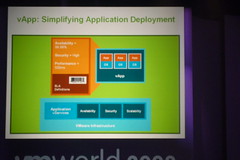
[8.21] vApp containers: Evolution of appliances, based on OVF, supporting multi-tiered applications. Necessary to easily move apps to the cloud.

vApp

[8.22] VMware is “obsessed with availaility”. Protection against planned and unplanned downtime. (VMotion, multipathing, teaming, HA, …) Wrapping this all together is Site Recovery Manager.

[8.23] Unplanned application downtime: VMware Fault Tolerance. (First demoed last year by Mendel Rosenblum, then called “Continuous Availability”)

[8.25] FT demo on stage by Mark Vaughn, customer from First American Corp who’s been using it in beta.

[8.27] Three ESX servers. Machine running on 1st, which is taken down. Keeps running on 2nd, and gets re-protected on 3rd server.

Demoing with jackpot application, powering off server, VM keeps running on second server.
FT demo
Very simple interface. Single click to protect a VM. Technology based on VMotion, called vLockstep.

[8.31] Moving up to Security vServices.

[8.32] All these features need good management. vCenter (new name for VirtualCenter). Fitting together with partner offerings.

Going over the different parts announced monday (see our post on VDC-OS for details.)

[8.37] More details on vCenter AppSpeed, based on Beehive acquisition. Dynamically adjust VM settings to meet QOS requirements. Demo with Asaf Wexler, Beehive founder.

[8.41] Demo of AppSpeed, now integrated with vCenter. Deep analysis of application behaviour, even multi-tiered. AppSpeed detects certain clicks in a web app that lead to database load, adjusting resources for database server as needed.

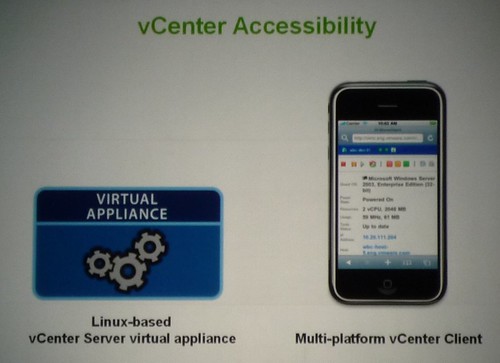
[8.45] Finally. vCenter Server virtual appliance, based on Linux. Applause in the crowd. (That’s what I’ve been telling them for more than 2 years by the way… lv)

Also working multiplatform clients. (iPhone, Blackberry, Mac, Linux)

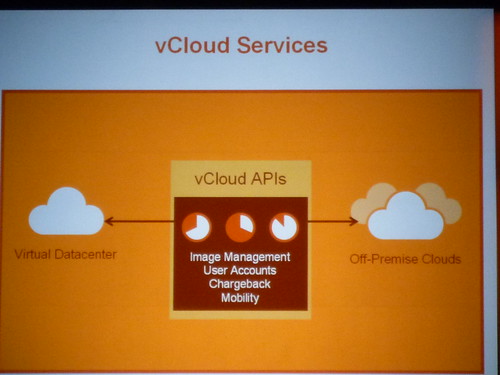
[8.47] Short overview of the vCloud initiative.

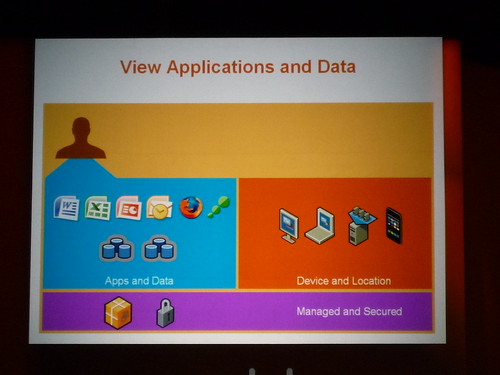
[8.50] Moving to vClient, the VMware View initiative. Apps and Data are no longer tied to physical devices, let alone location. The work “desktop” no longer fits the bill.

Adapting the user experience depending on location, network and device. Announcement yesterday of Teradici collaboration yesterday, for better RDP protocol.

[8.58 ] Repeating VMware has always been focused on the desktop as well. Started with Workstation in 1999, Unity in Fusion and Workstation 6.5, … The better (“fatter”) the client, the richer the experience should be.

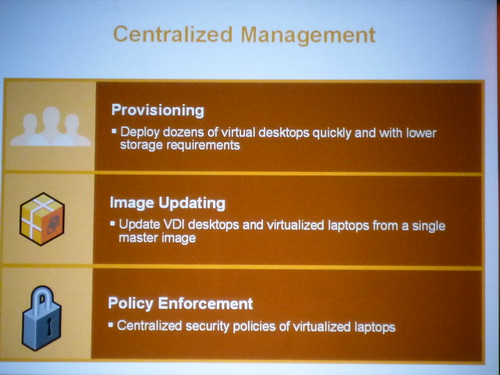
[8.59 ] Desktop management: Provisioning, Image updating and Policy enforcing. Demo of VMware View by Jerry Chen. View composer uses linked clones and templates to quickly deploy virtual desktops.


[9.04] VMware View can also manage physical desktop/laptops (using a “client hypervisor”) to deploy policies or applications. Installing apps by dragging Thinapps on top of VMs. Policies are deployed by modifying the master VM. Demo using Google Chrome. (Deploy app, deploy desktops, revoke access.)

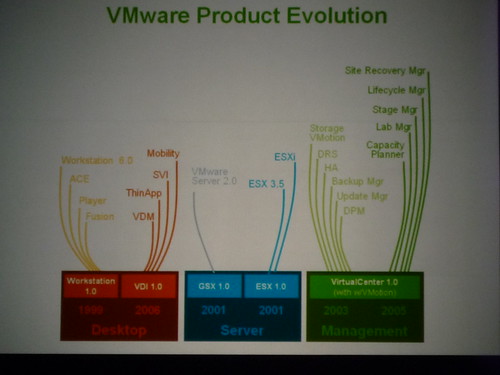
[9.11] Wrapping up with product evolution over the last 10 years, and the next initiatives.


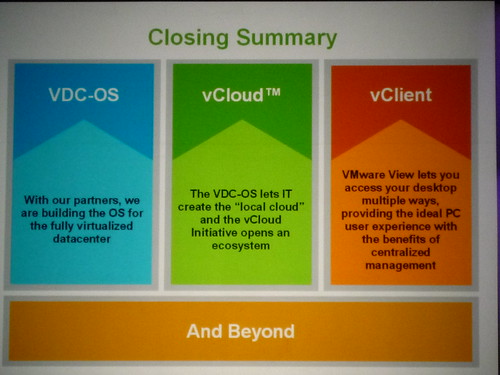
Thanks again for following, that wraps up our live keynote coverage of VMworld 2008.

For more updates, follow me on Twitter, my site Lodev.name or contact me on LinkedIn

Filed Under: News Tagged With: vmware vmworld keynote liveblog

  • « Go to Previous Page
  • Go to page 1
  • Interim pages omitted …
  • Go to page 3
  • Go to page 4
  • Go to page 5
  • Go to page 6
  • Go to page 7
  • Go to Next Page »

Primary Sidebar

Tags

acquisition application virtualization Cisco citrix Citrix Systems citrix xenserver cloud computing Dell desktop virtualization EMC financing Funding Hewlett Packard HP Hyper-V IBM industry moves intel interview kvm linux microsoft Microsoft Hyper-V Novell oracle Parallels red hat research server virtualization sun sun microsystems VDI video virtual desktop Virtual Iron virtualisation virtualization vmware VMware ESX VMWorld VMWorld 2008 VMWorld Europe 2008 Xen xenserver xensource

Recent Comments

  • C program on Red Hat Launches Virtual Storage Appliance For Amazon Web Services
  • Hamzaoui on $500 Million For XenSource, Where Did All The Money Go?
  • vijay kumar on NComputing Debuts X350
  • Samar on VMware / SpringSource Acquires GemStone Systems
  • Meo on Cisco, Citrix Join Forces To Deliver Rich Media-Enabled Virtual Desktops

Copyright © 2025 · Genesis Sample on Genesis Framework · WordPress · Log in

  • Newsletter
  • Advertise
  • Contact
  • About