• Skip to primary navigation
  • Skip to main content
  • Skip to primary sidebar
Virtualization.com

Virtualization.com

News and insights from the vibrant world of virtualization and cloud computing

  • News
  • Featured
  • Partnerships
  • People
  • Acquisitions
  • Guest Posts
  • Interviews
  • Videos
  • Funding

App-V, The “Microsoft Application Virtualization” Formerly Known As “SoftGrid”

June 16, 2008 by Robin Wauters 2 Comments

Microsoft Application Virtualization, the name the software giant has given the app virtualization solution it acquired when it bought Softricity back in 2006, got a new calling name today to match the Hyper-V branding: App-V (instead of SoftGrid).

From the SoftGrid App-V blog:

“Really it only matters to you because from now on we’re going to do our best to stop calling this product SoftGrid and start calling it App-V. Or Microsoft Application Virtualization if we’re feeling formal. This blog will eventually go from being the SoftGrid blog to the App-V blog, the SoftGrid forums will probably become the App-V forums, etc. and I want to make sure all of you are ahead of the curve just so there’s no confusion when you start seeing this name thrown around more and more over time.”

On a sidenote: looking for App-V references, we also found out a German snatched away the app-v.com domain name a few days ago.

[Source: ThinComputing.net]

Filed Under: News Tagged With: app virtualization, App-V, application virtualization, branding, Hyper-V, microsoft, Microsoft App-V, Microsoft Application Virtualization, MSAV, naming, SoftGrid, SoftGrid App-V, softricity, virtualisation, virtualization

VMware Releases Stage Manager 1.0

June 16, 2008 by Robin Wauters Leave a Comment

Almost a month after its original due date, VMware has released Stage Manager 1.0.

From the news release:

With VMware Stage Manager pre-production server sprawl, configuration drift and failed or delayed production releases are a thing of the past. VMware Stage Manager allows IT operations, service administrators and application owners to:

  • Visualize services, system configurations and release processes
  • Transition applications across the stages of the release process with a single mouse click
  • Accelerate the completion of change requests to production systems
  • Reduce server sprawl and resource requirements in pre-production
  • Enforce IT policies and regulatory compliance
  • Create and deploy clones of production systems for patch testing
  • Archive and restore any environment at any stage for auditing purposes.

Download the data sheet (PDF) for more information or try it for yourself by downloading an evaluation copy of VMware Stage Manager.

[Source: Virtual Enthusiasm]

Filed Under: News Tagged With: Stage Manager, Stage Manager 1.0, virtualisation, virtualization, vmware, VMware Stage Manager, VMware Stage Manager 1.0

Scalent Systems Releases Scalent V/OE 2.5

June 16, 2008 by Robin Wauters Leave a Comment

Scalent Systems today announced general availability of Scalent V/OE version 2.5, with enhanced workload and image portability functionality. Scalent claims to be the first company to deliver portability of Windows and Linux server images and associated provisioning of network connectivity & storage access across virtual andphysical machines in real time, without costly and time-consuming conversions.

Scalent Systems

With Scalent V/OE, IT organizations can dynamically provision for average demand and shift available resources as needed, in real time, to match business needs. Specific business systems can be redeployed as dictated by business priorities, time of day, or other policy-based criteria – so less hardware, software, and other resources are needed.

“Our customers consistently reduce their server populations by over 50% without sacrificing performance,” said Ben Linder, CEO of Scalent Systems. “Scalent V/OE allows IT organizations to extend the benefits of virtualization by rapidly provisioning servers, network, and storage at the physical level to quickly react to changing business needs.”

Filed Under: News Tagged With: Ben Linder, image portability, Scalent, Scalent Systems, Scalent Systems V/OE 2.5, Scalent V/OE 2.5, V/OE 2.5, virtualisation, virtualization

Wind River Releases Proprietary Hypervisor For Hardware Virtualization

June 16, 2008 by Robin Wauters Leave a Comment

Wind River Systems, the California, US-based provider of Device Software Optimization (DSO), today introduced a multicore software solution for device development, which aims to help companies solve complex business challenges by taking advantage of multicore processing and virtualization.

Wind River Systems

In connection with today’s announcement, Wind River announced that it will introduce a scalable hypervisor that aims to enable virtualization for devices across a broad range of vertical markets, including networking, industrial and consumer devices. The ability to virtualize hardware allows multiple operating environments to share underlying processing cores, memory and other hardware resources.

Wind River’s hypervisor will incorporate the same design practices and technology that Wind River uses for its products, such as Multiple Independent Levels of Security (MILS). The hypervisor will be tightly integrated with VxWorks and Wind River Linux, and can support a variety of other operating systems. It will be available for early access in August 2008.

Filed Under: News Tagged With: Device Software Optimization, device virtualization, hardware, hardware virtualization, Hypervisor, MILS, multicore software, Multiple Independent Levels of Security, virtualisation, virtualization, VxWorks, Wind River, Wind River Linux, Wind River Systems

VirtenSys and Neterion Demonstrate PCI Express Based I/O Virtualization Utilizing Standard 10Gb Ethernet I/O Adapter

June 16, 2008 by Robin Wauters 1 Comment

VirtenSys has developed the first PCI Express based I/O technology that virtualizes and shares I/O adapters among multiple physical servers without the need for adapter, device driver, or server modifications. The press release touts VirtenSys’ PCI Express I/O virtualization products to dramatically improve I/O utilization to greater than 80 percent; enhance throughput, and reduce I/O cost and power consumption by as much as 50 percent.

Neterion

VirtenSys

As a part of the VirtenSys go-to-market strategy, the company is demonstrating its technology to a number of server and storage Original Equipment Manufacturers (OEMs) and System Integrators (SIs). Later this year, VirtenSys aims to launch products that virtualize and share off-the-shelf Ethernet, Fibre Channel, and SAS/SATA PCI Express based I/O adapters. The products will be available in both rack-mount and blade server form factors.

VirtenSys collaborated with Neterion to provide virtualized 10GbE connectivity. VirtenSys developed, tested, and validated its virtualized I/O technology using the Neterion 10GbE Xframe E adapter. The two companies are working to speed the adoption of I/O virtualization.

Filed Under: News Tagged With: 10GbE, 10GbE adapter, 10GbE connectivity, I/O adapters, I/O Virtualization, Neterion, PCI Express, VirtenSys, VirtenSys Neterion, virtualisation, virtualization

Andrew Kutz Upgrades VMware Infrastructure Plug-in SVmotion

June 16, 2008 by Robin Wauters 3 Comments

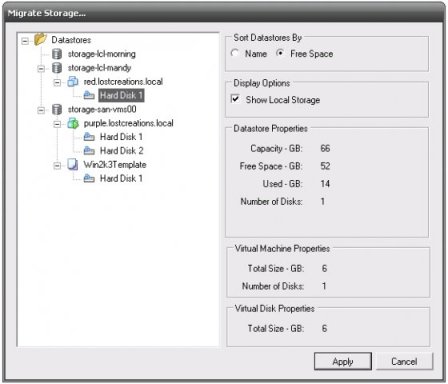
Andrew Kutz, author, developer and one of the leading experts on x86 server virtualization, has released version 1.0 of his populair VI plug-in SVmotion. The plug-in is available at SourceForge and includes new features like:

  • No longer counts RDM files against datastore size, fixing the bug that plagued the last version.
  • SVMotion operations against templates are not supported since VMware does not support them.
  • Added tool tips that explain why a relocation cannot take place
  • Automatically registers itself upon installation so you don’t have to enable it inside the VI client.
  • All SVMotion events write out a log, enabling better understanding of what went wrong in case of an error.
  • Aside from the library that loads the plug-in, all of VMware’s internal code has been replaced with the VI Toolkit for .NET.
  • The project is now supported by almost 20 unit tests, helping to ensure fewer bugs and greater stability.
  • The unit tests can be expanded to include testing for a system-resource supported number of servers since they use mock testing designed to work with the VI Toolkit for .NET.
  • The project is now built using NAnt, which allows nightly builds of the source, creates distributions, and builds the MSI installer.

SVmotion

Update: also read this Virtualization Admin article, and Andrew’s comment on this post.

[Source: VMBlog]

Filed Under: News Tagged With: Andrew Kutz, plug-in, SVmotion, SVmotion 1.0, VI, VI plug-in, virtualisation, virtualization, vmware, VMware Infrastructure, VMware SVmotion, VMware SVmotion 1.0

  • « Go to Previous Page
  • Go to page 1
  • Interim pages omitted …
  • Go to page 302
  • Go to page 303
  • Go to page 304
  • Go to page 305
  • Go to page 306
  • Interim pages omitted …
  • Go to page 371
  • Go to Next Page »

Primary Sidebar

Tags

acquisition application virtualization Cisco citrix Citrix Systems citrix xenserver cloud computing Dell desktop virtualization EMC financing Funding Hewlett Packard HP Hyper-V IBM industry moves intel interview kvm linux microsoft Microsoft Hyper-V Novell oracle Parallels red hat research server virtualization sun sun microsystems VDI video virtual desktop Virtual Iron virtualisation virtualization vmware VMware ESX VMWorld VMWorld 2008 VMWorld Europe 2008 Xen xenserver xensource

Recent Comments

  • C program on Red Hat Launches Virtual Storage Appliance For Amazon Web Services
  • Hamzaoui on $500 Million For XenSource, Where Did All The Money Go?
  • vijay kumar on NComputing Debuts X350
  • Samar on VMware / SpringSource Acquires GemStone Systems
  • Meo on Cisco, Citrix Join Forces To Deliver Rich Media-Enabled Virtual Desktops

Copyright © 2025 · Genesis Sample on Genesis Framework · WordPress · Log in

  • Newsletter
  • Advertise
  • Contact
  • About