
• Skip to primary navigation
  • Skip to main content
  • Skip to primary sidebar
Virtualization.com

Virtualization.com

News and insights from the vibrant world of virtualization and cloud computing

  • News
  • Featured
  • Partnerships
  • People
  • Acquisitions
  • Guest Posts
  • Interviews
  • Videos
  • Funding

News

VMWare’s Newest Blog: Virtual Reality

January 16, 2008 by Robin Wauters 1 Comment

VMWare just announced that it’s adding a new blog on Virtual Reality to its blog network . In its debut post, Mike DiPetrillo touts about the 4 reasons why he switched to VMWare Fusion (other than being a VMWare employee). Here goes the list:

1) Stability. At the core of Fusion is the same engine we’ve been shipping with VMware Workstation since 1998. It’s in its 6th generation and just plain works. I can’t tell you how many times I’ve crashed my machine while running Parallels. For example, here’s a neat trick. Go start up your Windows XP VM in Parallels. Run something that uses a lot of CPU. For me that’s usually running MS Flight Sim. Now, go and suspend the VM. BAM! Crashes every time on several different machines. I’ve got 5 other tests I’ll blog on in the future where Parallels just crashes with simple tasks.

2) Battery Life. Even at idle, Parallels still uses about 15 – 20% of the CPU on my Macbook Pro. My battery only lasts about 1 1/2 hours on the road. Ouch! With Fusion it seems to run much cooler – about 0.5% of the CPU. My battery agrees and usually lasts about 4 hours on a single charge.

3) USB just works. Before switching to the Mac I had a HP Scanjet 7800. Great scanner. When I switched to the Mac and ran Parallels I couldn’t see or use the scanner anymore. There were no drivers for the Mac so I had to go to my really old Epson single sheet scanner I had laying around. Urggh. In comes Fusion to save the day. Right away Windows in a Fusion VM recognized the scanner and I became a much happier person (my wife would agree).

4) Performance. According to the CNET Crave Tests we really perform well. I tend to agree with that. I haven’t done any official benchmarks just yet but things are snappier with Fusion. Just do a search for “vmware fusion performance” and you’ll get several other opinions on the matter which pretty much agree that Fusion is faster.
Filed Under: News Tagged With: blog, blogging, Mike DiPetrillo, Virtual Reality, virtualisation, virtualization, VMWare Fusion, VMWare Workstation

Novell CTO Jeff Jaffe Outlines Technical Strategy for 2008

January 16, 2008 by Robin Wauters Leave a Comment

Jeff Jaffe , Executive Vice President and Chief Technical Officer for Novell, published a blog post 2 days ago outlining the company’s technical strategy for 2008. This is what he had to say about its focus on virtualization:

We see agility and customer focus as key in our progress on virtualization – one of the hottest areas in the industry. In SUSE Linux Enterprise 10, we introduced open source virtualization into a commercial Linux distribution before anyone else did. Once we introduced this, we spoke to customers. We spoke to partners. We spoke to analysts. We spoke to everyone! By listening, we discovered that we had not yet nailed it. In 2007 we listened, and in a very short time we became a leader in virtualization.

Our Open Enterprise Server customers told us that they wanted NetWare virtualized on SUSE Linux Enterprise Server – to take advantage of all of the drivers provided by Linux. And it needed to perform. After all, file and storage performance for NetWare is critical. A unique partnership between our Workgroup team and our Open Platform Solutions team has resulted in virtualization capability in SUSE Linux Enterprise Server 10 SP1 that is higher performance and more manageable than any other open source solution. This is the basis for OES 2.

We talked to other customers. They did not want virtualization as a bare technology. They wanted it to be managed. Novell quickly turned around and built technology to manage workloads and provision virtual machines. ZENworks Orchestrator. The best managed open source virtualization solution.

And we listened to customers and partners some more. They said get a tight partnership with Microsoft to optimize Windows on SUSE Linux Enterprise Server. Build a joint lab for testing – so customers have the confidence that our solution works best with Microsoft. We did all of that!

Here is the totality. From a barebones hypervisor in SUSE Linux Enterprise Server, we now have an industrial strength hypervisor, supporting the demanding NetWare workload, optimized for Microsoft, SAP and others, with a joint lab for testing. It is manageable with ZENworks and will address low latencies.

How did we do this? We listened!

Virtualization clearly is a key topic for the industry, and with the 2007 results we have both staked a claim and demonstrated our agile processes. Look for this to continue to be an area of significant investment in 2008.

Filed Under: News, People Tagged With: 2008, Jeff Jaffe, linux, Novell, OES 2, Open ENterprise Server, SUSE Linux Enterprise 10, virtualisation, virtualization, windows, ZENWorks Orchestrator

VMWare Picks Up Desktop Virtualization Startup Thinstall

January 15, 2008 by Robin Wauters 2 Comments

Virtualization may well be considered non-sexy in some parts , VMWare’s announcement that it is set to acquire Thinstall , a San Francisco-based desktop virtualization technology provider, should be able to change that view. Bringing virtualization to the desktop is a natural evolution that is destined to become a huge opportunity in a thriving market, and Thinstall’s remarkable progress over the past few years have obviously captured the attention of the 30,6 billion $ gorilla, who made the acquisition move for an undisclosed amount.

virtualization-vmware-thinstall.jpg

When you install a Windows program or an upgrade of a previously installed program on your PC, it messes with just about everything, including the registry that stores all of the settings, options, and configuration files for the Windows OS. That, in turn, opens up opportunities for security breaches and vastly increases other headaches for the IT staff who have to deploy software in organizations with lots of PCs. It all makes the idea of software-as-a-service—serving up applications on-demand over corporate networks or the web— look quite appealing. But if companies could give their employees a way to run traditional desktop programs like MS Word and PowerPoint over a corporate network without actually having to install them, they could keep using these powerful programs with less hassle—and might not be so tempted by web-based alternatives like Google Docs.

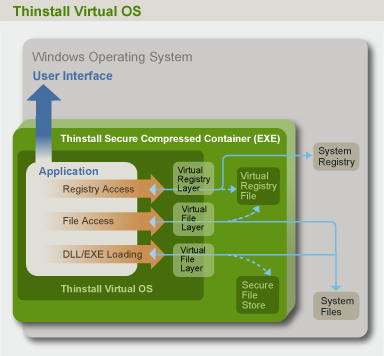
That’s exactly what Thinstall allows. Using its system, companies can create special, compact Thinstall versions of programs like PowerPoint. When a worker accesses one of these executable files over a network, it loads within a virtual operating system that communicates with the resident operating system, but doesn’t modify it in any way. A “thinstalled” application runs in “user mode” only, meaning that the user can start it, but can’t fiddle with the machine’s other settings.

For VMware, this deal pushes them deeper into the software side of virtualization, which is a good thing considering the company’s dominant market share on the server side. To feed that huge market cap, VMware needs to grow. That’s exactly what makes buying Thinstall, an application virtualization product much similar to Microsoft SoftGrid, Citrix’s Application Streaming, or Symantec / Altiris’s SVS technology, a very logical step. The move also follows on the heels of VMware’s purchase of small independent software integrator Propero . The company will likely make additional buys to stay ahead of its competition.

For additional analysis, you might want to give The Brian Madden Company‘s piece a good read.

VMware also disclosed its acquisition of services-related assets from Foedus , a Portsmouth, New Hampshire-based provider of virtualization technologies and services. From the press release:

VMware intends to leverage Foedus’s application and desktop virtualization services expertise to help VMware partners expand their virtualization services business.  Foedus’s remaining assets, including the company’s sales and marketing organizations, were acquired earlier this month by GreenPages Technology, a national, consultative IT solutions provider and VMware Authorized Consultant (VAC) partner.

Filed Under: Acquisitions, News Tagged With: acquisition, application virtualization, desktop virtualization, Foedus, Thinstall, virtualisation, virtualization, vmware

30% reduction to attend Profoss, the European Virtualization Conference in Brussels

January 11, 2008 by Robin Wauters Leave a Comment

As a reader of Virtualization.com you receive a 30% discount to attend the European Virtualisation Conference in Brussel on  22 and 23 january 2008.

Participation to this 2 day event normally costs 290 euros excluding VAT, but is now reduced to 203 EUR ,when you use our promo code VIRTDOTCOM at registration.  Participation for one day only is possible at half this cost. This unique conference is organised by Profoss at the Thon Hotel Brussels City Centre (walking distance from the North Station). Major players will be present such as Sun Microsystems, AMD, HP, Unisys, Oracle, Citrix and Microsoft to name just a few.

Day 1: 22 january 2008: Strategy Day

09:45 Current state and evolution of the virtualisation market by John Abbott
11:00 Virtualization: Shift happens by Tarry Singh
12:00 Lunch break
13:00 Networking and discussion time
13:30 Case study by Kris Buytaert
14:30 Closed and open source solutions: an open discussion. panel
15:30 Coffee break
16:00 The impact of virtualization on the enterprise infrastructure by Duncan Hardie
17:00 The future is in the management tools by Niko Nelissen

Day 2: 23 january 2008: Technical Day

09:30 Integrating virtualization in the OS by Frank Kohler
11:00 Coffee break
11:15 Conform deployment of virtual and physical machines with openQRM and Xen by Matthias Rechenburg
12:15 Lunch
13:00 Networking and discussion time
13:30 Optimal storage platform for a virtualized environment by Kristof De Spiegeleer
14:30 HA clustering made simple with OpenVZ by Werner Fischer
15:30 Coffee break
16:00 Linux-VServer: light-weight and resource efficient OS level virtualization by Herbert Poetzl
17:00 Hardware Acceleration for optimal Virtualized Performance by Mike Kreiten

We hope to meet many of you in real life as we will cover this event on-line.

Filed Under: News, People Tagged With: brussels, conference, european virtualisation conference, event, profoss, reduction, virtualisation, virtualization

Parallels Server Beta program launched

January 10, 2008 by Robin Wauters Leave a Comment

Leopard server virtual machines are now possible in the Parallels Server Open beta launch.

The Parallels Server Beta program, invites you to toss your proverbial hat into the ring and help them get the product ready for shipping. Parallels Server seems packed with lots of great stuff, like:

The ability to run more than 50 different x86 and x64 guest operating systems on any, Windows, Linux and Mac OS X Server. That’s right, this isn’t just a Mac product; its ready to go on just about any server, PC or Mac.

The option to run virtual machines either in lightweight hypervisor mode (similar in implementation to Desktop for Mac) or in the headless mode via a “bare metal” hypervisor. This second option is particularly interesting as it enables VMs to run in parallel (pun intended) without being dependent on a primary operating system

The ability to – for the first time EVER – run Mac OS X Leopard Server in a virtual machine! Yes, you heard right; if you’re a Mac user, you will be able to run Leopard Server in its own VM. Great for testing and development, but also important for Mac Server admins who want to maximize their Xserve hardware.

More information by Ben Rudolph at source.

Filed Under: News Tagged With: Leopard, Leopard Server, linux, Mac OS X, Parallels, Parallels Server Beta, virtualisation, virtualization, windows

Today the future of Virtualization was demoed by VMWare

September 13, 2007 by Robin Wauters Leave a Comment

Over the last few years virtualization became a mainstream tool for IT administrators looking to consolidate applications within a data center and continues to be adopted as companies expand the technology to plan for business continuity and create high-availability servers.
At the same time virtualization becomes more available in desktops and mobile devices, where the increased flexibility allows businesses and consumers to reduce costs and increase security.

At VMware’s conference in San Francisco today, their chief scientist Mendel Rosenblum demoed an impressive step ahead in raising the high-availability capabilities of Virtualization technology.

Dr. Mendel RosenblumRosenblum saw the future of Virtualization and named it continuous high availability

He demonstrated two servers running Microsoft Exchange Server being replicated in real time from one virtualization host to another. The primary server on stage that was running the equivalent of 50 users pounding on Microsoft Outlook. The server’s ongoing activity was being mirrored on a secondary server, which was receiving a live stream of events as they were entered into the log of the virtual machine on the first server.

Through a new twist on VMware’s management software, Virtual Infrastructure 3, he unplugged the primary machine, and the second detected a failure and shifted handling the users to the secondary server. Since this secondary server was already receiving a stream of log events, it could pick up at the precise point where the other had left off. The pause between one virtual machine stopping and the secondary server’s virtual machine starting appeared to be about a second.  This is basically extending to memory and input devices interaction what is applied to storage data with continuous data protection (CDP) solutions well-known in the security industry. Read the above twice and show of your knowledge of the latest acronym to your tech-savvy friends and explain what CHA or “continuous high availability” stands for in Virtualized environments.

“Ultimately, virtualization will bring about a vision that server makers years ago presented–a dynamically adjusting, self-managing data center…since this approach works not for a few select applications but for anything that runs in a VMware virtual machine! By adopting an approach in between streaming and software-as-a-service, the application starts to run after about 10% of the download occurs, making virtualized applications more palatable to end users…What we’re effectively doing is taking things that were statically assigned in the past and turning them over to a piece of software that makes decisions about how to schedule it. We’re moving toward this idea of a data center that really manages the hardware itself.” Rosenblum added.
Although this much applauded technology is far from being shipped to their customers, VMware seems to have set another milestone in the Virtualization history.
Detailed reports of his keynote are written by the editors Stephen Shankland, Charles Babcock  and industry blogger Alessandro Perilli.

Filed Under: News, People Tagged With: IT administration, Mendel Rosenblum, Microsoft Exchange Server, Virtual Infrastructure 3, virtualisation, virtualization, vmware

  • « Go to Previous Page
  • Go to page 1
  • Interim pages omitted …
  • Go to page 233
  • Go to page 234
  • Go to page 235
  • Go to page 236
  • Go to page 237
  • Interim pages omitted …
  • Go to page 240
  • Go to Next Page »

Primary Sidebar

Tags

acquisition application virtualization Cisco citrix Citrix Systems citrix xenserver cloud computing Dell desktop virtualization EMC financing Funding Hewlett Packard HP Hyper-V IBM industry moves intel interview kvm linux microsoft Microsoft Hyper-V Novell oracle Parallels red hat research server virtualization sun sun microsystems VDI video virtual desktop Virtual Iron virtualisation virtualization vmware VMware ESX VMWorld VMWorld 2008 VMWorld Europe 2008 Xen xenserver xensource

Recent Comments

  • C program on Red Hat Launches Virtual Storage Appliance For Amazon Web Services
  • Hamzaoui on $500 Million For XenSource, Where Did All The Money Go?
  • vijay kumar on NComputing Debuts X350
  • Samar on VMware / SpringSource Acquires GemStone Systems
  • Meo on Cisco, Citrix Join Forces To Deliver Rich Media-Enabled Virtual Desktops

Copyright © 2025 · Genesis Sample on Genesis Framework · WordPress · Log in

  • Newsletter
  • Advertise
  • Contact
  • About