
• Skip to primary navigation
  • Skip to main content
  • Skip to primary sidebar
Virtualization.com

Virtualization.com

News and insights from the vibrant world of virtualization and cloud computing

  • News
  • Featured
  • Partnerships
  • People
  • Acquisitions
  • Guest Posts
  • Interviews
  • Videos
  • Funding

Kris Buytaert

Kemari v1.0 Released

December 6, 2008 by Kris Buytaert Leave a Comment

Last month,TAMURA Yoshiaki from the Kernel Group , OSS Computing Project at the NTT Cyber Space Labs announced the availability of Kemari on the Xen Devel mailing list.

Kemari is an open-source virtual machine synchronization mechanism for fault tolerance. It’s similar to Remus which we covered earlier.

Kemari tries to achieve a fault tolerance setup that does not
require the use of specific hardware or modification of applications.
Kemari aims to keep VMs transparently running in times of hardware
failures. It transfers the state of the primary VM to the secondary
VM when the primary VM is about to send an event to devices such as
storage and networks.
In short it is trying to real time mirroring of Virtual Machine instances.

The, source (Kemari has been released under the GPL) , documentation and different presentations including a Video running both a Linux and Windows demo are available at the Kemari Website

Kemari is listed on Xen Product Roadmap, and is asking for reviews and comments from the community.

We already mentionned Remus in earlier posts here at Virtualization.com and it seems the the Kemari and Remus project are planning to merge in order to to propose a better solution for Xen 3.4 together.
Filed Under: Guest Posts, Videos Tagged With: HA, kemari, open source, opensource, remus, virtualisation, virtualization, Xen

openQRM 4.2 Released, Includes Cloud Sauce

November 16, 2008 by Kris Buytaert 1 Comment

Matt just let us know that he released openQRM 4.2 into the wild. This new opensource openQRM release includes VMware ESX and Citrix XenServer support, a Puppet plugin and the Cloud Add-on.

This new version comes with additional support for VMware ESX, an integration with Puppet for automated configuration management, improvements for the high-availability mechanism and, last but not least, a Cloud-plugin.

This new Cloud-plugin provides a fully automated private cloud with a separated Cloud portal for external data-center users to submit their requests to. The Cloud-plugin features a complete automated provisioning cycle including automatic deprovisioning, Deployment of phyiscal and virtual machines from different virtualization types, P2V, V2P, V2V, P2P, “Clone-on-deploy” and a billing system.

So with openQRM you can deploy and manage any machine inside and outside your firewall. Need that extra CPU load for a weekend on Amazon, fine openQRM will manage it for you.

openQRM is probably the first management tool that integrates both traditional Physical and Viritual Datacenter deployment and provisioning technologies and Cloud deployments all from 1 console , It allows you to migrate back and forth between different deployment types. So you might be running your test servers in the cloud and when you go live migrate them to a physical location within you firewall. openQRM even integrates a billing infrastructure, an administrator can hand out CCU Cloud Compute units to his openQRM users and they then can use resources in the Cloud for that budget.

John Willis said earlier this week in one of his podcasts that that the combination of openQRM , Puppet and Eucalyptus could be the dream combination that makes Datacenter management easier than ever.
Two third is done.. the final step might not be far away..

Did we mention it was Open Source ?

Go get openQRM here or watch the screencast for more information on the Cloud features.

Update: Matt just let us know the new openQRM.com is now live !

Filed Under: Guest Posts, News Tagged With: CitrixXenServer, eucalyptus, matt rechenburg, openqrm, VMware ESX

The End of Neverland, What Neverland ?

November 14, 2008 by Kris Buytaert Leave a Comment

Stop the presses, RedHat and AMD just announced the end of Neverland.

The big News seems to be that RedHat and AMD managed to do Live migration of a virtual machine between 2 different CPU Vendors.

Now given my age and my starting alzheimer, LinuxKongress 2005 in Hamburg seems like ages ago,
As a speaker giving my Automating Xen Deployments talk early on the first conference day , I flew in the day before the conference and I needed some network connectivity so I sneeked into Ian Pratt’s tutorial about Xen. I remember sitting between Heinz Mauelshagen and my colegue Peter Leemans, Heinz was playing with SMP guests on a non SMP host and tried to figure out the limits.

If I recall correctly at the end of his session Ian was explaining Live Migration and demoing it by migrating a small virtual machine around between laptops of people in the front rows of the audience , Laptops from different architectures and from there started a discussion about CPU feature checking.

I asked around and some people actually remember parts of the discussion and the demo.

So for me , when RedHat and AMD claim today they have achieved in something new that was Never going to be implement they are either focusing on nitty details, like migrating from 2 brand new CPU’s to each other and forgetting the fundaments already existed for ages or just trying to get some positive news out of the door. In which they succeeded.

But I`m looking out for the next step in virtualization , not just mashups of things we’ve all been doing before, or things that are really similar to existing things.

Filed Under: Guest Posts, News Tagged With: amd, Ian Pratt, kvm, linuxkongress, marketing, RedHat, virtualization, Xen

Can We Stop Hyping The Cloud Yet ?

November 5, 2008 by Kris Buytaert 2 Comments

The past six to nine months we’ve seen the rapid invasion of the Cloud, Cloud Computing or a variant including Cloud. We’ve had different Barcamp style Cloudcamps, there are bloggers rebranding their virtualization blog to a cloudblog and there are new aggregators popping that gather all cloudy news.

Now let’s face it, there is absolutely nothing new on the horizon.
The cloud terminology has been coined by the marketing people, you know the weird folks in suits that are a bit uncomfortable at campstyle events, yep those guys. Oh well.. not all of them are like that 🙂

When Amazon had an overstock of machines in the summer of 2002 they launched Amazon Web Services and for a lot of people that was the start of what today they call Cloud Computing. Their Server as a Service , the Elastic Compute Cloud, also known as “EC2”, The idea that you can launch a Virtual Machine somewhere remotely, manage it via an API and Pay As You Use .

So in came the abbreviations, SAAS, Software as a Service, the new business model for a lot of software vendors, PAAS , Platform As A Service, the new service for the ISP’s. And SOSAAS, Same Old Software as a Service

But the strange thing is that the idea wasn’t Amazon’s in the first place.

If you would read the following project description :
“The project is building a public infrastructure for wide-area distributed computing. We envisage a world in which execution platforms will be scattered across the globe and available for any member of the public to submit code for execution. The sponsor of the code will be billed for all the resources used or reserved during the course of execution. This will serve to encourage load balancing, limit congestion, and hopefully even make the platform self-financing.”

You’d think Amazon wouldn’t you ? Wrong bet, The above text is coming straight from the Xenoservers project at the University of Cambridge yes, the project that eventually lead to the development of the Xen Virtual Machine Monitor, on which coincidentally Amazon EC2 is based.

But was this the first form of distributed deployment of user resources. ?
Reuven, Mr Cloud, thinks not ,

Even way back then the criminal syndicates had developed “service oriented architectures” and federated id systems including advanced encryption. It has taken more then 10 years before we actually started to see this type of sophisticated decentralization to start being adopted by traditional enterprises.

So the script kiddies had a whole cloud of dynamically on demand deployable instances of hosts where they could deploy their malware. No Pay As You Go, and certainly no fuzz about which licenses needed to be bought.

Just as in today’s Clouds, on of the reasons why the cloud is getting so popular is that people using it don’t have to think about how many extra software licenses, the biggest part of it’s underlying technology is Open Source, not a non scalable, proprietary platform

The cloud to me is the mix of Virtualization, Scalability, Automation , Open Source, Large Scale Deployment , playing the puppetmaster, and High Availability .. and let it be the Virtualization part and the Management of Virtual environments which I cover for Virtualization.com

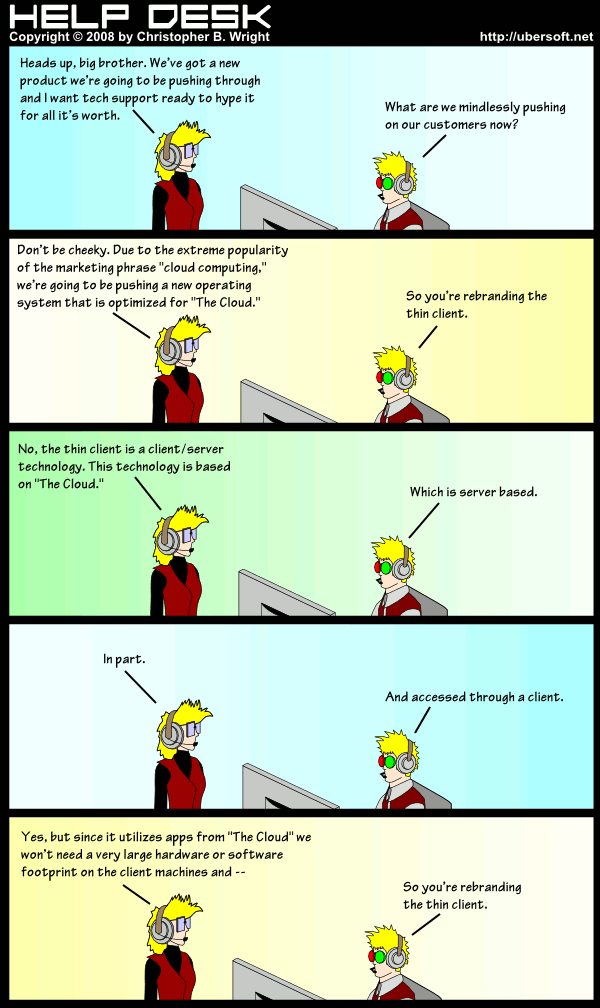
So yes you’ll be reading more cloud news here, as after all part of it is just plain old Virtualization, or SAAS, or Thin Client

Thin Cloud Computing

Filed Under: Guest Posts Tagged With: Amazon EC2, cloud, PaaS, SaaS, sosaas, virtualization, Xen, xenoservers

RightScale Supports The Smell Of Saunas

November 4, 2008 by Kris Buytaert Leave a Comment

Today RightScale Inc. announced they will team up with the Eucalyptus team have their platform available with Eucalyptus so they can deliver an Easy to Mange Open Source Cloud Computing platform.

They have announced that starting today, November 4, 2008 they will have the RightScale Cloud computing management platform ready for use with the Eucalyptus Puclic Cloud (EPC).


“We are honored to collaborate with the talented UCSB Eucalyptus Project Team to accelerate the advancement of cloud computing technology,” said Michael Crandell, CEO at RightScale. “Now anyone — from those just becoming familiar with cloud computing to organizations evaluating a massive application for deployment on Amazon’s EC2 — will be able to easily test their applications on the Eucalyptus EC2-compatible, open source cloud infrastructure using RightScale’s management platform.”

RightScale was already supporting Amazon’s EC2, FlexiScale and now GoGrid and sends a big message to the Cloud Community that Eucalyptus is a valuable platform to support.

Earlier this year Elastra also announced support for Eucalyptus. May we wonder why the Eucalyptus folks went with RightScale and not with Scalr ? Afterall integrating Scalr with Eucalyptus seems like a good way to achieve a fully featured opensource platform.

And on a final note .. if RightScale titles their Press Release “RightScale and the Eucalyptus Team Join Forces to Deliver Easy-to-Manage Open Source Cloud Computing” , when will they show us the code ?

Filed Under: Guest Posts, News, Partnerships Tagged With: cloud, ec2, eucalyptus, FlexiScale, GoGrid, rightscale, virtualization

Roger Baskerville Leaves Citrix / XenSource

November 2, 2008 by Kris Buytaert Leave a Comment

Roger Baskerville has left Citrix, where he started out as the Sales Director of Xensource EMEA , after the Citrix merger to become Regional Director Northern Europe Server Virtualization .

During his years at Xensource Roger was one of the first commercial pushers of Xen and later XenEnterprise.

Roger has now joined Vizioncore as Vice President for EMEA and he will be responsible for EMEA operations. He leads the sales, marketing and systems engineering teams based across the region. Baskerville has held a variety of senior channel focused EMEA sales leadership positions with both mature high tech organizations as well as start-up operations. Previous companies include LightPointe, Palm, Compaq and NCR. A seasoned industry speaker who is both technically astute and sales focussed, Baskerville brings with him a wealth of experience in virtualization and international sales.

Earlier this year Quest fully acquired VizionCore as part of their journey into virtualization, after earlier
already owning a smaller part of the company. VizionCore then was described as the leading provider of disaster recovery and other products for virtual infrastructure management.

Today their website reads
“VizionCore Inc. provides software that helps organizations safeguard and optimize their virtualized environments and allows them to extract the maximum return on their investment in the VMware platform. Vizioncore’s software products support essential IT strategies, including business continuity, high availability and disaster recovery.”

With this move Roger stays in the Virtualization world where he has worked for the past couple of years, however moving from a fully Open Source based technology to a back to a proprietary environment.

The bigger question however is .. who else will be leaving Citrix/ XenSource. and when ? XenSource has been with Citrix for about a year now .. maybe there are other people jumping ship.

Filed Under: Featured, Guest Posts, People Tagged With: citrix, citrix xenserver, Citrix XenSource, industry moves, recruitment, Roger Baskerville, virtualisation, virtualization, Vizioncore, XenEnterprise, xensource

  • « Go to Previous Page
  • Go to page 1
  • Interim pages omitted …
  • Go to page 7
  • Go to page 8
  • Go to page 9
  • Go to page 10
  • Go to page 11
  • Interim pages omitted …
  • Go to page 16
  • Go to Next Page »

Primary Sidebar

Tags

acquisition application virtualization Cisco citrix Citrix Systems citrix xenserver cloud computing Dell desktop virtualization EMC financing Funding Hewlett Packard HP Hyper-V IBM industry moves intel interview kvm linux microsoft Microsoft Hyper-V Novell oracle Parallels red hat research server virtualization sun sun microsystems VDI video virtual desktop Virtual Iron virtualisation virtualization vmware VMware ESX VMWorld VMWorld 2008 VMWorld Europe 2008 Xen xenserver xensource

Recent Comments

  • C program on Red Hat Launches Virtual Storage Appliance For Amazon Web Services
  • Hamzaoui on $500 Million For XenSource, Where Did All The Money Go?
  • vijay kumar on NComputing Debuts X350
  • Samar on VMware / SpringSource Acquires GemStone Systems
  • Meo on Cisco, Citrix Join Forces To Deliver Rich Media-Enabled Virtual Desktops

Copyright © 2025 · Genesis Sample on Genesis Framework · WordPress · Log in

  • Newsletter
  • Advertise
  • Contact
  • About