
• Skip to primary navigation
  • Skip to main content
  • Skip to primary sidebar
Virtualization.com

Virtualization.com

News and insights from the vibrant world of virtualization and cloud computing

  • News
  • Featured
  • Partnerships
  • People
  • Acquisitions
  • Guest Posts
  • Interviews
  • Videos
  • Funding

Search Results for: ovf

VMware Debuts VMware vCloud Integration Manager

February 7, 2012 by Robin Wauters Leave a Comment

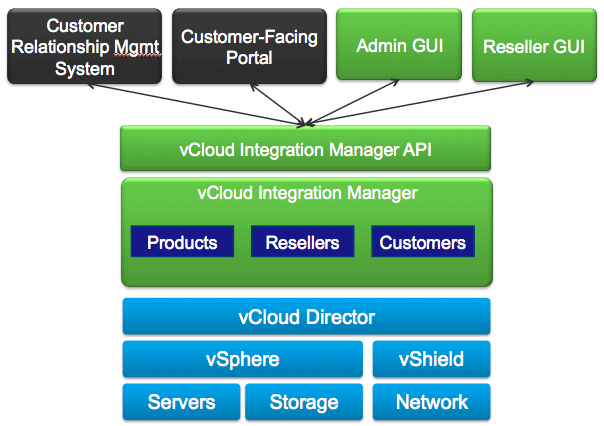
VMware today introduced VMware vCloud Integration Manager, a new solution designed to help service providers automate the delivery and operations of VMware vCloud Director-based clouds.

VMware also announced that nearly 90 service provider partners now offer services that have met VMware criteria as VMware vCloud Powered, an almost 3x increase since Q3 2011.

VMware vCloud Integration Manager software will allow service providers to quickly create and deploy cloud service offerings.

VMware vCloud Integration Manager is expected to be available in Q1 2012 and will be priced on a usage-based subscription model familiar to vCloud Service Providers.

Almost 90 service providers have launched vCloud Powered services since VMware introduced the program in February 2011. The VMware vCloud Powered program requires VMware Service Provider Program (VSPP) partners to offer services based on VMware vSphere and vCloud Director while exposing the vCloud API and supporting the Open Virtualization Format (OVF).
Filed Under: Uncategorized Tagged With: vCloud Integration Manager, vmware, VMware vCloud Integration Manager

Former Cisco CTO Alan Conley Joins Zenoss

September 26, 2011 by Robin Wauters Leave a Comment

Zenoss has announced the appointment of Alan Conley as chief technology officer.

Conley joins Zenoss from Cisco, where for many years he led their IT operations architecture and was most recently CTO of the Network Management Technology Group where he was responsible for Cisco’s cloud and virtualization management offerings.

Conley has extensive experience in the cloud management industry. He was a key driver of Cisco’s strategy and architecture for cloud management, next generation network API, OpenStack, DMTF OVF 2.0, and Open Network Foundation (ONF).

Conley also brings to Zenoss more than 14 years’ experience in IT at Cisco as a distinguished engineer responsible for IT operations and management technology.

Filed Under: People Tagged With: Alan Conley, Cisco, Zenoss

Former Cisco CTO Alan Conley Joins Zenoss

August 25, 2011 by Robin Wauters Leave a Comment

Zenoss today announced the appointment of Alan Conley as chief technology officer.

Conley joins Zenoss from Cisco where for many years he led Cisco’s IT operations architecture and was most recently CTO of the Network Management Technology Group where he was responsible for Cisco’s cloud and virtualization management offerings.

Conley was a key driver of Cisco’s strategy and architecture for Cloud management, next generation network API, OpenStack, DMTF OVF 2.0, and Open Network Foundation (ONF).

Conley also brings to Zenoss more than 14 years’ experience in IT at Cisco as a distinguished engineer responsible for IT operations and management technology.

As CTO, Conley will be responsible for driving Zenoss cloud management vision, direction and on-going innovation.

Filed Under: People Tagged With: Alan Conley, Zenoss

DMTF’s Open Virtualization Format 1.1 Receives Thumbs Up From ANSI

September 1, 2010 by Robin Wauters Leave a Comment

Distributed Management Task Force (DMTF), the organization bringing the IT industry together to collaborate on systems management standards development, validation, promotion and adoption, today announced that its Open Virtualization Format (OVF) standard version 1.1 has been adopted as an American National Standards Institute (ANSI) International Committee for Information Technology Standards (INCITS) standard.

This achievement marks a major milestone in DMTF’s efforts to enable interoperable, platform-independent cloud and virtual management solutions.

OVF has been designated as ANSI INCITS 469 2010 by the INCITS Executive Board. INCITS is accredited by ANSI, the organization that oversees the development of American National Standards. ANSI accreditation signifies that the procedures used by the standards body in connection with the development of American National Standards meet the Institute’s essential requirements for openness, balance, consensus and due process.

DMTF will continue to work with INCITS to submit OVF to the International Standards Organization/International Electrotechnical Commission (ISO/IEC) for adoption as an international standard.

First published in March 2009, OVF simplifies interoperability, security and machine lifecycle management by describing an open, secure, portable, efficient and extensible format for the packaging and distribution of workloads consisting of one or more virtual machines and applications. This enables software developers to ship pre-configured, ready-to-deploy solutions and allows end-users to distribute applications into their environments with minimal effort. OVF is the cornerstone of DMTF’s virtualization standards efforts and is also considered an important foundation for the organization’s cloud standards development.

Filed Under: News Tagged With: ansi, Distributed Management Task Force, DMTF, incits

DMTF Debuts New Open Cloud Standards Incubator Documents, Workgroup Formation

July 28, 2010 by Robin Wauters Leave a Comment

Distributed Management Task Force (DMTF), the organization bringing the IT industry together to collaborate on systems management standards development, validation, promotion and adoption, today announced the availability of two new documents produced by its Open Cloud Standards Incubator.

The documents – “Use Cases and Interactions for Managing Clouds” and “Architecture for Managing Clouds” – will form the foundation for DMTF’s ongoing cloud standards work.

In addition, DMTF has also launched the Cloud Management Workgroup (CMWG), to develop cloud management standards based on the recommendations outlined in the Incubator documents.

The “Use Cases and Interactions for Managing Clouds” and the “Architecture for Managing Clouds” describe how standardized interfaces and data formats can be used to manage cloud environments. Together, they provide a comprehensive overview of DMTF’s recommended use cases, interactions, data formats and overall architecture for cloud management.

Moving forward, the CMWG will focus on using this information to develop a set of standards that deliver architectural semantics and implementation details to achieve interoperable management of clouds between service providers and their consumers and developers.

Additional areas of emphasis within the workgroup will include creating cloud service management models and developing mappings to prevalent infrastructure models, including DMTF’s Open Virtualization Format (OVF). The CMWG will also continue collaborating with DMTF alliance partners including Storage Networking Industry Association (SNIA), Open Grid Forum (OGF), TeleManagement Forum (TM Forum), and Cloud Security Alliance (CSA).

DMTF announced the formation of the Open Cloud Standards Incubator in April 2009, to address the need for open management standards for cloud computing. Led by many key stakeholders in the cloud computing space, the Incubator developed a set of informational specifications and processes to advance the standardization of cloud management.

In addition to the “Use Cases and Interactions for Managing Clouds” and “Architecture for Managing Clouds,” a whitepaper entitled “The Interoperable Cloud” is also available.

Documents developed by the Incubator can be downloaded here.

Filed Under: News

Release: VMware Studio 2.1

July 14, 2010 by Robin Wauters Leave a Comment

VMware Studio is an integrated development tool that takes existing software applications and packages them into virtual machines and vApps that are ready to run and optimized for VMware platform products.

VMware Studio can build Linux-based VMs, Windows-based VMs, and vApps running single tier or multitier applications.

The company has released a new version today, VMware Studio 2.1.  An with it, a number of new improvements, enhancements and security fixes:

VMware Studio improvements:

  • Additional Linux OS support is provided for SLES 11.2, CentOS 5.4, RHEL 5.4, and Ubuntu 8.04.3 and 8.04.4.
  • Unlike previous versions, VMware Studio 2.1 can create virtual appliances from virtual machines that were not originally created with VMware Studio, based on a discovery phase.
  • The CLI offers the –newos option so you generate a build profile for any RPM-based or DEB-based Linux OS.
  • You can run concurrent builds with Studio 2.1. After a configurable limit is reached, builds wait in a queue.
  • The generated virtual machine always reboots before your application installs. Some applications expect a full installed working system before they themselves will install. Rebooting after OS installation provides the real environment in which to install, instead of an artificial post-installation environment.
  • You can now specify the order of application package repository installation.
  • VMware Studio 2.1 optionally analyzes the list of RPM and DEB packages to locate unused items and generate a small-footprint virtual machine. It can also reduce the footprint post-installation with a file removal list.
  • VMware Studio 2.1 can generate a discovery report showing contents of a virtual appliance.
  • You can now import vApp profiles.
  • You can translate your EULA into multiple languages, and vCenter Server will display it in the language of the prevailing locale.
  • You can digitally sign an OVF file, so VMware vSphere 4.1 can verify the signed certificate during OVF import.
  • VMware vSphere 4.1 also supports OVF with thin provisioned disk, and the vmw:Config option.
  • You can associate network labels with specific NIC cards by modifying the XML profile.

Updates to virtual appliances have been enhanced:

  • You can generate signed manifests so customers can ensure that patches are coming from a trusted source.
  • Polling for available updates was optimized.
  • The appliance manifest now carries change log information, which can contain information on whether an update is critical or required. You can force reboot of the appliance after an update.
  • You can add your EULA, in any one language, to an update.
  • Extended configuration parameters can be passed through to the manifest.
  • The virtual appliance administrator can create a tarball of log files to help support personnel diagnose failed updates and other problems.

Filed Under: News

  • « Go to Previous Page
  • Go to page 1
  • Go to page 2
  • Go to page 3
  • Go to page 4
  • Interim pages omitted …
  • Go to page 7
  • Go to Next Page »

Primary Sidebar

Tags

acquisition application virtualization Cisco citrix Citrix Systems citrix xenserver cloud computing Dell desktop virtualization EMC financing Funding Hewlett Packard HP Hyper-V IBM industry moves intel interview kvm linux microsoft Microsoft Hyper-V Novell oracle Parallels red hat research server virtualization sun sun microsystems VDI video virtual desktop Virtual Iron virtualisation virtualization vmware VMware ESX VMWorld VMWorld 2008 VMWorld Europe 2008 Xen xenserver xensource

Recent Comments

  • C program on Red Hat Launches Virtual Storage Appliance For Amazon Web Services
  • Hamzaoui on $500 Million For XenSource, Where Did All The Money Go?
  • vijay kumar on NComputing Debuts X350
  • Samar on VMware / SpringSource Acquires GemStone Systems
  • Meo on Cisco, Citrix Join Forces To Deliver Rich Media-Enabled Virtual Desktops

Copyright © 2025 · Genesis Sample on Genesis Framework · WordPress · Log in

  • Newsletter
  • Advertise
  • Contact
  • About