• Skip to primary navigation
  • Skip to main content
  • Skip to primary sidebar
Virtualization.com

Virtualization.com

News and insights from the vibrant world of virtualization and cloud computing

  • News
  • Featured
  • Partnerships
  • People
  • Acquisitions
  • Guest Posts
  • Interviews
  • Videos
  • Funding

Partnerships

Kace Integrates Virtual Systems Management Tool Kbox Into VMWare Infrastructure

February 18, 2008 by Robin Wauters 1 Comment

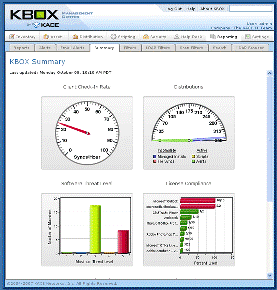
Kace announced today what it calls the first virtual systems management appliances to run natively within the VMware infrastructure. Kace’s Virtual Kbox appliances offer users a software product that runs on the user’s existing hardware. Earlier versions of the Kbox appliance required the installation of separate hardware to deploy and manage IT resources.

virtualization-kace-kbox.png

The Virtual Kbox appliances family is now shipping and fully supports physical and virtual machines across Windows, Mac, Linux and Solaris environments.

“Unlike a generation of virtual appliances preceding it, the Virtual Kbox family provides a systems management and deployment solution that is fully integrated from a highly optimized and hardened operating system through an easy-to-use, Web-based application,” Rob Meinhardt, cofounder and CEO of Kace, told TechNewsWorld.
virtualiztion-kace-kbox-21.gif

The virtual appliance aims at delivering the benefits of a hardware appliance, including fast deployment times with low costs and ease of use. It also provides the benefits of virtualization, such as improved resource utilization, reduced energy and cost savings, improved maintainability and support and the ability to quickly scale. While the product’s name implies that it is an actual hardware device, it is a software product that runs on the customer’s computer. The virtual appliance product will do all that a physical appliance will do, he said. It provides the full range of features found in physical appliance management devices.

Virtualization is exploding in popularity in many enterprise categories. Organizations are seeking new ways to leverage this technology, also according to Meinhardt. “We’ve seen an incredible ramping up for virtualization. This gave us an opportunity to deliver our Kbox products for virtual appliance management,” said Lubos Parobek, Senior Director of Product Management for Kace.

Kace, which started in 2003, is targeting companies with from 100 to 1 000 employees. It currently has 450 customers worldwide, mostly in the SMB category, according to CEO Rob Meinhardt.”That gives us up to 100 000 companies worldwide as potential users,” he said.

Technorati Tags: Kace, Kace+Kbox, Kace+Virtual+Kbox, Kbox, linux, Lubos+Parobek, Macintosh, Rob+Meinhardt, Solaris, Virtual+Kbox, virtualisation, virtualization, vmware, windows

Company Index: VMWare

[Source: TechNewsWorld]

Filed Under: News, Partnerships, People Tagged With: Kace, Kace Kbox, Kace Virtual Kbox, Kbox, linux, Lubos Parobek, Mac, Rob Meinhardt, Solaris, Virtual Kbox, virtualisation, virtualization, vmware, windows

Sun Aims To Virtualize Web 2.0 Startups. From LAMP to SAMP?

February 18, 2008 by Robin Wauters 1 Comment

Sun MicroSystems aims to equip the next generation of Internet companies (read: Web 2.0 startups) with its hardware and software and will offer virtualization products to help them keep their costs to a minimum, make their data centers more flexible, and give developers multiple target environments.

virtualization-jonathan-schwartz-sun.jpg

“You can see a connection to developing under VirtualBox and moving the software to a server running xVM,” Sun CEO Jonathan Schwartz said; “xVM is Sun’s Xen-based hypervisor, due in June. Sun views a virtualized development environment as a way to capture developer loyalty. The company already offers developers incentives to use Java, namely its NetBeans tools and the PHP, Ruby, and Perl scripting languages through the Sun Developer Network. It registered an additional 1 million developers on its network in 2007”, Schwartz said, “and building a relationship with those developers is key to getting more of its software into Web 2.0 companies”.

As Sun is set to acquire open source relational database MySQL, the company seems determined to turn “LAMP” (which stands for Linux, Apache, MySQL and PPHP / Perl) into “SAMP”, evidently substituting Linux for Solaris in the pet name for every open source developer’s favorite tool set.

Sun also has a special program with custom offerings for startups dubbed Startup Essentials, which it has recently expanded to Canada, France and Germany.

Technorati Tags:
Jonathan+Schwartz, LAMP, MySQL, open+source, SAMP, Solaris, Startup+Essentials, Startups, Sun, Sun+Microsystems, VirtualBox, virtualisation, virtualization, Web+2.0

[Via InformationWeek]

Filed Under: Acquisitions, News, Partnerships, People Tagged With: Jonathan Schwartz, LAMP, MySQL, open source, SAMP, Solaris, Startup Essentials, Startups, sun, sun microsystems, VirtualBox, virtualisation, virtualization, Web 2.0

EMC & SAP Heading Into Cloud Computing Together?

February 17, 2008 by Robin Wauters Leave a Comment

According to Reuters, EMC and SAP are about to team up to deliver computer programs over the web. The news company cites a senior executive from German software provider SAP AG, President of SAP Labs North America and member of the SAP Executive Board Doug Merritt, predicting an upcoming partnership whereby the companies will use virtualization technology centralizing computing and storage functions at data centres (‘cloud computing’).

virtualization-sap.png virtualization-emc.jpg

Merritt chose not to discuss specifics, such as the expected launch date for the new venture and the financial details involved. Moreover, EMC, while openly betting hosting software and services will be a key to growth over the coming years, declined to comment on Merritt’s statements. A blog post by Chuck Norris Hollis, an EMC VP, doesn’t shed more light on the potential alliance but hints at the possibility of a partnership.

If EMC eventually enters the web hosting game through its partnership with SAP, it will be entering a market filled with household name competitors like HP, Symantec, Microsoft, Amazon, Google and IBM.

So far EMC has only announced one key services product, namely MozyEnterprise, an upgraded version of automated backup service Mozy that it acquired last year. EMC reportedly said earlier this month it plans to sell Mozy’s services to large corporations, through a recently upgraded EMC infrastructure dubbed ‘Fortress’.

SAP has also been noisy about launching its own flavor of SaaS program BusinessByDesign to combat Salesforce.com. At an announcement in September, SAP said it would look to partner with companies to provide applications and hosting, which it now seems to have found in EMC.

Technorati Tags: BusinessByDesign, , Chuck+Hollis, , cloud+computing, , data+centre, , Doug+Merritt, , EMC, , Fortress, , hosting, , Mozy, , MozyEnterprise, , Reuters, , SAP, , SAP+AG, , virtualisation, , virtualization

Filed Under: Featured, News, Partnerships, People Tagged With: BusinessByDesign, Chuck Hollis, cloud computing, data centre, Doug Merritt, EMC, Fortress, hosting, Mozy, MozyEnterprise, Reuters, SAP, SAP AG, virtualisation, virtualization

ViUX Automates Hosting With Parallels / SWSoft

February 14, 2008 by Robin Wauters Leave a Comment

virtualization-viux.png

Server virtualization firm, Parallels/SWsoft, has partnered with software-as-a-service and technology solutions firm, ViUX Systems, to provide a complete hosting automation system for all of its clients, including resellers.

The new hosting system is based upon several modules – HSPComplete, Virtuozzo, Plesk and SiteBuilder – to fully automate all four levels of hosting that ViUX offers. Those four levels – Shared Hosting ervers , Virtual Private servers (VPS), Dynamic Dedicated servers (DDS) and Reseller Hosting servers (RHS) – use redundant, multi-homed, high-speed connections, within multiple geographically dispersed data centers.

Joe Murphy, Vice-President of ViUX said:

”Partnering with Parallels/SWSoft gives us a completely automated hosting infrastructure and allows us to offer virtualized hosting to bridge the gap for those customers that have outgrown the shared hosting environment but are not quite ready for a fully dedicated server. In addition, we can now offer automated deployment of hosted applications in a SaaS module, such as: SmarterMail, SmarterStats, DotNetNuke, Miva Merchant, osCommerce.”

To market their new hosting system, ViUX has also undertaken a complete revision of its website, providing an easier-to-use interface that complements the new capabilities and flexibility of its automated, virtualized hosting infrastructure. ViUX has also migrated most of its servers to a new data center in Iowa which allows the company to deploy new servers virtually on demand.

Mr. Murphy continued,

”Our partnership with Parallels/SWSoft also allows us to offer leased licenses for HSPcomplete, Virtuozzo, Plesk and other related products, in a license leasing module to other hosting providers and resellers. We have also formed a similar partnership with SmarterTools, which allows us to likewise offer leased licenses of: SmarterMail, SmarterStats, and SmarterTickets. This will allow smaller hosting providers or resellers to obtain these industry leading products from ViUX at low monthly fees and avoid the upfront cost of purchasing directly from the vendor.”

Filed Under: News, Partnerships, People Tagged With: hosting, Joe Murphy, Parallels, Parallels SWSoft, SaaS, shared hosting, swsoft, SWSoft Parallels, Virtual Private Server, virtualisation, virtualization, ViUX, ViUX Systems

Ubuntu To Adopt KVM As Primary Virtualization Platform

February 14, 2008 by Kris Buytaert 2 Comments

Ubuntu is the first Linux distribution to choose KVM over Xen as it’s virtualization solution.

In an interview from UbuntuWeekly with Soren Hansen, the 26-year-old who works for Canonical as virtualization specialist on the Ubuntu server team, said:

“We’ve chosen to settle on KVM as our main virtualization focus. KVM is a special version of QEMU which utilizes the new virtualization extensions that both Intel and AMD have added to their newest CPU models.”

The Ubuntu team is integrating libvirt, virsh and virt-manager as a graphical frontend in their upcoming edition.

Ubuntu is quickly becoming the leading Desktop distribution , so choosing for KVM as their virtualization platform makes a lot of sense. Traditionally, Xen has been the server virtualization platform where as KVM , developed by Avi Kivity from Qumranet, has been gaining more desktop use adoption.

Filed Under: News, Partnerships Tagged With: avi kiviti, kvm, qumranet, soren hansen, ubuntu, virtualisation, virtualization, Xen

Trigence Signs Strategic Partnership with Virtualization Consolidation Academy

January 31, 2008 by Robin Wauters Leave a Comment

Trigence , another provider in application virtualization solutions, today announced a partnership with the Virtualization Consolidation Academy to utilize the academy’s facilities to make application virtualization technology visible and understandable to end-users. VCA evaluates different technologies and tests solutions for feasibility, compatibility, implementation and user-friendliness. Additionally, VCA trains partners and large enterprises throughout the region on virtualization technology and best practices.

virtualization-trigence-virtualizationconsolidationacademy.jpg

The VCA is a new endeavor that includes many virtualization solutions that are proving the value of the virtual data center. VCA’s virtual data center is an initiative that presents the data center as a centrally managed service which virtualizes all hardware and software resources at the backend. Recent variations of the virtual data center model include grid, fabric, and utility computing. The ultimate goal in all variations is a cost effective solution with an uninterrupted quality-of-service.

“Our partnership with the Virtualization Consolidation Academy is further proof of our global commitment to provide the solutions data center managers need to get control of their applications in ways that simplify operations and require fewer resources,” said John Hamilton, Executive Vice President and Chief Operating Officer of Trigence. “The European market is becoming an important focus for us, and we are excited to leverage all that the VCA has to offer to reach those companies in need of a comprehensive application virtualization solution for their data centers.”

Trigence claims companies around the world use them to:

— Manage and migrate Solaris, Linux and Windows applications throughout the data center

— Consolidate both Physical and Virtual server environments

— Do a better job of managing all applications throughout their lifecycle from development and delivery to maintenance and modernization

Trigence is different from hyper-visor and other virtualization technologies because it encapsulates the application at a level above the OS. The result is a completely virtualized environment where application capsules now have the freedom to be moved and managed without reconfiguration to either the application or the server.

To be watched!

Update: Tarry Singh has an interview with COO & EVP of Trigence, John Hamilton .

Technorati Tags:

Trigence, VCA, virtual+data+center, virtualisation, virtualization, Virtualization+Consolidation+Academy

Filed Under: News, Partnerships Tagged With: Trigence, VCA, virtual data center, virtualisation, virtualization, Virtualization Consolidation Academy

  • « Go to Previous Page
  • Go to page 1
  • Interim pages omitted …
  • Go to page 39
  • Go to page 40
  • Go to page 41
  • Go to page 42
  • Go to page 43
  • Go to page 44
  • Go to Next Page »

Primary Sidebar

Tags

acquisition application virtualization Cisco citrix Citrix Systems citrix xenserver cloud computing Dell desktop virtualization EMC financing Funding Hewlett Packard HP Hyper-V IBM industry moves intel interview kvm linux microsoft Microsoft Hyper-V Novell oracle Parallels red hat research server virtualization sun sun microsystems VDI video virtual desktop Virtual Iron virtualisation virtualization vmware VMware ESX VMWorld VMWorld 2008 VMWorld Europe 2008 Xen xenserver xensource

Recent Comments

  • C program on Red Hat Launches Virtual Storage Appliance For Amazon Web Services
  • Hamzaoui on $500 Million For XenSource, Where Did All The Money Go?
  • vijay kumar on NComputing Debuts X350
  • Samar on VMware / SpringSource Acquires GemStone Systems
  • Meo on Cisco, Citrix Join Forces To Deliver Rich Media-Enabled Virtual Desktops

Copyright © 2025 · Genesis Sample on Genesis Framework · WordPress · Log in

  • Newsletter
  • Advertise
  • Contact
  • About