
• Skip to primary navigation
  • Skip to main content
  • Skip to primary sidebar
Virtualization.com

Virtualization.com

News and insights from the vibrant world of virtualization and cloud computing

  • News
  • Featured
  • Partnerships
  • People
  • Acquisitions
  • Guest Posts
  • Interviews
  • Videos
  • Funding

News

Ativas Data Center Picks Cisco Nexus 5000 Solution To Boost Virtualization

September 25, 2009 by Robin Wauters Leave a Comment

Cisco has announced that Ativas Data Center, an Asamar Group company, has invested in a Cisco NexusTM 5000 Series switch-based solution to underpin its next-gen data center architecture.

Ativas will deploy one of the first data centers in Brazil and in Latin America to adopt one of the most advanced technologies in terms of data center virtualization and connectivity. The facility is planned to start operations in early 2010, in the Minas Gerais Brazilian state.

The Cisco solution for Ativas is based on the innovative VSS technology (Virtual Switching System), which is present at the network core layer and at the network distribution layer. This technology allows centralized infrastructure to operate as a single virtual switch with high levels of redundancy, so processing of the entire data flow is equally shared among them.

The innovative architecture of the Cisco Nexus 5000 Series Switches simplifies data center transformation by helping to enable a standards-based, high-performance unified fabric. Next-generation data centers increasingly have dense, multicore, virtual-machine-intensive servers.

As a network foundation of the Cisco Data Center 3.0 architecture and the latest addition to the family of data-center-class switches, the Cisco Nexus 5000 Series can meet these business, service, application and operational requirements.

The Cisco solution was chosen by Ativas Data Center due to its high added value and its ability to address current market requirements. Virtualization maximizes physical resources, allowing providers to offer higher-quality solutions and increased cost-benefit rates for end customers.

Ativas’ processing capacity will be doubled by the Cisco solution, allowing it to offer its clients higher availability and optimized network-contingency features, with easy management features.
Filed Under: News

Bloomberg Interviews EMC CEO Joe Tucci: “Gearing Up For Round Two”

September 25, 2009 by Robin Wauters Leave a Comment

Joe Tucci pulled EMC Corp. out of a two-year sales slump after the dot-com bust. Now he’s gearing up for round two: an industry shakeup that he expects to be even more punishing.

Tucci, 62, says the global economic crisis and a shift to a model where companies get computing power over the Internet will drown at least some of the biggest names in computing.

Full interview on Bloomberg.

Filed Under: News

Network World on Citrix’ Imminent ‘Major Desktop Virtualization Push’

September 25, 2009 by Robin Wauters Leave a Comment

A new push will be announced in early October. While Citrix has not yet revealed its plans publicly, analysts say the company is making desktop virtualization a major priority. New products and industry partnerships are likely on the horizon.

“It’s going to be very aggressive,” says ITIC lead analyst Laura DiDio. “They’re coming out with guns blazing, and they have a big emphasis on pretty widespread and varied industry partnerships. That’s not a big surprise. A lot of folks are doing that, but the depth and breadth [of Citrix’s partnerships] is pretty impressive.”

More on Network World.

Filed Under: News

Guest Post By Greg Ness: “Virtualization’s Golden Spike”

September 24, 2009 by Robin Wauters Leave a Comment

This is a cross-post of a blog article written by Gregory Ness, former VP of Marketing for Blue Lane Technologies who is currently working for InfoBlox.

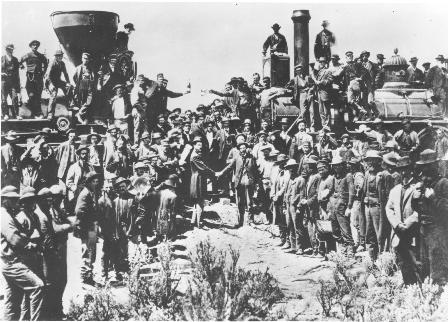
It only makes sense that the steam locomotive existed before the completion of the Transcontinental Railroad. One breakthrough created the need for another. The power of the VM (virtual machine) introduced unprecedented mobility and flexibility, albeit within the confines of a VLAN container. That mobility and flexibility has created new demands for larger, unified and intelligent network infrastructures or infrastructure 2.0.

An Historical Perspective on Network Innovation

The steam engine, the locomotive and the rail are perfect examples of synergistic developments. Greater speed and mobility pushed the limits of infrastructure and created a compelling case for longer stretches of track. More cities became connected by rail lines over time, and soon even towns sprang up “in the middle of nowhere” along the tracks.

The increasing reach of the railroad opened up massive opportunities for development and trade and helped to forge national identities. From towns to industries the railroad shifted competitive advantage based on the sheer power and influence of transport and created massive wealth redistribution.
Today’s technology leaders, especially in the network and server and virtualization space (like Cisco, HP, VMware and others) will achieve strategic advantage if they get the spike before their competitors. Let me explain as we glimpse back at a strategic moment in US history defined by a spike of gold.

The Golden Spike Ceremony: 1869

ness

Thanks to Wikipedia for the photo.

Virtualization’s virtual machine is pushing the limits of today’s static networks just as the steam locomotive drove the construction of iron rails to connect the coasts.

Perhaps today, like those who think that virtualization ends with the VLAN, there were some who didn’t understand the need for a rail system to connect both coasts.

Full VMotion is Virtualization’s Golden Spike

Yet the questions we ask today regarding our static, manually managed networks need to be answered before we can fulfill the full potential of VMotion. Many of the questions may ultimately be answered by the newly formed infrastructure 2.0 working group.

Addressing and automation are core issues; solving them will deliver new potentials in security, application delivery and disaster avoidance/recovery and create entirely new IT business models and applications. They will also help to minimize the impact of the necessary complexity that VMware’s Thiele talks about in his latest blog:

The network is a great example of “hidden” complexity. Today the average network administrator can plug in a switch to another switch and then plug devices into the new switch and expect that in most cases the network will work. Imagine if before he could get the server to talk to the switch he had to create a new address from scratch or spell out the switch port in the server’s network interface card. The fact is networks have been hiding complexity for years, but they still have a long way to go. When you can log into a console and use your mouse pointer to drag a server into a network or resource pool and have the appropriate network security and routing policies applied, you’ll be getting close to IT nirvana. Although you might disappoint the hardcore network administrator who was hoping to spend some late nights and weekends tweaking the environment.

(Mark Thiele, VMware, “Complexity in IT Systems…” Sep 17, 2009)

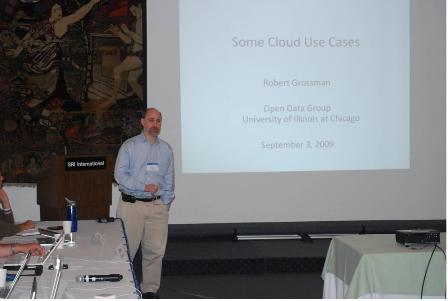
Ironically, Bob Grossman, who is considered to be one of the fathers of cloud computing, kicked off the infrastructure 2.0 working group with a preso highlighting a train at the Russian/Chinese border undergoing a manual gauge change. Talk about a “tin spike” connecting the two systems; each train is lifted by a team of laborers so that the undercarriage can be adjusted for a different sized track.

Bob has been building clouds (multi-site grids of computing power) for decades. His understudy, Stuart Bailey, founded Infoblox (my employer).

Bob Grossman Briefing the Infrastructure 2.0 Work Group

ness 2

Yet rail systems are incredibly linear, especially in those days. Today’s networks are more like pulsing meshes. So if a VM takes off from one VLAN for another determining its location (security, delivery, management policies require foreknowledge of the VM’s location) is strategic to a stateful trip. If you can preserve the state (security, etc) of the VM while it moves great distances you deliver the golden spike, full VMotion.

That spike is strategic to the fortunes of networking vendors, cloud providers and enterprises because it enables new levels of flexibility, scale, automation and security across data centers, transforming the economics of IT, in the same way that the Transcontinental Railroad helped to unify a nation and create new towns and cities, and grow established ones.

Railroads were a critical fabric for the industrial revolution and the global emergence of nationalism. Networks are the critical and often overlooked fabric for the most powerful form of cloud computing the next stage of the computer revolution, sometimes called the intercloud.

This makes addressing strategic to the golden spike. That was one of the critical cloud problems discovered decades ago when the University of Illinois (Bob Grossman’s team) switched from circuit to packet switched networks and inspired Stu to launch Infoblox. And that brings us back to the dust covered worlds of DNS, DHCP and IP address management automation and an emerging technology called IF-MAP.

When this golden spike is driven into the network it will enable a new generation of cloud operating systems layered on top of sophisticated cloud positioning systems with real-time intelligence on systems, location, policy, etc. We’ll see hyper-efficient and intelligent networks that are as fast and up-to-date as individual hypervisor and VLAN tools today.

From President Kennedy’s undelivered speech intended to be delivered at the Dallas Trade Mart on November 22, 1963: “Except the Lord keep the city, the watchman waketh yet in vain.”

You can follow my rants and reads at: www.twitter.com/Archimedius. I am a Senior Director at Infoblox.

Filed Under: Featured, News

Burton Group’s Five Trends That Will Transform IT in 2010

September 24, 2009 by Robin Wauters 1 Comment

Burton Group , a research and consulting firm focused on in-depth analysis of enterprise information technologies, has projected five trends in 2010 that are transforming enterprise IT.

Burton Group has identified IT trends that will ultimately affect enterprise IT practices and strategy. The trends will also bring business and technology stakeholders closer together, especially where pure economics drive enterprise IT decisions, creating a critical junction in the decade beginning in 2010.

Externalization, Consumerization and Globalization

Externalization plays an important role in IT economics, prompting value assessments of what capabilities should be treated as commodity. Consumerization reflects the desire for individual choice of devices and applications for maximum personal productivity. Democratization is evident in the rise and importance of social networks within and outside the modern enterprise. Ultimately, these elements converge to reshape the perception of enterprise IT and the traditional career path of the IT professional.

Cloud Computing

Over the next several years, enterprise demand will lead to maturity in cloud computing solutions, especially with respect to virtualization techniques, risk management and pricing models. Cloud computing offers some uniquely attractive benefits, but also carries some significant risks. The key to cloud computing is comprehension: Knowing what the cloud is, strengths, weaknesses, risks, and usage and pricing models is important for IT organizations that are looking to use the cloud to create a competitive advantage.

Data Center Transformation

2010 marks the start of data center transformation by virtualizing many aspects of the data center and establishing a hybrid of internal and external IT providers. The dynamic data center exposes new methods and external offerings that give IT organizations a way to provide the right level business IT services from external specialized IT service providers, including private and public cloud providers.

Social Computing

Adoption of social computing is accelerating in organizations worldwide. As social computing moves from niche to mainstream, enterprises are focusing on empowering worker interactions through social networking and are reporting real value. Enterprises must also plan for these factors shaping social computing in 2010 and beyond: business and cultural drivers, increasing risk and vendor strategies.

Wireless Everything

With the explosive growth and widespread availability of wireless networking products and services, substantial changes lay ahead for enterprise networks. Greater use of wireless mobile devices owned by employees is causing IT to rethink standard policies of issuing smartphones and even laptop computers to everyone. Employees are increasingly using their own wireless mobile devices, and enterprises must consider mobility as a strategic initiative rather than tactical capability.

Filed Under: News

Release: Citrix NetScaler VPX Virtual Appliance

September 24, 2009 by Robin Wauters Leave a Comment

Citrix has announced the general availability of the Citrix NetScaler VPX virtual appliance and unveiled a new Citrix Ready Open Networking Program to support it.

The new program establishes a powerful partner ecosystem to support Citrix NetScaler VPX, the industry’s only leading application delivery and load balancing solution that is available as a virtual appliance. With the introduction of the Open Networking Program, Citrix is making it easier for ISVs, enterprise customers and cloud infrastructure providers to create powerful virtual networking solutions they can confidently integrate with a broad range of partner solutions already verified to work with NetScaler VPX.

The Citrix Ready Open Networking Program establishes a broad partner ecosystem to support the deployment of virtualized NetScaler services into nearly any environment. By leveraging the program, Citrix customers can confidently build comprehensive application delivery infrastructures using NetScaler VPX and integrate with a multitude of partner solutions:

  • Platform Partners – Provide a broad array of deployment options for NetScaler VPX software.
  • Application Partners – Validate interoperability with NetScaler VPX and deliver turnkey solutions with tightly-integrated NetScaler load balancing and application delivery.
  • Cloud and Hosting Providers – Offer on-demand application networking to customers in both shared and dedicated service models.
  • Solution Partners – Complement NetScaler VPX functionality to provide holistic and comprehensive solutions, including cloud-based messaging security and flexible identity management products.

Charter members of the new Citrix Ready Open Networking Program partners include Ankeena, Apere, Arista, Dell, Fujitsu, HP, Intel, Joyent, Oracle, SoftLayer, Trend Micro and Vyatta.

Since its May 2009 debut as a publicly available tech preview release, NetScaler VPX has been downloaded and evaluated by thousands of enterprise customers and cloud infrastructure providers eager to bring needed flexibility and efficiency to their datacenters. Now available for general purchase, NetScaler VPX is poised to expand the market for advanced web application delivery technology.

NetScaler VPX makes it simple and cost effective for organizations of all sizes to deploy market-leading application delivery capabilities for every web application. By combining broad platform support, affordable licensing and gigabit performance, NetScaler VPX brings advanced application delivery technology to both common and emerging customer scenarios not addressed by appliance-only deployments:

  • Making Shared Services Work in Cloud and Enterprise Datacenters – NetScaler VPX enables next generation multi-tenancy architectures, bringing application-specific and tenant-specific acceleration, security and traffic management close to the application in a flexible software tier. This complements NetScaler MPX hardware appliances at the data center edge that are handling large-scale services common to all tenants.
  • On-demand Load Balancing and Application Delivery – For the first time, industry-leading application delivery and load balancing can be provisioned as an on-demand service by cloud and hosting providers seeking to enhance the elasticity and profitability of their offerings. Datacenter architectures are freed from the inherent rigidity of appliance-only solutions.
  • Moving NetScaler Upstream in the Application Lifecycle – NetScaler VPX makes critical application optimization, security and management technology capabilities readily accessible to development teams so that application delivery can be “baked” into the application. Additionally, it addresses thorny configuration support and change management issues by allowing evaluation of application delivery policies in test and stage environments, before promoting into production environments.

For easy evaluation and limited production deployments, Citrix is offering NetScaler VPX Express Edition, which can be downloaded and activated at no cost. NetScaler VPX Express provides all IT professionals – including networking managers and application development and test teams – a simple, risk-free option to evaluate advanced web application delivery technology. It also provides an affordable option for inserting NetScaler technology into non-production test and development environments, allowing policy and configuration changes to be tested before they are promoted into a live environment.

NetScaler VPX is available today from Citrix Solution Advisors worldwide. In addition to being available with Standard, Enterprise and Platinum Edition feature sets, NetScaler VPX Express Edition can be downloaded for free from http://www.citrix.com/netscalervpxexpress. NetScaler VPX is also available as an on-demand, cloud-based service from cloud vendors such as SoftLayer.

Filed Under: News

  • « Go to Previous Page
  • Go to page 1
  • Interim pages omitted …
  • Go to page 80
  • Go to page 81
  • Go to page 82
  • Go to page 83
  • Go to page 84
  • Interim pages omitted …
  • Go to page 240
  • Go to Next Page »

Primary Sidebar

Tags

acquisition application virtualization Cisco citrix Citrix Systems citrix xenserver cloud computing Dell desktop virtualization EMC financing Funding Hewlett Packard HP Hyper-V IBM industry moves intel interview kvm linux microsoft Microsoft Hyper-V Novell oracle Parallels red hat research server virtualization sun sun microsystems VDI video virtual desktop Virtual Iron virtualisation virtualization vmware VMware ESX VMWorld VMWorld 2008 VMWorld Europe 2008 Xen xenserver xensource

Recent Comments

  • C program on Red Hat Launches Virtual Storage Appliance For Amazon Web Services
  • Hamzaoui on $500 Million For XenSource, Where Did All The Money Go?
  • vijay kumar on NComputing Debuts X350
  • Samar on VMware / SpringSource Acquires GemStone Systems
  • Meo on Cisco, Citrix Join Forces To Deliver Rich Media-Enabled Virtual Desktops

Copyright © 2025 · Genesis Sample on Genesis Framework · WordPress · Log in

  • Newsletter
  • Advertise
  • Contact
  • About