• Skip to primary navigation
  • Skip to main content
  • Skip to primary sidebar
Virtualization.com

Virtualization.com

News and insights from the vibrant world of virtualization and cloud computing

  • News
  • Featured
  • Partnerships
  • People
  • Acquisitions
  • Guest Posts
  • Interviews
  • Videos
  • Funding

Lode Vermeiren

Rackspace Acquires Cloud Providers Slicehost And Jungle Disk

October 22, 2008 by Lode Vermeiren Leave a Comment

Rackspace Hosting today announced it has acquired privately owned VPS provider Slicehost, and storage provider Jungle Disk. (hat tip to TechCrunch)

The purchase price of the combined acquisitions is approximately $11.5 million payable in cash and stock, with the potential for up to $16.5 million in additional payouts of cash and stock based on certain performance criteria.

Rackspace is one of the largest providers of dedicated servers. Recently it has also moved into the virtualization world through partnerships with VMware and its own “cloud” division Mosso. Today’s announcement further shows that traditional hosting companies anticipate a growing importance of virtualization-based solutions.

Slicehost is one of the leading providers of Xen-based virtual servers. They cater mostly to developer crowds. In two years they have managed to build a customer base that runs more than 15.000 virtual servers.

Jungle Disk is a provider of storage software that works in conjunction with Amazon’s S3 storage platform. Rackspace announced that it will gradually move over new customers to its own storage systems, but will continue to support Amazon S3 as well.

Rackspace owns 8 datacenters in the United States, Hong Kong and the UK, and further has sales offices througout Europe and South Africa.

Filed Under: Acquisitions, News Tagged With: Amazon, cloud, hosting, jungledisk, Rackspace, slicehost, vmware, Xen

VMworld 2008 – VMware CTO Dr. Stephen Herrod Keynote liveblog

September 17, 2008 by Lode Vermeiren 4 Comments

After the liveblog of CEO Paul Maritz’s keynote yesterday, we’re here again, ready for the keynote by VMware CTO Dr. Stephen Herrod.

[7.45] The room is filling up already, nice music pumping through the soundsystem. Watch this space for live updates.

[8.03] The keynote starts with a video with customer quotes. First up: Qualcomm.

Hill Air Force Base apparently uses VMware as well, as does eBay. (They actually have a testimonial up at one of the lounges on the Solutions Exchange floor.

Metro Health uses VDI, is very satisfied with the instant access it provides.
Via Health is another healthcare customer, already treating the internal infrastructure as an internal cloud.

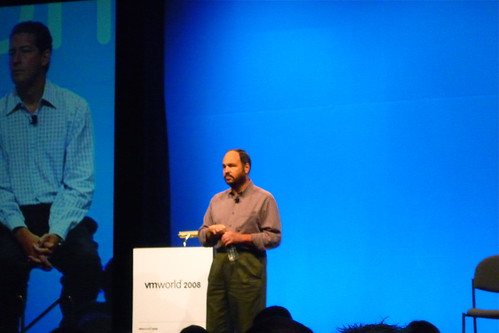
[8.06] Dr. Stephen Herrod, CTO, takes the stage.
Stephen Herrod

[8.07] They struggled choosing a name for the VDC OS. They took the name from their customers. The VDC OS is a continuation of the VMware roadmap.

Running through the three infrastructure components. (cpu/storage/network)

vCompute: yesterday Intel migration on FlexMigration / Enhanced VMotion Compatibility

[8.10] Over the past few years, they managed to go up to 4 VCPUs, 64 GB per VM, 9 GB/s network throughput and 100.000 IOPS. Near future: 8 VCPUs, 256 GB per VM, 40 GB/s and 200.000 IOPS.

[8.11] vCompute: bigger resource pools, up to 64 nodes per cluster, up to 4096 cpu cores

[8.12] DPM (Distributed Power Management) becomes more important as resource pools grow and capacity becomes abundant.

Showing a collective 50% savings when running a simulated workload with VMmark.

vStorage: lots of partners for SRM today.

[8.14] vStorage; started with VMFS. Recently: Storage VMotion, coming soon between protocols.

New features: Thin provisioning and linked clones. This is also possible in lots of storage arrays. They want to integrate with this arrays, to take advantage of the better performance of built-in features. vStorage API to make this possible.

[8.16] vNetwork: Attacking network visibility, QOS and scalability. Originally they focused on single servers, then they moved the attention to shared storage. Next up is shared networking.

[8.18] Today: virtual switch, needs to be configured per server. Doesn’t scale configuration-wise. State needs to move around with virtual machines. Answer: vNetwork distributed switch – a vSwitch that spans servers. Configure once, and use on every ESX host.

[8.19] Network vMotion: move the network state along with machines. Open API, making the first third party vSwitch possible: Cisco Nexus 1000V, a vSwitch with Cisco CLI.

[8.20] Moving up to application layer. VMware wants applications to behave better virtually than physically.

[8.21] vApp containers: Evolution of appliances, based on OVF, supporting multi-tiered applications. Necessary to easily move apps to the cloud.

vApp

[8.22] VMware is “obsessed with availaility”. Protection against planned and unplanned downtime. (VMotion, multipathing, teaming, HA, …) Wrapping this all together is Site Recovery Manager.

[8.23] Unplanned application downtime: VMware Fault Tolerance. (First demoed last year by Mendel Rosenblum, then called “Continuous Availability”)

[8.25] FT demo on stage by Mark Vaughn, customer from First American Corp who’s been using it in beta.

[8.27] Three ESX servers. Machine running on 1st, which is taken down. Keeps running on 2nd, and gets re-protected on 3rd server.

Demoing with jackpot application, powering off server, VM keeps running on second server.
FT demo
Very simple interface. Single click to protect a VM. Technology based on VMotion, called vLockstep.

[8.31] Moving up to Security vServices.

[8.32] All these features need good management. vCenter (new name for VirtualCenter). Fitting together with partner offerings.

Going over the different parts announced monday (see our post on VDC-OS for details.)

[8.37] More details on vCenter AppSpeed, based on Beehive acquisition. Dynamically adjust VM settings to meet QOS requirements. Demo with Asaf Wexler, Beehive founder.

[8.41] Demo of AppSpeed, now integrated with vCenter. Deep analysis of application behaviour, even multi-tiered. AppSpeed detects certain clicks in a web app that lead to database load, adjusting resources for database server as needed.

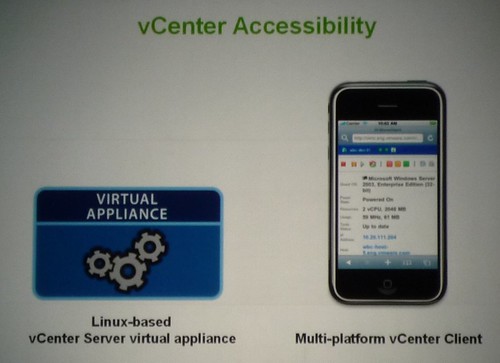
[8.45] Finally. vCenter Server virtual appliance, based on Linux. Applause in the crowd. (That’s what I’ve been telling them for more than 2 years by the way… lv)

Also working multiplatform clients. (iPhone, Blackberry, Mac, Linux)

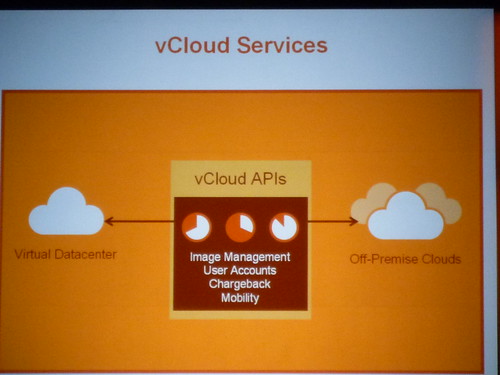
[8.47] Short overview of the vCloud initiative.

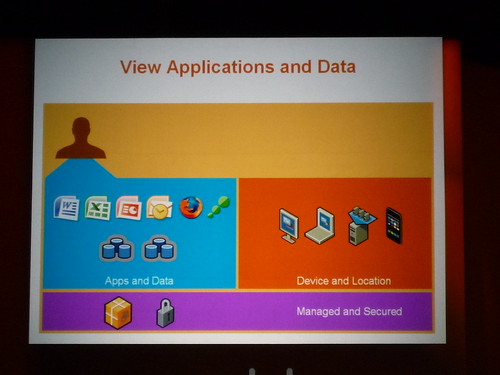
[8.50] Moving to vClient, the VMware View initiative. Apps and Data are no longer tied to physical devices, let alone location. The work “desktop” no longer fits the bill.

Adapting the user experience depending on location, network and device. Announcement yesterday of Teradici collaboration yesterday, for better RDP protocol.

[8.58 ] Repeating VMware has always been focused on the desktop as well. Started with Workstation in 1999, Unity in Fusion and Workstation 6.5, … The better (“fatter”) the client, the richer the experience should be.

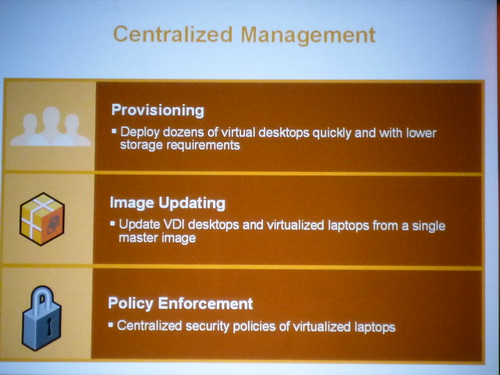
[8.59 ] Desktop management: Provisioning, Image updating and Policy enforcing. Demo of VMware View by Jerry Chen. View composer uses linked clones and templates to quickly deploy virtual desktops.


[9.04] VMware View can also manage physical desktop/laptops (using a “client hypervisor”) to deploy policies or applications. Installing apps by dragging Thinapps on top of VMs. Policies are deployed by modifying the master VM. Demo using Google Chrome. (Deploy app, deploy desktops, revoke access.)

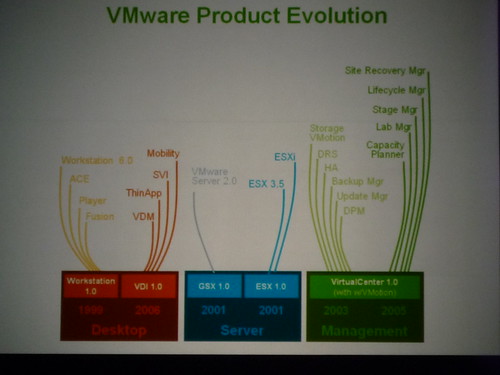
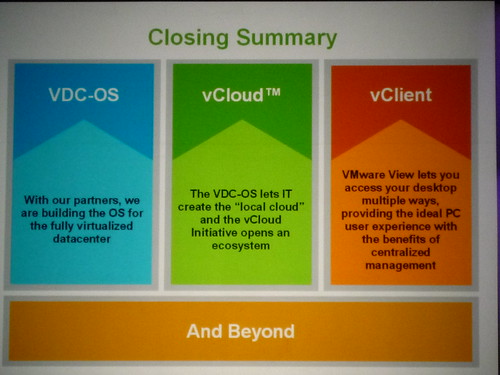
[9.11] Wrapping up with product evolution over the last 10 years, and the next initiatives.


Thanks again for following, that wraps up our live keynote coverage of VMworld 2008.

For more updates, follow me on Twitter, my site Lodev.name or contact me on LinkedIn

Filed Under: News Tagged With: vmware vmworld keynote liveblog

The Virtual Infrastructure Evolves Into The Virtual Datacenter OS

September 16, 2008 by Lode Vermeiren 3 Comments

More and more details on what VMware calls the “Virtual Datacenter OS” are starting to come out of VMworld. The new CEO, Paul Maritz, is expected to elaborate on this new strategy in today’s keynote. (update: check our live blog coverage)

(Update 2: also check the coverage on Between The Lines and Virtually Speaking, both ZDNet blogs)

The VDC-OS is not a new product per se, but an umbrella name for a set of products and features, much like VMware Virtual Infrastructure is composed of ESX server, VirtualCenter and features like DRS, HA and VMotion.

VDC-OS is a natural evolution from the “virtual infrastructure” approach, which no longer only includes the virtualization servers and their shared storage and networking, but also the “next layer” in the virtualization stack, both upwards and downwards: VDC-OS no longer stops at the guest OS level, but provides application services as well, and in the other direction goes beyond the local network and is aware of the bigger picture.

The building blocks that make up VDC-OS will sound very familiar to beta testers of ESX 4.0 and technology partners. They include some new features, recent acquisitions and better integrated versions of the current product line-up, as well as third-party add-ons bearing the VMware Ready logo. All of these are called “vServices”.

The three big areas of vServices VMware identifies are:

  • Application vServices – Availability, Security, Scalability
  • Infrastructure vServices – vCompute, vStorage, vNetwork and vCloud
  • Management vServices – vCenter (the new name for VirtualCenter)

The new and current features in depth:

Application Services
Availability:

  • HA, VMotion, Storage VMotion, NIC/HBA teaming
  • VMware Fault tolerance, formerly known as “Continuous availability” – which allows a VM to run on two hosts simultaneously, using lock-stepping of CPU instructions. (new)
  • vCenter Data Recovery – built-in disk-based backup and recovery of VMs and the files within them, including data deduplication. (new)

Security

  • ESXi, a stripped-down hypervisor in only 32 MB of code, to reduce the attack surface
  • VMware vSafe (first announced at VMworld Europe), with third party support add-ons from IBM, Checkpoint, Radware and McAfee, who will announce their first products today (new)

Scalability

  • DRS
  • Hot add of virtual CPU, memory and PCIe devices like network adapters (new)
  • Very large VMs with 8 virtual CPUs and 256 GB of RAM (new)

Infrastructure Services

vCompute

  • CPU/Memory optimization with hardware assists, page sharing and memory ballooning
  • DRS
  • VMDirectPath – enabling wirespeed network access to VMs (new)
  • Paravirtualized SCSI – providing more iops per second at lower latency (new)

vStorage

  • VMFS
  • Linked clones (first demonstrated at VMworld 2007 in San Francisco) – allows multiple VMs to run from the same base disk (new)
  • Storage VMotion
  • Thin Provisioning (new)
  • APIs to closer work together with storage arrays (new)

vNetwork

  • more offload technologies to reduce virtualization overhead
  • Distributed vNetwork virtual switches (new)
  • Third-party virtual switches – the first one to be announced today by Cisco (new)

Cloud Services (vCloud)

  • VMotion and Storage VMotion (within the “internal cloud”)
  • VMware vCloud (new)
  • Network vMotion – preserving network and security policies when a virtual machine is being migrated (new)
  • vApp – an encapsulation of a VM and its policies and service levels, based on OVF (new)

Management

vCenter replaces VirtualCenter, and integrates the add-on products today known as Stage Manger, Lab Manager and the likes. It integrates withing other management frameworks from the likes of IBM and CA.

  • vCenter AppSpeed – performance monitoring and remediation to guarantee service levels. (new)
  • vCenter Orchestrator – to automate repetitive workflows
  • vCenter CapacityIQ – proactive capacity planning for entire VI environments
  • vCenter Chargeback – to allow IT departments or cloud service providers to charge based on VM usage
  • vCenter ConfigControl – called “update manager on steroids” by VMware, a central way to configure and update the virtual data center
  • Host Profiles – to standardize the setup of ESX hosts using templates

Watch out for more announcements by VMware and its partners in the coming hours and days.

Filed Under: Featured, News Tagged With: ESX 4.0, ESX Server, Paul Maritz, VDC-OS, Virtual Datacenter OS, virtualcenter, virtualisation, virtualization, vmware, VMware ESX 4.0, VMWare ESX Server, VMware Virtual Datacenter OS, vmware virtualcenter, VMware vServices, vServices

VMworld 2008 – VMware CEO Paul Maritz Keynote Liveblog

September 16, 2008 by Lode Vermeiren

Welcome to the Virtualization.come liveblog of the VMworld 2008 Keynote with CEO Paul Maritz.
[Updated with Q&A and more pictures]

[8.09] The program is starting. A video with testimonials from eBay, Qualcomm and the likes is on the big screens. There’s 14.000 people in the room ready for the first big keynote of the new CEO.

[8.10] The theme of the conference and the keynote is “Virtually anything is possible”.

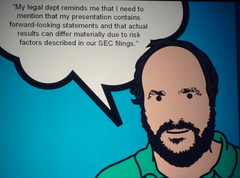
[8.11] Paul Maritz takes the stage. Since VMware is now a public company, a disclaimer about forward looking statements is projected on the screen.

[8.12] 2008 is the occasion of two anniversaries: the 10th anniversary of VMware, and Paul Maritz stated working 30 years ago. Over the last three decades he’s seen several big “tsunamis” in IT. He’s looking forward to the next waves.

[8.13] Maritz recognizes two big forces, centralized and decentralized IT. Both have their strenghts and weaknesses. VMware brings the best of both: central, easy management, and a rich, customized user experience.

[8.14] Martiz spend a big part of the 1990s as an evangelist of client-server computing (while at Microsoft), leading to a big proliferation of x86 servers around the world.

[8.16] At the same time during the mid 1990s, the world wide web emerged, providing a rich yet decentralized user experience.

[8.17] Maritz recognizes the contribution of Diane Greene and Mendel Rosenblum, who founded VMware in 1998 and recently left the company.

[8.18] The roots of VMware are in the first product, VMware Workstation, a client-side product with extremely clever engineering.

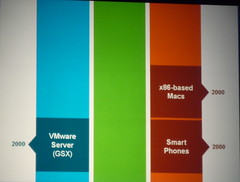
As CPUs got more powerful, VMware introduced server products, the first being VMware GSX in 2000.

[8.19] The success of server virtualization made the VMware Infrastructure possible in 2004, to address the management issues that arose from an increasing number of servers, virtualized and physical.

Over the last few years, new application frameworks have emerged merging centralized computing and rich end user experiences. Examples are AJAX, RoR, Python-based frameworks like Django, ..

[8.21] VMware has continued to invest in client-side computing. like VMware Fusion in 2007 – lowering the barrier of Macs to enter into most corporate environments.

Nowadays, in 2008, the big buzzword is “cloud”. Paul Maritz says everyone’s got “cloud fever”.

We’re moving fundamentally away from a client-centered world. The applications and services get more flexible, and move around between places and devices. This requires the IT environments to be managed as a giant environment – a cloud.

[8.23] VMware is responding to this trends with three initiatives: Virtual Datacenter OS, vCloud Initiative, vClient Initiative.

The driving forces:

  • Internal cloud – IT departments are forced to use their resources and applications even more efficient and efficiently.
  • Scaling outside the firewalll – Making the connection between the internal cloud and external cloud providers in public datacenters. (such as Amazon EC2, ..)
  • Solving the “desktop dilemma”

The first announcement is the formal announcement of the “virtual datacenter OS” – a new level of abstraction that separates the underlying infrastructure from the application workloads, to create a self-healing, self-managing elastic compute cloud.

[8.27] Several collaborations made this vCompute, vCloud, … initiatives possible. The first one is a collaboration between Intel and VMware.

Intel Xeon 7400 series provide the next generation of FlexMigration technology, making VMotion between heterogeneous CPUs possible.

Cisco formally announces the first third-party virtual switch for the Virtual Infrastructure.

vStorage: disaster recovery collaboration with lots of storage vendors to enable Site Recovery Manager. Up on the slide now: 3par, Falconstore, Compellent, IBM, Dell EqualLogic, EMC, Netapp, HP, Lefthand, Xiotech and Netapp.

[830] vApps: extending the Virtual Appliance approach. Initial support from IBM, SAP and Novell. vApps describes collections of appliances (for multi-tiered applications), and their service level properties. This metadata enables the VDC OS to provide service levels to this collection of apps.

[8.33] New management services to help manage this extensive datacenter OS. VirtualCenter becomes vCenter: a framework into which new plugins that extend the services can be integrated. It also interacts with third party management software from BMC, CA, HP, IBM Tivoli, …

[8.36] The strategic, business benefits of a VDC-OS, according to VMware:

  • Increase infrastructure efficiency with standardized management and efficient use of resources
  • Increase application agility with simple provisioning, repurposing and zero downtime
  • Enable business driven IT, whith shorter response times, quick disaster recovery, pay-for-usage models and reduced energy and real estate needs

[8.39] Even though this all sounds quite new, the needs for this cloud are here today. VMware hopes to be able to make the internal infrastructure, the “internal clooud” to be more compatible with external cloud providers.

Service provider partners today: more than 100. On the slide: BT, Verizon, Sungard, Savvis and T Systems. They provide compatibility with workloads defined as vApps.

[8.43] Technology preview of the vCloud on stage. Demo: an application has an SLA with a response time under 4 seconds. If the SLA is not met, the app will be pushed to an external cloud provider. The SLA is defined using the Appspeed component of vCenter

[8.48] Extra load is being generated. The internal VM can’t meet the SLA anymore, so a VM is being launched in the cloud to which the load is diverted.

Interesting demo, but a bit hard to grasp from a distance, not as impressive as continuous availability last year (now called VMware Fault Tolerance). This will be cool nonetheless.

[8.50] Now on to the Desktop Dilemma. IT wants to bring down costs, the users want to be mobile, use macs, don’t want the info locked up in a single device, want the info anywhere, anywhere, and in a rich experience. This will be the VMware View announcement.

Data lifetime spans device lifetime, so it should not be lockup up in a single device.

VMware has always continued to invest in client-side products.

[8.53] The first solution to this problem was the VMware VDI concept. This way, the users workspace was no longer tied to a single device.

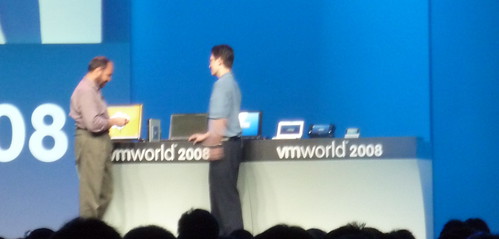
[8.56] A next demo of VMware View. First they demo the existing VDM product on a thin client. There’s lots of other devices on the stage though. The VM is saved on a USB key, which is used to boot a laptop. They also demo improved 3D graphics support.

New announcement: codevelopment with Teradici to improve the remote desktop protocol.

The new product family of VDI products is going to be called VMware View.

[9.05] And with that, the keynote comes to an end. Paul Maritz seems to have forgotten the Twitter questions…

So that wraps up our first live keynote blog. Keep watching Virtualization.com for more updates from VMworld. A video overview of the keynote will be following soon.


Update: Some of the questions from the Q&A session afterwards:


Q: What do you see as the two major challenges for VMware in the coming years?

A: Paul Maritz – Several related challenges: Deepen and extend the value proposition of the products, and extend this to the cloud. The organisation needs to mature further to be able to deliver this into actual products. Maintain high quality, interact with the ecosystem around virtualization, mature as a partner. Reach out better to the community. Articulate this all to the customers.

Q: What about the threat posed by Red Hat/Qumranet/KVM
A: Paul Maritz – Open Source is a great phenomenon. Open sourcing ESX has been discussed already. First step is making ESXi free. They’re not religious about not supporting for instance Xen in the VDC framework.

Q: How does SRM fit in with the vCloud initiative. Will it not make SRM redundant?
A: vCloud federation complements SRM in a way that it facilitates DR for companies that have no external disaster site, to be able to get up and running faster on an external cloud.

Q: Is VMware becoming an OS company?
A: Paul Martiz – In a way. That’s why it’s explicitly called Virtual Datacenter Operating System. The name came from customers, who kept calling it a Datacenter OS.

It’s an OS in the sense that it abstracts the applciation loads from the underlying hardware. Not in a traditional OS/app sense, but it has lots of parallels with traditional OS’es, so the name does apply. The services and APIs can be used to deliver OS capabilities, to frameworks like Ruby on Rails, so that the underlying [JeOS] gets thinner and thinner in the complete framework.

Q: VMotion today is restricted to a network domain. Are you working on enabling this across networks and geographies?
A: Yes. On the storage side we need replication for this. On the network side you need stretched VLANs or interaction with routing tables. VMware is working with its partners to provide this capabilities.

Q: Are there initiatives coming for non-profits and educational customers?
A: Today there is already academic pricing for US schools. There also will be an academic program to provide software to schools around the world, which will later be extended to non-profits.
No timeframe on this yet.

Q: Are you going to further expand your product line to the Mac? Specifically ESX and ACE.
A: More on this in the Fusion / ACE sessions..

Q: The issue with update 2 (the timebomb bug) was a wake-up call that VMware is becoming a single point of failure for the complete datacenter. How do you address this very real concern?
A: Paul Maritz: We’re continously maturing and improving our QA and security procedures. The issue with update 2 was amateur hour. We do take this serious and try to make sure this never happens again.

[NB: There’s a session with Paul Maritz on this issue tomorrow afternoon.]

Q: It seems like everytime I dream about a new feature I’d like to see in VMware, you guys come up with it. However, one big issue with the vCloud initiative is time drift in application. How will you fix this?
A: It is a big dilemma. On the Linux side we’re submitting patches to the kernel to improve this. Paravirtualization also helps OS’es communicate with the hypervisor to avoid timing issues.

Q: With the VDI solution where the desktop can reside on different devices. How’s the licensing going to work out? Per client? Per devices?
A: Not worked out yet.

Q: When are you going to release a VirtualCenter client for Linux?
A: Paul Martiz – I think VirtualCenter as a modern application should be OS independent. It’s not out of the question, but it’s hard work, not in a defined roadmap yet.

Filed Under: Uncategorized Tagged With: vmworld keynote vmware

  • « Go to Previous Page
  • Go to page 1
  • Go to page 2
  • Go to page 3

Primary Sidebar

Tags

acquisition application virtualization Cisco citrix Citrix Systems citrix xenserver cloud computing Dell desktop virtualization EMC financing Funding Hewlett Packard HP Hyper-V IBM industry moves intel interview kvm linux microsoft Microsoft Hyper-V Novell oracle Parallels red hat research server virtualization sun sun microsystems VDI video virtual desktop Virtual Iron virtualisation virtualization vmware VMware ESX VMWorld VMWorld 2008 VMWorld Europe 2008 Xen xenserver xensource

Recent Comments

  • C program on Red Hat Launches Virtual Storage Appliance For Amazon Web Services
  • Hamzaoui on $500 Million For XenSource, Where Did All The Money Go?
  • vijay kumar on NComputing Debuts X350
  • Samar on VMware / SpringSource Acquires GemStone Systems
  • Meo on Cisco, Citrix Join Forces To Deliver Rich Media-Enabled Virtual Desktops

Copyright © 2025 · Genesis Sample on Genesis Framework · WordPress · Log in

  • Newsletter
  • Advertise
  • Contact
  • About