
• Skip to primary navigation
  • Skip to main content
  • Skip to primary sidebar
Virtualization.com

Virtualization.com

News and insights from the vibrant world of virtualization and cloud computing

  • News
  • Featured
  • Partnerships
  • People
  • Acquisitions
  • Guest Posts
  • Interviews
  • Videos
  • Funding

vCloud

Wyse Software Suite Components To Be Integrated Into VMware View

September 28, 2008 by Robin Wauters Leave a Comment

VMware today announced a licensing agreement with Wyse Technology to use its remote display software to enhance RDP for VMware View. Bolstering its vClient Initiative and its commitment to support broad customer choice for the use of multiple protocol technologies, VMware plans to integrate two components of Wyse’s software suite into a future release of VMware View.

VMware View will include a portfolio of products that will give end users a single view of all their applications and data in a familiar, personalized environment – dubbed “myview” – that will be available from almost any device and location. With VMware View, enterprises will be able to replace traditional PCs with virtual desktops that follow users instead of devices. These virtual desktops will be centrally managed in the datacenter, but they will be able to run locally on a laptop or remotely from a server. VMware View will help enterprises achieve streamlined desktop and application management while reducing desktop TCO, improving security of data and enhancing user experience, flexibility and productivity.

In addition to supporting Wyse thin clients, the licensing agreement is designed to enable VMware to use Wyse’s enhancements with personal computers and third-party thin client devices. VMware View with Wyse’s TCX-MMR (multimedia) and TCX-MDS (multi-display) solutions will enhance virtual desktop solutions.

As part of VMware’s vClient initiative, VMware View will provide customers the flexibility to choose the protocol for its users through multi-protocol support. VMware also plans to license Teradici’s PC-over-IP protocol as previously announced. In addition, VMware View is expected to support protocols from HP and Sun.
VMware

Filed Under: Partnerships Tagged With: licensing agreement, myview, RDP, RDP for VMware View, vCloud, virtualisation, virtualization, vmware, VMware vCloud, VMware View, Wyse, Wyse Software Suite, Wyse Technology

vCloud: VMware To Be Cloud Computing Provider Too, But Inside Your Private DC (And Not Tomorrow)

September 15, 2008 by Toon Vanagt 3 Comments

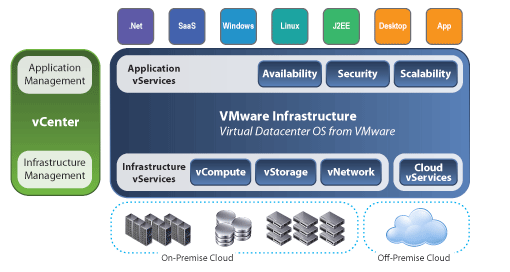
Many of the 14.000 attendants to VMworld will be happy to learn they are not going to be out of their jobs soon. Especially with cloud providers threatening to reduce corporate IT departments, completely virtualized datacenters are believed to be the future. VMware intends to keep those datacenters under their corporate client’s control on standardized X86 hardware.

(Update: link to the ‘Virtual Datacenter OS for VMware‘ product page and its Cloud vServices)

(Update 2: the link to the official press release, more comments below and a mention on Between The Lines)

Will vCloud be introduced as a cure against outsourcing to third party data centers? It is VMware’s aspiration to offer every business the flexible infrastructure associated with Amazon, Google and Salesforce. However without the need to offer excess computing power to external clients. VMware is not alone with this vision as this is very close to the network grail George Kurian at Cisco envisions:

What is most important in the virtualization world is to not to think about your data center as traditional silos of storage, server, network, firewall, application… We need to bring virtualization into the network… If you think about networking speeds and latency getting faster and lower respectively, you can, in essence, really extend virtualization to all aspects of IT systems. Down the road we see the opportunity to drive things like processor virtualization, memory virtualization, as interconnect speeds go up dramatically and latencies reduce over the next two to three years.

VMware’s new CEO Paul Maritz (who was an early believer in cloud computing) will use this vCloud announcement (not a product release) to warm up the 14,000 people expected at its annual conference in Las Vegas this week. According to a well researched article by Patrick Thibodeau over at Computer World:

… the planned cornerstone product is VMware’s Virtual Datacenter Operating System (VDC-OS) for managing the underlying systems, or “internal cloud.” Desktops and laptops are part of this virtualization umbrella, with their operating systems running in a virtual machine on the client computer that is managed back from the data center. VMware also wants to make it possible for IT managers to seamlessly tap into the resources of third-party hosting providers in the same way they can now move server resources inside their data center. It calls this new technology vCloud. VMware’s product set, including its VDC-OS, is limited to x86 architectures. That’s why Bogomil Balkansky, VMware’s senior director of product marketing cited Google as the example of IT’s Parthenon, and not the data center of some other Fortune 100 company. Google has standardized on x86. Most other large companies and many mid-sized firms also have environments that include RISC-based servers, Unix operating systems and midrange systems running Cobol-based applications that have been developed over decades — not on the new systems that Google has bought and built in its 10 short years….
Charles King, an analyst at Pund-IT Inc. in Hayward, Calif., believes VMware’s approach will raise interesting questions for hardware vendors, in particular, about its long-term impact on their products. If all x86 systems are treated as virtual pools, the underlying hardware may be of less consequence, he said.

The initiative has broad support from partners across the industry, including BT, Rackspace, SAVVIS, Sungard, T-Systems, and Verizon Business.

Intel will not be shocked by that conclusion as it will gladly ship those six core processors. Neither will HP be panicking as it has been succesfully integrating its own virtualization suites across multiple platforms (X86, Integrity) and continues to extend its Opsware capabilities. And Sun went open source with its xVM Server as outgrowth of the Xen project that even supports SPARC and Solaris.

We are very curious if “vCloud” as a product name is going to survive the release cycles and the vetting by their marketing department. It also has to be noted that vCloud is specifically intentend to be an Operating System for all aspects of the virtual datacenter. We suggest to rather name it the VDC-framework, as it seems to contain sets of services to be extended in very standardized ways (APIs & SDKs) and no direct interaction with the underlying hardware. The Xen model has proven to be very successful with such ‘extensions’ by third party ISVs.

We could not help to notice that the domain name vCloud.com redirects to VoiceCloud.com, which is powered by that omni-present cloud provider: Amazon Web Services.

VMware’s partners do learn there is some good news to with plenty of room to hook on those new API sets and offer their tools for managing heterogeneous hypervisor environments or as Balkansky boldly puts it:

“Our strategy for now is to provide richer capabilities for our operating systems rather than provide some shallow capabilities for other platforms”.

Update: More interesting links on this VMworld keynote surprise spoiler:

  • Virtual Datacenter OS: official release from VMware
  • VMware’s Virtual Datacenter OS by Scott Lowe
  • VMware Tries to Expand Throughout the Data Center by James Niccolai at PCworld

Filed Under: Featured, News Tagged With: cloud, cloud computing, Cloud vServices, Paul Maritz, vCenter, vCloud, vCloud Initiative, VDC-OS, Virtual Datacenter Operating System, Virtual Datacenter Operating System for VMware, Virtual Datacenter OS, Virtual Datacenter OS from VMware, Virtual Private Data Center, virtualisation, virtualization, vmware, VMWorld, VPDC

  • « Go to Previous Page
  • Go to page 1
  • Go to page 2

Primary Sidebar

Tags

acquisition application virtualization Cisco citrix Citrix Systems citrix xenserver cloud computing Dell desktop virtualization EMC financing Funding Hewlett Packard HP Hyper-V IBM industry moves intel interview kvm linux microsoft Microsoft Hyper-V Novell oracle Parallels red hat research server virtualization sun sun microsystems VDI video virtual desktop Virtual Iron virtualisation virtualization vmware VMware ESX VMWorld VMWorld 2008 VMWorld Europe 2008 Xen xenserver xensource

Recent Comments

  • C program on Red Hat Launches Virtual Storage Appliance For Amazon Web Services
  • Hamzaoui on $500 Million For XenSource, Where Did All The Money Go?
  • vijay kumar on NComputing Debuts X350
  • Samar on VMware / SpringSource Acquires GemStone Systems
  • Meo on Cisco, Citrix Join Forces To Deliver Rich Media-Enabled Virtual Desktops

Copyright © 2025 · Genesis Sample on Genesis Framework · WordPress · Log in

  • Newsletter
  • Advertise
  • Contact
  • About