
• Skip to primary navigation
  • Skip to main content
  • Skip to primary sidebar
Virtualization.com

Virtualization.com

News and insights from the vibrant world of virtualization and cloud computing

  • News
  • Featured
  • Partnerships
  • People
  • Acquisitions
  • Guest Posts
  • Interviews
  • Videos
  • Funding

LAN

Meru Networks Launches “Virtual Ports” For Wireless Network

November 10, 2008 by Robin Wauters Leave a Comment

Meru Networks has brought the techniques of virtualization to the wireless world, enabling the optimization of radio frequency (RF) resources to bring wireless LAN performance and reliability level with wired networks, reducing the price of wireless networking to a fraction of its wired equivalent.

Meru’s established “virtual cell” WLAN architecture, first launched in 2003, puts all access points on a single radio channel. This benefits companies by reducing or eliminating the need for costly RF planning, while ensuring excellent quality of service for mobile users.

With today’s introduction of Meru’s new “virtual port” capability, every wireless client device accessing the WLAN (laptop, phone, PDA, scanner) gets its own unique identifier (BSSID) that stays with the device wherever it moves within the WLAN.

This lets enterprises control the WLAN resources that an individual client device gets – just as in a wired switched network – providing enterprises with the ability to predict the cost of managing, provisioning and growing the wireless network in the way they have managed servers, storage and wired network resources.
The increased control realized with virtual port technology is especially important as wireless becomes the primary edge technology for network connectivity in an increasing number of environments, and as new and diverse wireless devices, based on the high-performance 802.11n Wi-Fi standard, proliferate throughout the enterprise.

Virtual port technology is available with Meru’s System Director 3.6 software, which is available now. Meru customers with active support contracts can upgrade to virtual port capability at no charge.
Filed Under: News Tagged With: LAN, LAN virtualization, Meru, Meru Networks, radio frequency, RF, virtualisation, virtualization, virtualization LAN, wired networks, wireless

Virtualize Your BlackBerry With The Bayalink Liberty USB Key

February 28, 2008 by Robin Wauters 2 Comments

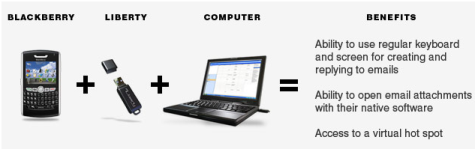
Software developer Bayalink Solutions recently announced the general availability of Bayalink Liberty, a virtualization solution for BlackBerry smartphones from Research In Motion (RIM). Liberty is a Bluetooth-enabled USB key enabling you to view RIM smartphone applications and documents on a PC screen and type with a full-size keyboard.

virtualization-blackberry-usb-bayalink-liberty1.png

Once the necessary software is installed, Liberty allows you to access your BlackBerry mailbox and other applications like contacts and calendar information—in their native formats—and both Internet Explorer and Firefox browsers on a much larger screen, as well as type messages or commands using a normal sized keyboard. The Liberty key uses the BlackBerry data connection to access e-mail and the Web, so users can connect via most Windows-based PCs with USB ports, regardless of whether or not they’re in range of a LAN or Wi-Fi network. That means enterprise BlackBerry users who access the Internet through BES servers and connect to corporate systems via Virtual Private Networks don’t need to mess with any special VPN software when connecting with their laptops.

You can watch a demo here.

The hardware + software kit doesn’t exactly come cheap: ordering makes you $ 99 lighter, renewable at the same price every year, although the relatively high pricing isn’t likely to stop enterprise users from purchasing the handy utility. Unfortunately, Bayalink Liberty only works with PCs running Windows 2000/XP/Vista, so Mac or Linux users are out of luck for the time being. Furthermore, the software is only available for BlackBerry 8700 series devices with OS 4.2.1.101 or higher; BlackBerry Pearls; BlackBerry Curves; and BlackBerry 8830 World Edition smartphones.

[Source: Advice CIO]

Filed Under: News Tagged With: Bayalink, Bayalink Liberty, Bayalink Solutions, BlackBerry, BlackBerry 8700, BlackBerry 8830 World Edition, BlackBerry Curve, BlackBerry Pearl, LAN, Liberty, Research in Motion, RIM, Virtual Private Network, virtualisation, virtualization, VPN, Wi-Fi

Primary Sidebar

Tags

acquisition application virtualization Cisco citrix Citrix Systems citrix xenserver cloud computing Dell desktop virtualization EMC financing Funding Hewlett Packard HP Hyper-V IBM industry moves intel interview kvm linux microsoft Microsoft Hyper-V Novell oracle Parallels red hat research server virtualization sun sun microsystems VDI video virtual desktop Virtual Iron virtualisation virtualization vmware VMware ESX VMWorld VMWorld 2008 VMWorld Europe 2008 Xen xenserver xensource

Recent Comments

  • C program on Red Hat Launches Virtual Storage Appliance For Amazon Web Services
  • Hamzaoui on $500 Million For XenSource, Where Did All The Money Go?
  • vijay kumar on NComputing Debuts X350
  • Samar on VMware / SpringSource Acquires GemStone Systems
  • Meo on Cisco, Citrix Join Forces To Deliver Rich Media-Enabled Virtual Desktops

Copyright © 2025 · Genesis Sample on Genesis Framework · WordPress · Log in

  • Newsletter
  • Advertise
  • Contact
  • About