
• Skip to primary navigation
  • Skip to main content
  • Skip to primary sidebar
Virtualization.com

Virtualization.com

News and insights from the vibrant world of virtualization and cloud computing

  • News
  • Featured
  • Partnerships
  • People
  • Acquisitions
  • Guest Posts
  • Interviews
  • Videos
  • Funding

Search Results for: virtualization security

Call for Papers on Virtualization in High-Performance Cluster

January 26, 2008 by Robin Wauters Leave a Comment

The 3rd Workshop on Virtualization in High-Performance Cluster and Grid Computing (VHPC’08) is calling for papers. This prestigious workshop will be held as part of Euro-Par 2008, at Las Palmas de Gran Canaria on the Canary Island in Spain from August 26 to 29, 2008

Focus on Virtual machine monitors (VMMs)

VMMs are reaching wide-spread adoption in a variety of operating systems as well as scientific educational and operational usage areas. With their low overhead, hypervisors allow for concurrently running large numbers of virtual machines, providing each encapsulation, isolation and in the case of Xen, network-wide CPU migratability. VMMs offer a network-wide abstraction layer of individual machine resources to OS environments, thereby opening whole new cluster-and grid high-performance computing (HPC) architectures and HPC services options. With VMMs finding applications in HPC environments, these workshops aim to bring together researchers and practitioners active on virtualization in distributed and high-performance cluster and grid computing environments. The workshops will be one day in length, composed of 20 min paper presentations, each followed by 10 min discussion sections. Presentations may be accompanied with interactive demonstrations and the accepted papers will be published in the Springer LNCS series. The workshop will be chaired by Michael Alexander (WU in Vienna) and Stephen Childs (co-chair), Trinity College in Dublin and will end with a 30 minute panel discussion by the presenters.

Topics include the following subject matters:

Virtualization in cluster and grid environments

Workload characterizations for VM-based clusters

  • Virtualization in cluster and grid environments
    Workload characterizations for VM-based clusters
    VM cluster and grid architectures
    Cluster reliability, fault-tolerance, and security
    Compute job entry and scheduling
    Compute workload load leveling
    Cluster and grid filesystems for VMs
    VMMs, VMs and QoS guarantees
    Research and education use cases
    VM cluster distribution algorithms
    MPI, PVM on virtual machines
    System sizing
    Hardware support for virtualization
    High-speed interconnects in hypervisors
    Hypervisor extensions and utilities for cluster and grid computing
    Network architectures for VM-based clusters
    VMMs/Hypervisors on large SMP machines
    Performance models
    Performance management and tuning hosts and guest VMs
    Power considerations
    VMM performance tuning on various load types
    Xen/other VMM cluster/grid tools
    High-speed Device access from VMs
    Management, deployment of clusters and grid environments with VMs
    Information systems for virtualized clusters
    Management of system images for virtual machines
    Integration with relevant standards e.g. CIM, GLUE, OGF, etc.
Filed Under: News Tagged With: call for papers, euro-par 2008, HPC, vhpc08, virtual machine monitors, virtualisation, virtualization, VMM, workshop

VMWare Picks Up Desktop Virtualization Startup Thinstall

January 15, 2008 by Robin Wauters 2 Comments

Virtualization may well be considered non-sexy in some parts , VMWare’s announcement that it is set to acquire Thinstall , a San Francisco-based desktop virtualization technology provider, should be able to change that view. Bringing virtualization to the desktop is a natural evolution that is destined to become a huge opportunity in a thriving market, and Thinstall’s remarkable progress over the past few years have obviously captured the attention of the 30,6 billion $ gorilla, who made the acquisition move for an undisclosed amount.

virtualization-vmware-thinstall.jpg

When you install a Windows program or an upgrade of a previously installed program on your PC, it messes with just about everything, including the registry that stores all of the settings, options, and configuration files for the Windows OS. That, in turn, opens up opportunities for security breaches and vastly increases other headaches for the IT staff who have to deploy software in organizations with lots of PCs. It all makes the idea of software-as-a-service—serving up applications on-demand over corporate networks or the web— look quite appealing. But if companies could give their employees a way to run traditional desktop programs like MS Word and PowerPoint over a corporate network without actually having to install them, they could keep using these powerful programs with less hassle—and might not be so tempted by web-based alternatives like Google Docs.

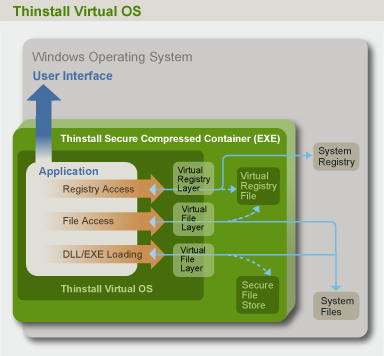
That’s exactly what Thinstall allows. Using its system, companies can create special, compact Thinstall versions of programs like PowerPoint. When a worker accesses one of these executable files over a network, it loads within a virtual operating system that communicates with the resident operating system, but doesn’t modify it in any way. A “thinstalled” application runs in “user mode” only, meaning that the user can start it, but can’t fiddle with the machine’s other settings.

For VMware, this deal pushes them deeper into the software side of virtualization, which is a good thing considering the company’s dominant market share on the server side. To feed that huge market cap, VMware needs to grow. That’s exactly what makes buying Thinstall, an application virtualization product much similar to Microsoft SoftGrid, Citrix’s Application Streaming, or Symantec / Altiris’s SVS technology, a very logical step. The move also follows on the heels of VMware’s purchase of small independent software integrator Propero . The company will likely make additional buys to stay ahead of its competition.

For additional analysis, you might want to give The Brian Madden Company‘s piece a good read.

VMware also disclosed its acquisition of services-related assets from Foedus , a Portsmouth, New Hampshire-based provider of virtualization technologies and services. From the press release:

VMware intends to leverage Foedus’s application and desktop virtualization services expertise to help VMware partners expand their virtualization services business.  Foedus’s remaining assets, including the company’s sales and marketing organizations, were acquired earlier this month by GreenPages Technology, a national, consultative IT solutions provider and VMware Authorized Consultant (VAC) partner.

Filed Under: Acquisitions, News Tagged With: acquisition, application virtualization, desktop virtualization, Foedus, Thinstall, virtualisation, virtualization, vmware

Today the future of Virtualization was demoed by VMWare

September 13, 2007 by Robin Wauters Leave a Comment

Over the last few years virtualization became a mainstream tool for IT administrators looking to consolidate applications within a data center and continues to be adopted as companies expand the technology to plan for business continuity and create high-availability servers.
At the same time virtualization becomes more available in desktops and mobile devices, where the increased flexibility allows businesses and consumers to reduce costs and increase security.

At VMware’s conference in San Francisco today, their chief scientist Mendel Rosenblum demoed an impressive step ahead in raising the high-availability capabilities of Virtualization technology.

Dr. Mendel RosenblumRosenblum saw the future of Virtualization and named it continuous high availability

He demonstrated two servers running Microsoft Exchange Server being replicated in real time from one virtualization host to another. The primary server on stage that was running the equivalent of 50 users pounding on Microsoft Outlook. The server’s ongoing activity was being mirrored on a secondary server, which was receiving a live stream of events as they were entered into the log of the virtual machine on the first server.

Through a new twist on VMware’s management software, Virtual Infrastructure 3, he unplugged the primary machine, and the second detected a failure and shifted handling the users to the secondary server. Since this secondary server was already receiving a stream of log events, it could pick up at the precise point where the other had left off. The pause between one virtual machine stopping and the secondary server’s virtual machine starting appeared to be about a second.  This is basically extending to memory and input devices interaction what is applied to storage data with continuous data protection (CDP) solutions well-known in the security industry. Read the above twice and show of your knowledge of the latest acronym to your tech-savvy friends and explain what CHA or “continuous high availability” stands for in Virtualized environments.

“Ultimately, virtualization will bring about a vision that server makers years ago presented–a dynamically adjusting, self-managing data center…since this approach works not for a few select applications but for anything that runs in a VMware virtual machine! By adopting an approach in between streaming and software-as-a-service, the application starts to run after about 10% of the download occurs, making virtualized applications more palatable to end users…What we’re effectively doing is taking things that were statically assigned in the past and turning them over to a piece of software that makes decisions about how to schedule it. We’re moving toward this idea of a data center that really manages the hardware itself.” Rosenblum added.
Although this much applauded technology is far from being shipped to their customers, VMware seems to have set another milestone in the Virtualization history.
Detailed reports of his keynote are written by the editors Stephen Shankland, Charles Babcock  and industry blogger Alessandro Perilli.

Filed Under: News, People Tagged With: IT administration, Mendel Rosenblum, Microsoft Exchange Server, Virtual Infrastructure 3, virtualisation, virtualization, vmware

HP upgrades virtualization features of Integrity servers

March 20, 2006 by Robin Wauters Leave a Comment

Quoting from the HP official announcement:

HP has enhanced its HP Integrity server line and HP-UX 11i operating environment with significant capacity, virtualization and management upgrades.

The enhancements offer customers greater server capacity as well as faster deployment of enterprise software within an HP Virtual Server Environment (VSE) running on the HP-UX 11i operating system – some virtualization projects can be brought online in less than half the time.
…
The next-generation chipset for Integrity servers delivers significant enhancements to performance and availability. The chipset enables customers to get 30 percent more work done across multiple workloads, while using the same number of Intel Itanium 2 processors. Featured and available today in the cell-based HP Integrity rx7640, rx8640 and Superdome servers, the chipset delivers single system availability features to improve memory availability, interconnectivity and fault tolerance…

Enhanced security and availability

HP is extending its business continuity and availability solutions by providing more disaster-tolerance offerings for HP-UX 11i customers. The capabilities include intercontinental failover of Oracle® 10g environments and support of SONET, a low-cost networking option for disaster recovery. New HP Serviceguard Extensions for SAP improve the speed and simplicity of high-availability solutions for HP-UX 11i and Linux on HP Integrity servers. …More information about HP Integrity systems is available at www.hp.com/go/integritymarch06.

Filed Under: News Tagged With: Hewlett Packard, HP, HP Integrity, HP Virtual Server Environment, HP-UX 11i, Integrity, virtualisation, virtualization, VSE

Impacts of Application Virtualization and Streaming

February 24, 2006 by Robin Wauters Leave a Comment

Softricity hosted an interesting webcast with Brian Gammage, Gartner Research Vice President, about desktop virtualization:

Virtualization is widely regarded as the most important technology to hit the enterprise in decades. The potential benefits for the desktop are tremendous, with improvements in the manageability, security and flexibility of personal computing. By reducing complexity, virtualization promises to streamline support, accelerate deployments and reduce the cost of personal computing. But virtualization is occurring at more than one level; decoupling hardware, operating systems and applications. So, what are these different levels of virtualization technology and how are they being used by companies today? How mature is the technology? How does application virtualization differ from machine virtualization and what role does streaming technology play?

Join featured Gartner Research Vice President, Brian Gammage, a recognized expert in desktop virtualization, to learn what application virtualization and streaming really are, and how they can impact your approach to managing user access to enterprise applications.

See it here.

Thanks to Thincomputing.net for the news.

Filed Under: News, Videos Tagged With: brian gammage, desktop virtualization, gartner, gartner research, softricity, thincomputing, virtualisation, virtualization

Video: Interview Simon Crosby, CTO of XenSource – Citrix (VMworld 2008) part 2/2

November 13, 2008 by Toon Vanagt 1 Comment

In this second part of our exclusive video interview recorded at VMworld2008 in Las Vegas, the Citrix XenSource CTO denies that there is more than a ‘fabulous partnership’ between Microsoft and Citrix. In his typical outspoken style, Simon Crosby does not see his competitor VMware take of into the clouds with vaporware. He remains an advocate for open standards and shines his light on Virtualization security issues (aka VirtSec by the insiders).

.
A full transcript of the interview is below and the  first part of our interview can be viewed here.

(00:00) Simon, in the blogosphere there are these ever mounting rumors about Microsoft and Citrix. What can you comment on that relationship. Add Cisco, VMware and you’ve got a complicated puzzle.

It is.

(00:10) It’s intriguing though.  Many people see a lot of interesting things going on there, what can you say about that?

So our partnership with Microsoft is great.  I mean fabulous.  Microsoft makes a ton out of everything of what Citrix does and they give us scale and we basically take the platform, extend its features set. We’ve done this for years.  It turned out to what XenSource was doing in Virtualization with Microsoft, very similar to the traditional Citrix model of working closely with Microsoft to extend the platform and deliver a bunch of features.  So we do that today and so we’re partner in Virtualization for XenDesktop and runs great on Hyper-V, runs great on XenServer and you know, that’s a terrific partnership.  We’ve partnered also in the area of Virtualization generally and interoperability is key. But XenServer in the platinum edition, not generally known, has the ability to run VMs on VMware or Hyper-V or Xen or even bare metal. Okay, so once you’ve taken your VMs and centralized them into a central repository, we can boot them and run them on anything, right?  Which allows us to extend the concept of Virtualization beyond just Xen, to other hypervisors and even bare metal.

(01:23) If we go back to the cloud concept, because that has been buzzing this industry for a few months now.  What I find quite intriguing is that there’s no standards.  Every cloud has its own APIs and with VMware launching its newest product line (vCloud).  It’s not very clear what those APIs are going to look like, nor when we’re going to have them.  Xen is also moving in that direction with CCC or C3 (Citrix Cloud Center).

Yeah, though not from an API perspective. I agree with you that the APIs are an important one and the ABI.  That is compatibility between the enterprises that counts a big deal. The VMware announcement yesterday, the demonstration around the clouds, the big bullet point on Paul Maritz slide was compatibility, okay? Which basically says that every cloud is going to have to buy by VMware.  You know what?  It’s just not going to happen, okay?  So compatibility is an important concern.  It’s really important that enterprise that  adopt Virtualization know that their VMs will run great in their enterprise but also in the cloud and if the only way we can achieve that is if everybody buys VMware, I can tell you the industry is sunk.  That’s not going to happen.  So compatibility is an important consideration.  OVF is a great component of that and I think it gives us a good way of migrating that whole process.

(02:43)  Do you think that the DMTF is a good standards body to also look into APIs that the vendors agree upon from Amazon to Citrix?

(02:50) Simon Crosby:  I’m not so sure about the Amazon guys. You should go out and speak to Werner on that. But in general, you know Amazon is very open to moving towards standard based APIs, kind of an innovator out there. But VMware, to give them credit, is doing a great job in the DMTF.  They really are.  So, I got to tell you that I’m not a fan of LibVirt you know in the Linux world, it doesn’t have strong semantics.  It doesn’t have like a well-defined API or ABI but the DMTF world is moving forward terrifically, yeah very good.

(03:24) Virtualization was a way of abstracting. Now clouds are another way of abstracting?

They are just another hypervisor platform for me.

(03:34) What about an OS.  What would be your definition, VMware is calling it an OS? 

Oh, the data center OS?

(03:42) Interviewer:  How do you define such an OS?  Do you consider it an OS, a framework or an API set?

You know what?  I think it’s vaporware, right?  So let’s be real for a bit, there are several key things that people want to achieve.  They want to achieve greater agility, greater dynamism, and greater security. There are a lot of ways to get there. But defining a data center OS based on a product which has got a single point of failure, isn’t the way to get there.  There are very interesting technologies that one can bring to solve that problem. In general, I don’t think they (VMware) have them.  Now, it differs between enterprises and clouds on how you want to do this. Enterprise IT runs in a very different way than the cloud.  So we know today that NetScalers drives automatically very large files, that is we can use NetScalers sitting in the application hard drive to dynamically move traffic between machines whenever machine fails, between data center whenever data center fails and on the fly bring up new VMs and servers on the basis of need. Because we can watch the application response times and drive the data center in that way.  That is in particular like a kind of cloud architecture. There are some enterprise adopting it. But at data center OS which is built in the management domain out of a bunch of stuff which is really just managing software.  I don’t buy the concept.  It’s an important concept that people start to think about, that is agility and dynamism and data center reintroduce a whole bunch of complexities but it isn’t here yet.

(05:14) Maybe to finish off, you mentioned security?

Yeah.

(05:18) How do you see that involve, it’s one of the major concern of these people.  How do you secure Virtual issues?  How do you make absolutely sure that they can’t break out?

There are three things here, one of them is how do you secure the guests?  How do you secure the hypervisor?  And how do you virtualize the security function generally, okay?  So let’s start. How do you secure the guest?  You know, the basic capabilities of inspecting the traffic, block an I/O, everybody can do that.  That’s straightforward.  VMware took a one step further with VMsafe which allows their plug-in security appliances to inspect the memory of running guests.  The black hat folks just don’t like this approach, okay?  We have an equivalent thing in open source that the big scary moment is if you compromise that interface, you can get hold of any memory of any guest.  It’s really, really scary.  So you have to do better than that, you know. 

But in general, virtualizing the security function is thought very open area and Chris Hoff has a perfect take on this, you know it’s very, very early days and has a ton of work to do.  Moreover is I/O starts to go back into hardware so we just get IOV devices coming.  None of those security appliance gets to look at the traffic anymore, so it’s going to be very interesting.  So all has to get down again.  Securing a hypervisor, we’re absolutely concerned about that.  That is one of our key focuses, I guess VMware is concerned about it.  They have a big code base.  I think one of their big things that they do is they went from you know ESX to ESXi was to ditch the console OS which is a major headache for them.  You know we’re down onto tens of megabytes in software now, generally written onto read-only flash and we focus manically on securing our box, right?  That’s absolutely what we have to do.  Now can we make guest more secured?  Absolutely we can do that and that’s the next big one which is how you can use the Virtualization platform itself and Virtualization to provide greater security for the workload while it’s running and through its life cycle.  So once you separated the software from the server, can I take a guest to walk out of the building without a memory stick?  That’s an interesting question.

(07:31) Simon, I’d like to thank you for the time you’ve given us and for the straight talk and your views on Virtualization and everything around it.  See you.

Filed Under: Featured, Interviews, People, Videos Tagged With: citrix, Citrix XenSource, CitrixXenServer, CTO, interview, Las Vegas, Simon Crosby, video, virtualisation, virtualization, VMWorld, VMWorld 2008, XenEnterprise, xenserver, xensource

  • « Go to Previous Page
  • Go to page 1
  • Interim pages omitted …
  • Go to page 19
  • Go to page 20
  • Go to page 21
  • Go to page 22
  • Go to page 23
  • Interim pages omitted …
  • Go to page 65
  • Go to Next Page »

Primary Sidebar

Tags

acquisition application virtualization Cisco citrix Citrix Systems citrix xenserver cloud computing Dell desktop virtualization EMC financing Funding Hewlett Packard HP Hyper-V IBM industry moves intel interview kvm linux microsoft Microsoft Hyper-V Novell oracle Parallels red hat research server virtualization sun sun microsystems VDI video virtual desktop Virtual Iron virtualisation virtualization vmware VMware ESX VMWorld VMWorld 2008 VMWorld Europe 2008 Xen xenserver xensource

Recent Comments

  • C program on Red Hat Launches Virtual Storage Appliance For Amazon Web Services
  • Hamzaoui on $500 Million For XenSource, Where Did All The Money Go?
  • vijay kumar on NComputing Debuts X350
  • Samar on VMware / SpringSource Acquires GemStone Systems
  • Meo on Cisco, Citrix Join Forces To Deliver Rich Media-Enabled Virtual Desktops

Copyright © 2025 · Genesis Sample on Genesis Framework · WordPress · Log in

  • Newsletter
  • Advertise
  • Contact
  • About