• Skip to primary navigation
  • Skip to main content
  • Skip to primary sidebar
Virtualization.com

Virtualization.com

News and insights from the vibrant world of virtualization and cloud computing

  • News
  • Featured
  • Partnerships
  • People
  • Acquisitions
  • Guest Posts
  • Interviews
  • Videos
  • Funding

Archives for June 2008

Catbird Delivers Virtual Infrastructure Security Assessment

June 3, 2008 by Robin Wauters Leave a Comment

Catbird, virtualization security specialist and developer of the V-Agent virtual appliance, announced (PDF) today the industry’s “first and only” Virtual Infrastructure Security Assessment (VSA).

Catbird

Catbird’s VSA helps IT administrators identify and close the potential gaps in security and compliance created in the move from “P to V”. The 30-day assessment includes a security analysis, reports with actionable intelligence and a plan to mitigate risk and protect critical virtual systems, networks, desktops and processes.

The VSA aims to identify the scope and magnitude of the virtualization compliance gap through qualitative and quantitative analysis of the new architecture’s impact on change control, separation of duties, network visibility and segmentation, and secondary validation.

Catbird’s V-Security assessment starts by establishing a scope based on existing controls and best-practices on the physical infrastructure. Once the scope is defined, the team deploys Catbird’s V-Security to passively monitor the networks and check specific assets identified in the scope of work.

Catbird VSA clients receive their first report within 24 hours of setup. For the next four weeks, Catbird’s V-Security monitors and tests all network segments for gaps in security, integrity, management control, configuration and availability. Daily dashboard reports provide snapshots of the test results, which are then aggregated into a comprehensive report presented in an actions workshop by the assessment team. The final report identifies compliance and protection gaps, and contains explicit recommendations based on common best security practices to immediately correct each identified issue.

Catbird’s Virtual Infrastructure Security Assessment is delivered through its partners.

Filed Under: News Tagged With: Catbird, Catbird V-Agent, Catbird V-Security, Catbird Virtual Infrastructure Security Assessment, Catbird VSA, V-Agent, V-Security, virtsec, Virtual Infrastructure Security Assessment, virtualisation, virtualization, virtualization security, VSA

Ceedo Debuts Enterprise-Class Application Virtualization Solution

June 3, 2008 by Robin Wauters 1 Comment

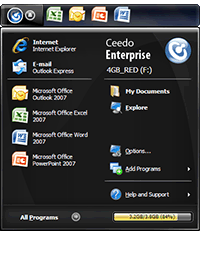
Ceedo today launched Ceedo Enterprise, which allows IT administrators to create, deploy and remotely manage desktop workspace environments enabling a number of scenarios including: application portability, remote management, business continuity, and disaster recovery.

Ceedo

Ceedo’s technology, which the company claims has already been deployed on over four million devices worldwide, uses virtualization to generalize the installation process of standard Windows applications without requiring packaging. Ceedo Enterprise includes a Setup Virtualization Engine which uses the original standard setup files of an application to automatically perform the virtualization process.

Ceedo Enterprise

According to the company, deploying Ceedo to enterprise notebooks and desktops enables IT administrators to manage enterprise applications instantaneously and remotely — even install new software and update user files. Installing Ceedo to a USB device enables installed applications to work together and become portable for use on any Windows PC. Ceedo can be deployed from a Web server enabling a complete working application workspace to be delivered to employees or contractors in field.

Ceedo Enterprise Clients are $89 per seat perpetual license, although the company also announced that discounts are available for large volume purchases.

[Source: Marketwire]

Filed Under: News Tagged With: application virtualization, application virtualization solution, Ceedo, Ceedo Enterprise, Ceedo Setup Virtualization Engine, desktop workspace, Setup Virtualization Engine, virtualisation, virtualization

Virtual Iron And 2X Hook Up For Strategic Alliance

June 2, 2008 by Robin Wauters Leave a Comment

2X, provider of Thin Client and Server Based Computing Software, and Virtual Iron have announced a strategic alliance to provide a complete Virtual Desktop Infrastructure (VDI) and Application Publishing Solution.

Virtual Iron

2X

The 2X / Virtual Iron virtual desktop infrastructure (VDI) solution hosts individual Windows desktop PCs inside virtual machines running on servers in the data center. According to the join press release, this thin-client architecture is significantly easier to secure, maintain and support and it enables an organization’s complete Windows desktop environment to be securely accessed and serviced centrally.

The joint solution enables a fully isolated, customizable and secure environment where users are able to work with standard desktop operating systems and applications. Virtual desktops can be user-customized and provisioned on demand instantly, providing performance and user experience that are comparable to a desktop personal computer. This allows enterprises to replace physical desktops with virtual desktops for many usage scenarios such as call centers, offshore development, and secure, remote access.

[Source: Marketwire]

Filed Under: Partnerships Tagged With: 2X, 2X Virtual Iron, Application Publishing Solution, desktop virtualization, thin client, VDI, Virtual Desktop Infrastructure, virtual desktop software, Virtual Iron, Virtual Iron 2X, VirtualIron, virtualisation, virtualization

Fortisphere Joins Microsoft Startup Accelerator Program

June 2, 2008 by Robin Wauters Leave a Comment

Fortisphere, a provider of policy-based virtualization management software, today announced that it has been selected to join the Microsoft Startup Accelerator Program. As a member of the program, Fortisphere will receive customized Microsoft support for its software development initiatives and increased access to internal Microsoft resources, ensuring that its policy-based virtualization management solutions are compatible with Microsoft virtualization platforms—including the upcoming release of Hyper-V.

Fortisphere

The Microsoft Startup Accelerator Program is designed to connect high-potential startups committed to the Microsoft platform to an extensive support network that provides access to Microsoft people and programs, guidance on future directions and support to accelerate their success. Fortisphere has also been named a Microsoft Certified Partner.

“Membership in the Microsoft Startup Accelerator Program will deepen our relationship with Microsoft and provide us with more access to its virtualization technology,” said Michael Harper, president and CEO, Fortisphere. “Organizations are deploying heterogeneous virtual infrastructures to take full advantage of the cost-saving benefits of virtualization. Fortisphere provides the tools required to more efficiently manage heterogeneous virtual environments and ensure smart virtualization growth.”

Filed Under: News Tagged With: Fortisphere, Hyper-V, Michael Harper, microsoft, Microsoft Startup Accelerator Program, Microsoft Startup Zone, policy-based virtualization management, virtualisation, virtualization, virtualization management

Credit Suisse Enters Virtual Infrastructure Management Software Market With DynamicOps

June 2, 2008 by Robin Wauters 4 Comments

Swiss banking giant Credit Suisse Group launched a new spin-out today, aimed at taking an internally developed virtualization management platform to a commercial market.

Credit Suisse

The new company, DynamicOps, is being funded by an undisclosed amount of capital from Credit Suisse’s Next II venture group. Rich Krueger, a former executive at local storage virtualization equipment maker Incipient and CEO of DynamicOps, said the company is being operated “like a venture-backed firm” and that the amount of the funding is “substantial.”

The company’s virtual management product was originally developed internally by Credit Suisse’s Global Research and Development Group in 2005, after the company couldn’t find an external product to manage the firm’s growing virtualization infrastructure, officials said. The company has since rolled the product out to a variety of divisions across the company.

The company’s first product is focused on virtual desktops and server environment, but according to Krueger, who has also had stints at EMC, the firm will eventually move into other network layers, including storage.

Krueger said the 15-employee firm is in the process of building customer relationships with several firms but declined to name specific companies. Industries of focus, he said, include shipping and public utilities.

[Source: Mass High Tech]

Filed Under: News Tagged With: Credit Suisse, Credit Suisse DynamicOps, Credit Suisse Group, DynamicOps, EMC, Rich Krueger, virtual infrastructure management, virtualisation, virtualization, virtualization management

“Benchmarking” The Citrix / XenServer Combo with Ian Pratt (Video Interview – Part 3)

June 1, 2008 by Toon Vanagt Leave a Comment

During the Fosdem 2008 conference, we had a chance to sit down (on a bench) with Xen Guru Ian Pratt. Below is the third part (see part 1 and part 2) of our exclusive interview, where Ian shines his XenServer light on the Xen page tables algorithms, open source community involvement, management frameworks, the Citrix take-over, virtualization marketing with OS-enlightment, FUD-tactics by VMWare, …

We cut the interview into 4 digestable pieces, which we publish one at a time (see part 1 and part 2). As said, this is the third part (you can also find a written transcript below for your convenience):

This video is also available on Vimeo and Streamocracy.

(0:02) As you are one of the core members of the Xen project, you know that one of the hardest issues to address are the shadow page tables, which are a head ache when you build a hypervisor. I believe you are in the 6th rewrite of the Xen page tables algorithms. At the same time we see that the hardware vendors try to address this in a different way, by supporting it from the hardware up. What is the best way to go?

“It is one of those areas where having some hardware support certainly helps, but it is not a panacea, certainly with the hardware implementations that exist today. There are plenty of benchmarks (probably most benchmarks) that prove that the software approach of Xen wins out. Because there has been a lot of investment into that software approach and there is some really clever code in there right now, written by some super smart people. It is an interesting arms race between the two. One of the things that we are looking at is depending on the workload -dynamically chosen- whether you use the hardware approach or the purely software approach. You kind of hope that for that particular one –at least for the basic functionality- the hardware wins out over time. But there will always be parts of virtualizing the MMU (Memory Management Unit) which are best done by software. That is where OS-enlightment (aka) Para-virtualization comes in. That is a huge win for virtualizing the MMU.”

(1:30) That is a term I hear more often now. Where does the marketing term: “OS-enlightment” come from?

“We had been using the term para-virtualization. I think it was Microsoft that came up with the term “enlightment”, which we have been told is very much a nod to the Xen-heritage. Microsoft probably has rather more budget to spend on marketing than open source projects.”

We all know Microsoft understands a few things about marketing.

“I am not at all upset with that term. I am quite happy to use it and adopt it.”

(2:09) So Ian, it is quite interesting you just mentioned Citrix and the sun joined us. Do you think the contributions from the open source community have slowed down since the Citrix takeover?

“We certainly have not seen that! If you think about the life of the Xen project, there have been a number of significant changes.
When we left the university to setup XenSource, people were worried we might go off and take Xen in closed source or something, which we did not do. It is still the same group of guys, basically myself, Keir Fraser, Steve Hand, Christian Limpach…all off the same guys working on the project, with now many more off course.

Then Citrix acquired XenSource and we obviously had to explain to people what was happening. I think our community has seen that nothing has changed. One of the things that we did do was just to provide greater transparency. We have setup Xen.org, the Xen advisory board and all of the web site and everything where we run Xen.org. The advisory board now has focus from companies like Intel , AMD, HP, IBM. All big companies that are now contributing to Xen and have that oversight from the advisory board. So I think the community is pretty happy and it’s going from strength to strength.”

(3:33) How do you see the shift XenSource (now XenServer) made from building a para-virtualized platform, that served the open-source community and mainly targeted unix/linux-environments, to a company which has another main audience with Bill, the average Windows admin.

“We were never focused just on running only open source operating systems. That was never the aim. We wanted to build a platform that would be OS-agnostic and to be able to run any OS and do a great job at it. We have always put an awful lot of effort into supporting Windows, because there are a lot of windows OS instances out there, we can’t deny that. It is something that always has been important to us. What is different is the way that XenSource and now Citrix look at packaging Xen. Lots of different companies are bringing Xen to market. Obviously the Linux vendors are mainly concerned about running Linux. Solaris and Sun are mainly concerned about running Solaris. One of the things Citrix / Xenserver are trying to do is making sure it is OS agnostic and we did a great job at running Windows and a great job at running Linux as well.
Xen is awesome running Linux and completely blows any other virtualization solution out of the water and at running Windows it is extremely good too. Let’s put it this way: I am unaware of any benchmarks we lose. “

(05:02) When you look at the fight going on between the companies building the management frameworks for Xen and projects like Enomaly, OpenQrm, Redhat & Novell. Was the acquisition of Xensource by Citrix your easy way out of that fight?

“I think we are still very much in the fight. Xensource and all of these other companies are building management frameworks on top of Xen. I think that all of these companies are coming at it from a different point of view. Linux vendors are trying to provide that same look & feel they have within Linux and expose Virtualization through those same GUIs and tools. The difference is that companies like XenSource and Citrix are interested in making it very easy to use and are building a Virtual Machine hosting appliance, hiding all that complexity and expose it via a web GUI or a Windows user interface.

There are always going to be lots of companies building tools on top of Xen. Even if you look at XenServer, there are all of these other companies building products on top of XenServer, like Egenera, Platform, Marathon. There is a very healthy eco-system of building stuff on top of other people’s stuf. I guess people are happy, because everybody is making money.”

06:27 Some analysts say Microsoft acquired Xensource by proxy, hinting at a future take-over of Citrix by Microsoft. What is your opinion on that topic?

“I truly do not know anything about that. I think if Microsoft was going to buy Citrix, it would have done so a long time ago. I think that Microsoft is a very close Citrix partner and that XenSource has worked with Microsoft as well. There are a number of projects on which we have worked together, such as defining some of the para-virtualization or OS-enlightment extensions to enable Xen-guests to run on Microsoft’s hypervisor when that ships and also vice-versa. We have always found Microsoft quite easy to deal with to be honest.”

(07:16) You get good support from Microsoft?

“Certainly all the people that we deal with are perfectly nice guys.”

(7:23) So let’s talk about the less perfectly nice guys & women. When I read articles on blogs and in the press, I feel that VMware is recently throwing some mud at Citrix and Xensource and especially the marketing department. They try to cast some doubt on your products and projects. What do you think about these marketing techniques?

“Well there has been a certain use of FUD-tactics and things like that. That is sort of a natural reaction. That is what marketing departments will go and do. We have good working relationships with some of the technical folks at VMware and we work together on the OVF virtual appliance format. I know that some of their engineers get pretty embarrassed about some of the stuff their marketing department does. VMware tries to position things which are Xen features or architectural implementations as ‘weaknesses’ against their product. Whereas they know they have teams working flat out to get and implement those same ‘weaknesses’ into their own product. That is just the way it is. Marketing departments go off and do that, but at the end of the day customers will hopefully get the right message and buy the right product.”

(08:45) At least it shows they take you seriously.

“I guess we should be flattered.”

View part 1 or part 2 of this interview.

Filed Under: Featured, Interviews, People, Videos Tagged With: citrix, Citrix Ian Pratt, citrix xenserver, Ian Pratt, interview, Sun xVM, University of Cambridge, video, virtualisation, virtualization, Xen, Xen Ian Pratt, xen.org, XenDesktop, xenserver, xensource, XVM

  • « Go to Previous Page
  • Go to page 1
  • Interim pages omitted …
  • Go to page 14
  • Go to page 15
  • Go to page 16
  • Go to page 17
  • Go to Next Page »

Primary Sidebar

Tags

acquisition application virtualization Cisco citrix Citrix Systems citrix xenserver cloud computing Dell desktop virtualization EMC financing Funding Hewlett Packard HP Hyper-V IBM industry moves intel interview kvm linux microsoft Microsoft Hyper-V Novell oracle Parallels red hat research server virtualization sun sun microsystems VDI video virtual desktop Virtual Iron virtualisation virtualization vmware VMware ESX VMWorld VMWorld 2008 VMWorld Europe 2008 Xen xenserver xensource

Recent Comments

  • C program on Red Hat Launches Virtual Storage Appliance For Amazon Web Services
  • Hamzaoui on $500 Million For XenSource, Where Did All The Money Go?
  • vijay kumar on NComputing Debuts X350
  • Samar on VMware / SpringSource Acquires GemStone Systems
  • Meo on Cisco, Citrix Join Forces To Deliver Rich Media-Enabled Virtual Desktops

Copyright © 2026 · Genesis Sample on Genesis Framework · WordPress · Log in

  • Newsletter
  • Advertise
  • Contact
  • About