Data center management software firm Cassatt is "close to the end," stated founder and CEO Bill Coleman in a Forbes article. Coleman is well-known in Silicon Valley, having served as a senior exec in the early days of Sun Microsystems and as one of the co-founders of middleware company BEA systems. The ambitions with Cassatt were huge, but now (after raising $100 million in capital) the company is apparently having trouble even selling itself to one of the majors it aimed to compete with.
From the article:
"The big guys copied my story," says Coleman. Cassatt, he adds, was upended by a slowing economy and by customers skittish about closing big orders or changing existing ways.
"What frustrates me is my own naivete," he says. "I thought I could give companies something radical that had a proven return on investment, and they would be willing to change all their companies' computer policies and procedures to get that. Right now it's hard to get people to get beyond proof of concept tests or a data center energy analysis."
And it concludes:
For his own part, though, Coleman says, "I have to think about my people. Then I'm going to a beach for a month to think about what to do next."
We wish Coleman all the best.
Here's a video interview we conducted with the man in the Summer of 2008:
PART 1
-----
PART 2
---------------------------------------------------------------------------------------------------------------
According to the NY Times, Cisco Systems is planning a big push into the server market, essentially entering into competition with its historical partners HP and IBM (who declined to comment on the story).
A risky move for Cisco, but a very interesting one.
The product — a server computer equipped with sophisticated virtualization software — is a bold but risky move by Cisco into an unfamiliar, intensely competitive market that typically produces far lower profits than Cisco makes from network gear. But it reflects the company’s ambition to grow beyond its roots as the so-called plumber of the Internet to offer everything from instant messaging software to digital stereos.
As The Register points out, VMware technology is likely the foundation of the virtualization part, since Cisco still owns part of the company (about 2%). Cisco is not disclosing any specifics though, but the NY Times learned that Cisco could show off the first of its new systems as early as March.
Acquisition rumors between Cisco Systems and VMware (and even EMC in full) are sure to flare up again.
A good follow-up article was published on Forbes.
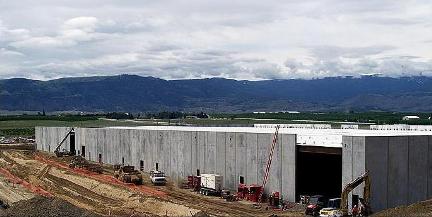
According to Data Center Knowledge, VMware is planning to locate a new data center in East Wenatchee (North Central Washington), leasing no less than 100,000 square feet of space in a new facility being built by Sabey Corporation on its Intergate.Columbia campus. VMware will be the biggest leaser by far; their data center will take up about two-thirds of the 189,000 square foot second building.
Company spokeswoman Melinda Marks said that VMware will use its new data center to expand research and development.
At last week's GigaOM VIP reception, just before their Structure 08 conference, we bumped into Arne Josefsberg, General Manager Online Infrastructure at Microsoft. He happened to be passing by in San Francisco and kindly agreed to get on record with comments on Hyper-V adoption at Microsoft. As he answered our late night questions, the party was just breaking up (hence the disturbing background sounds).
Although Arne declined to put exact numbers to the amount of servers at Microsoft, he did confirm he is responsible for dozens of datacenters around the world to support the software giant's online services. To give you an idea, Data Center Knowledge noted from a Microsoft executive that the company is adding no less than 10 000 servers per month.
Here is a datacenter lesson from Arne:
"As Microsoft obviously deploys a huge amount of processor, compute and storage capacity, [the need for] efficiency and utilization become super important to us. We work very closely with the Windows Operating system division. Hyper-V is actually becoming one of our key-technologies to drive better utilization of the hardware. We have Hyper-V in multiple datacenters in the Live-network, in production environments taking live traffic. It’s going quite quite well. So we are very jazzed about Hyper-V and virtualization as a technology to scale out our infrastructure.”
Arne’s team has been working closely with the Hyper-V development team for over a year and did not limit this collaboration to the hypervisor, but also the management tools and on how to manage hypervisors at very large scale.
When asked about cloud computing, Microsoft refers to its ‘Software plus Services' strategy which combines software on the desktop (still the major revenue driver for Microsoft) with centralized datacenter-based services. Microsoft seems high on its hybrid flavor of cloud computing and hopes to lead the way in this nascent industry as well.
And why were Dante Malagrino of Cisco and Ed Bugnion of Nuova Systems jointly featured in the video presentation of Cisco Nexus 5000 we shared earlier today?
Start-up Nuova Systems operated as a majority-owned subsidiary of Cisco, which had invested $70 million and owned 80 % of the company. Cisco announced its initial investment in Nuova in August 2006 and announced an amendment to the agreement in April 2007 that expanded the development scope, increased the funding commitment and raised the maximum potential payout of the transaction to $678 million. And now Cisco has formally expressed its intent to acquire remaining interest in the company.
"Cisco today announced its intent to purchase the remaining 20 % interest in San Jose-based Nuova Systems, a start up focused on the development of next-generation products for the data center market. Cisco today also introduced the Cisco Nexus 5000 Series, the first product developed by Nuova. The Cisco Nexus 5000 is a 10 Gigabit Ethernet "top-of-rack" switch that offers unified fabric capabilities through the support for multiple data center networking protocols and software intelligence."
The Nuova transaction is success-based with the total value primarily determined by the revenue of Nuova products over three measurement periods. The first measurement period will commence in early fiscal year 2010, the second measurement period will commence in late fiscal year 2010, and the third measurement period will commence in mid fiscal year 2011. The acquisition is expected to close in Q4 of Cisco's FY 2008. It will be acquisition No. 126 for Cisco overall and the fifth one in FY '08.
DataCenterKnowledge posted a video presentation today we would love to share with you too. It features Dante Malagrino of Cisco and Ed Bugnion of Nuova Systems with an explanation of how data center managers can use the new Cisco Nexus 5000 Series switches to optimize their virtualization efforts (Cisco recently introduced the 7000 Series). Prior to joining Cisco, Bugnion was a co-founder and chief architect of VMware.
Enigmatec, provider of run book automation (RBA) software, and Scalent Systems, provider of infrastructure virtualization software for large data centers, today announced an integration partnership to enable policy driven automation of server repurposing in the data center.
The partnership reportedly combines policy-based IT process automation from Enigmatec and server repurposing from Scalent to deliver an integrated software solution to dynamically place compute resources where and when they are needed in the data center. This implementation of real-time infrastructure should dramatically lower data center management operations costs while increasing flexibility in the face of business need change.
The Enigmatec Management System (EMS) continually monitors all levels of a multi-tier application stack for changes in availability or demand. When EMS detects a failure or load spike, the system orchestrates the reallocation of resources to the appropriate users and applications, leveraging Server Automation software to ensure that all resources are maintained at required release, patch and configuration levels. EMS also provides full lifecycle management of shared virtual resources including decommissioning, archiving and returning resources back to a server pool.
Scalent allows data center operators to rapidly change entire systems and associated topologies, including which servers are running, what software is running on them, and how they're connected to network and storage. Scalent does this in real-time without requiring physical changes to the infrastructure. Scalent V/OE software enables customers to take their data centers from "dead bare metal" (powered off hardware with no software installed) to live (newly deployed or restored), connected (to network and storage) servers, in five minutes or less.
“Scalent’s server repurposing solution gives IT operations the ability to dynamically change their server environment,” said Duncan Johnston-Watt, Chief Technology Officer, Enigmatec. “Integrating Scalent with Enigmatec takes this to its logical conclusion – using run book automation to orchestrate their data center virtualization solution delivers a policy-driven infrastructure which automatically adapts to meet changing business requirements.”
Not entirely related to virtualization as such, but hugely relevant as far we're concerned: Microsoft is getting serious about embracing containers as the key to building scalable, energy-efficient cloud computing platforms. The company's bold move is an affirmation of the potential for containers to address the most pressing power, cooling and capacity utilization challenges facing data center operators. Microsoft's new Chicago facility is part of the company’s fleet of next-generation data centers being built to support its Live suite of "software plus services" online applications.
DataCenterKnowledge quotes Microsoft Director of Data Center Services Michael Manos:
"The entire first floor of Chicago is going to be containers. This represents our first container data center. The containers are going to be dropped off and plugged into network cabling and power." The second floor of the immense facility will be a traditional raised-floor data center, Manos said. "It's a bold step forward. We're trying to address scale with the cloud level services. We were trying to figure the best way to bring capacity online quickly."
Manos added that the facility will accommodate between 150 and 220 shipping containers, which will be shipped and dropped off by trucks. That approach led Microsoft to consult with parking lot operators to address the design logistics of enabling large trucks to navigate within the facility.
In 2006, Sun Microsystems introduced Project Blackbox (now the Sun MD S20), the first effort at a “data center in a box” incorporating a high-density computing environment into a 20-foot shipping container. The containers can travel on trains, ships or trucks.
We were thinking about adding a joke about containers containing containers (you know, the software ones), but it's getting late and we've had quite a busy, interesting day already.
Insightful post by Arthur Cole over at ITBusinessEdge about server consolidation and virtualization. Cole argues that server consolidation done the right way remains the primary driver for most data centers.
But as those who have already taken the virtual plunge have no doubt realized, consolidating servers is not just a simple matter of powering up the virtualization layer and then pulling equipment out of racks. There is a long list of factors to consider with any centralization project and a wide range of land mines that need to be avoided to prevent service failures.
Cole refers to four interesting articles about server consolidation: